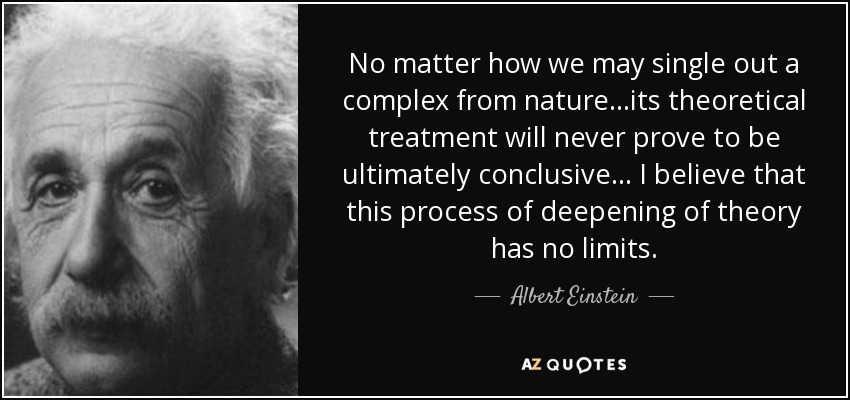
No matter how we may single out a complex from nature...its theoretical treatment will never prove to be ultimately conclusive... I believe that this process of deepening of theory has no limits.
...the physicist cannot simply surrender to the philosopher the critical contemplation of the theoretical foundations; for, he himself knows best, and feels more surely where the shoe pinches...Physical conceptions are free creations of the human mind, and are not, however it may seem, uniquely determined by the external world.
Parking Reform Made Easy provides both a theoretical framework and practical methods for reforming parking requirements. By giving planners a sound basis for developing reforms, Richard Willson remedies the problem that many planners feel unqualified to challenge and change long-standing minimum parking requirements.
This fear of criticism displayed by the advocates of freedom of criticism cannot be attributed solely to craftiness. No, the majority of the Economists look with sincere resentment upon all theoretical controversies, factional disagreements, broad political questions, plans for organising revolutionaries, etc.
An important contribution to a much-neglected but very important subject. No other author has set out to do what Davenport accomplishes, which is a systematic study of how key representatives of America's rising tide of religion attempted a theoretical understanding of, and practical response to, America's rising tide of commerce.
It turns out that the men who ultimately, who unpretentiously value peace are willing to sacrifice their own peace of mind in order to render it. The question is, 'Who, between opposing forces, would do such a thing?' It seems only theoretical albeit true that men who accept an objective rather than subjective moral standard are, in a general sense, more capable of making such sacrifices for the sake of peace.
I think my dad [ Stephen Hawking] would have been pleased if I had turned out a scientist because he truly believes that is the most interesting career open to anyone. But he also believes that you have to follow your own path in life and so he certainly wasn't going to push me toward theoretical physics when it didn't look like I was going in that direction naturally.
An American economist of two generations ago, H. J. Davenport, who was the best friend Thorstein Veblen ever had (Veblen actually lived for a time in Davenport's coal cellar) once said: "There is no reason why theoretical economics should be a monopoly of the reactionaries." All my life I have tried to take this warning to heart, and I dare call it to your favorable attention.
There's always a tension in my world between the pragmatic and the practical and the theoretical. I have a very theoretical turn of mind, but I also like to test things in place.
It may be seriously questioned whether the philosophies... which isolate mind and set it over against the world did not have their origin in the fact that the reflective or theoretical class of men elaborated a large stock of ideas which social conditions did not allow them to act upon and test. Consequently men were thrown back into their own thoughts as ends in themselves.
The existential attitude is one of involvement in contrast to a merely theoretical or detached attitude. "Existential" in this sense can be defined as participating in a situation, especially a cognitive situation, with the whole of one's existence.
Theoretical physicists live in a classical world, looking out into a quantum-mechanical world. The latter we describe only subjectively, in terms of procedures and results in our classical domain.
Theoretical approaches have their place and are, I suppose, essential but a theory must be tempered with reality.
The number one problem in academia today is not ignorant students but ignorant professors, who have substituted narrow "expertise" and "theoretical sophistication" (a preposterous term) for breadth and depth of learning in the world history of art and thought... Art is a vast, ancient interconnected web-work, a fabricated tradition. Overconcentration on any one point is a distortion. This is one of the primary reasons for the dullness and ineptitude of so much twentieth-criticism, as compared to nineteenth-century belles-lettres.
If you find that you're spending almost all your time on theory, start turning some attention to practical things; it will improve your theories. If you find that you're spending almost all your time on practice, start turning some attention to theoretical things; it will improve your practice.
The only knowledge that can truly orient action is knowledge that frees itself from mere human interests and is based in Ideas - in other words knowledge that has taken a theoretical attitude.
[Critical social science attempts] to determine when theoretical statements grasp invariant regularities of social action as such and when they express ideologically frozen relations of dependence that can in principle be transformed.
Sex itself only only exists in relation to procreation. That's one of the reasons why I sometimes object, and it's just a theoretical objection, but it's worth thinking about, to the whole notion that one calls what people of the same sex do, sexual relations. As a matter of fact, they have precisely turned their back on sexual relations, in order to engage in acts of mutual pleasure that have nothing whatsoever to do with sexuality...
It is hard to see how one could begin to develop a quantum-theoretical description of brain action when one might well have to regard the brain as "observing itself" all the time!
Myths often do a lot of theoretical good, while they are still new.
That's all very well as an abstract moral principle, Avril, a coffee-table theoretical construct, but there's no denying the sheer gratuitous pleasure to be derived from seeing members of the ruling class in pain and torment.
This law (regarding the theoretical efficiency of heat engines by Mr. Joule), and the law of the maximum efficiency of heat engines, are particular cases of a general law which regulates all transformation of energy, and is the basis of the Science of Energetics.
To avert the danger [posed by theory] to life, Nietzsche could choose one of two ways: he could insist on the strictly esoteric character of the theoretical analysis of life - that is, restore the Platonic notion of the noble delusion - or else he could deny the possibility of theory proper and so conceive of thought as essentially subservient to, or dependent on, life or fate... If not Nietzsche himself, at any rate his successors [Heidegger] adopted the second alternative.
One important idea is that science is a means whereby learning is achieved, not by mere theoretical speculation on the one hand, nor by the undirected accumulation of practical facts on the other, but rather by a motivated iteration between theory and practice.
Science has been effective at furthering our understanding of nature because the scientific ethos is based on three key principles: (1) follow the evidence wherever it leads; (2) if one has a theory, one needs to be willing to try to prove it wrong as much as one tries to prove that it is right; (3) the ultimate arbiter of truth is experiment, not the comfort one derives from one's a priori beliefs, nor the beauty or elegance one ascribes to one's theoretical models.
Follow AzQuotes on Facebook, Twitter and Google+. Every day we present the best quotes! Improve yourself, find your inspiration, share with friends
or simply: