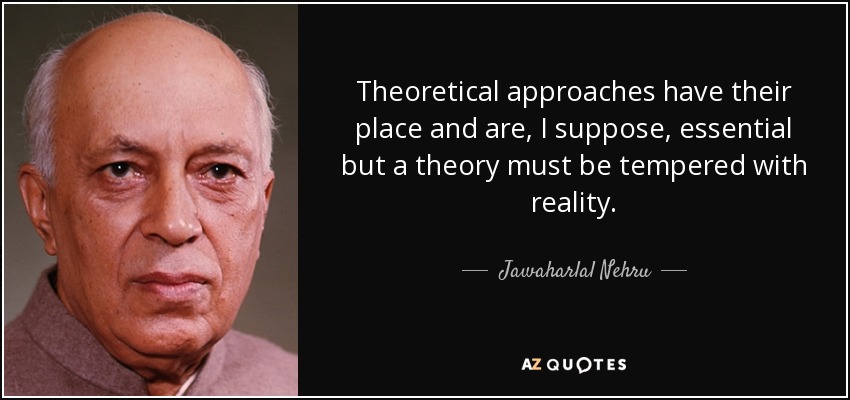
Theoretical approaches have their place and are, I suppose, essential but a theory must be tempered with reality.
The number one problem in academia today is not ignorant students but ignorant professors, who have substituted narrow "expertise" and "theoretical sophistication" (a preposterous term) for breadth and depth of learning in the world history of art and thought... Art is a vast, ancient interconnected web-work, a fabricated tradition. Overconcentration on any one point is a distortion. This is one of the primary reasons for the dullness and ineptitude of so much twentieth-criticism, as compared to nineteenth-century belles-lettres.
If you find that you're spending almost all your time on theory, start turning some attention to practical things; it will improve your theories. If you find that you're spending almost all your time on practice, start turning some attention to theoretical things; it will improve your practice.
The only knowledge that can truly orient action is knowledge that frees itself from mere human interests and is based in Ideas - in other words knowledge that has taken a theoretical attitude.
[Critical social science attempts] to determine when theoretical statements grasp invariant regularities of social action as such and when they express ideologically frozen relations of dependence that can in principle be transformed.
Sex itself only only exists in relation to procreation. That's one of the reasons why I sometimes object, and it's just a theoretical objection, but it's worth thinking about, to the whole notion that one calls what people of the same sex do, sexual relations. As a matter of fact, they have precisely turned their back on sexual relations, in order to engage in acts of mutual pleasure that have nothing whatsoever to do with sexuality...
It is hard to see how one could begin to develop a quantum-theoretical description of brain action when one might well have to regard the brain as "observing itself" all the time!
Myths often do a lot of theoretical good, while they are still new.
That's all very well as an abstract moral principle, Avril, a coffee-table theoretical construct, but there's no denying the sheer gratuitous pleasure to be derived from seeing members of the ruling class in pain and torment.
This law (regarding the theoretical efficiency of heat engines by Mr. Joule), and the law of the maximum efficiency of heat engines, are particular cases of a general law which regulates all transformation of energy, and is the basis of the Science of Energetics.
To avert the danger [posed by theory] to life, Nietzsche could choose one of two ways: he could insist on the strictly esoteric character of the theoretical analysis of life - that is, restore the Platonic notion of the noble delusion - or else he could deny the possibility of theory proper and so conceive of thought as essentially subservient to, or dependent on, life or fate... If not Nietzsche himself, at any rate his successors [Heidegger] adopted the second alternative.
One important idea is that science is a means whereby learning is achieved, not by mere theoretical speculation on the one hand, nor by the undirected accumulation of practical facts on the other, but rather by a motivated iteration between theory and practice.
Science has been effective at furthering our understanding of nature because the scientific ethos is based on three key principles: (1) follow the evidence wherever it leads; (2) if one has a theory, one needs to be willing to try to prove it wrong as much as one tries to prove that it is right; (3) the ultimate arbiter of truth is experiment, not the comfort one derives from one's a priori beliefs, nor the beauty or elegance one ascribes to one's theoretical models.
Now these two questions Does there exist a material reality distinct from sensible appearances? and What is the nature of reality? do not have their source in experimental method, which is acquainted only with sensible appearances and can discover nothing beyond them. The resolution of these questions transcends the methods used by physics; it is the object of metaphysics. Therefore, if the aim of physical theories is to explain experimental laws, theoretical physics is not an autonomous science; it is subordinate to metaphysics.
At present, when the prevailing forms of society have become hindrances to the free expression of human powers, it is precisely the abstract branches of science, mathematics and theoretical physics, which ... offer a less distorted form of knowledge than other branches of science which are interwoven with the pattern of daily life, and the practicality of which seemingly testifies to their realistic character.
Once the philosophical foundation of democracy has collapsed, the statement that dictatorship is bad is rationally valid only for those who are not its beneficiaries, and there is no theoretical obstacle to the transformation of this statement into its opposite.
For thousands of years humankind's finest minds have been struggling with the theoretical problem of finding the forms that would give peoples the possibility, without the greatest of torment, without internecine strife, of living side by side in friendship and brotherhood. Practically speaking, the first step in this direction is only being taken now, today.
Theoretical webs, dirty webs, fusty webs, old and shrivelling away into nothingness, a fine dust.Who needs that kind of stuff. Far far better getting out into the open air and doing it, actually doing it, something solid and concrete and unconceptualisable.
What appear to be the most valuable aspects of the theoretical physics we have are the mathematical descriptions which enable us to predict events. These equations are, we would argue, the only realities we can be certain of in physics; any other ways we have of thinking about the situation are visual aids or mnemonics which make it easier for beings with our sort of macroscopic experience to use and remember the equations.
However we select from nature a complex [of phenomena] using the criterion of simplicity, in no case will its theoretical treatment turn out to be forever appropriate (sufficient).... I do not doubt that the day will come when [general relativity], too, will have to yield to another one, for reasons which at present we do not yet surmise. I believe that this process of deepening theory has no limits.
Experience arises together with theoretical assumptions not before them, and an experience without theory is just as incomprehensible as is (allegedly) a theory without experience.
It is tribute to how far we have come in theoretical physics that it now takes enormous machines and a great deal of money to perform experiments whose results we can not predict.
It is however pretty evident, on general principles, that in devising for mathematical truths a new form in which to record and throw themselves out for actual use, views are likely to be induced, which should again react on the more theoretical phase of the subject.
Any philosophical and theoretical assurance that laughter is unique to the human being becomes somewhat unsure when one turns to the anthropological literature.
[T]he shaman treats all realities as subjective, much like some modern theoretical physicists are beginning to do. In such a viewpoint the question of whether an experience is real or not makes no sense, because the answer is yes and no, depending on your point of view.
Follow AzQuotes on Facebook, Twitter and Google+. Every day we present the best quotes! Improve yourself, find your inspiration, share with friends
or simply: