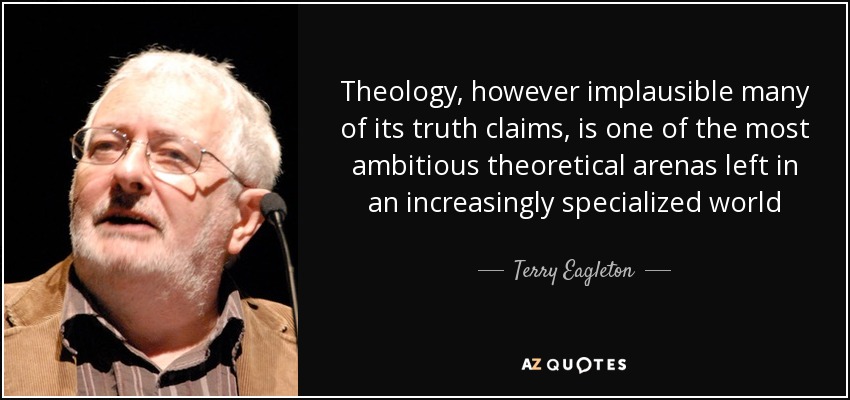
Theology, however implausible many of its truth claims, is one of the most ambitious theoretical arenas left in an increasingly specialized world
What appear to be the most valuable aspects of the theoretical physics we have are the mathematical descriptions which enable us to predict events. These equations are, we would argue, the only realities we can be certain of in physics; any other ways we have of thinking about the situation are visual aids or mnemonics which make it easier for beings with our sort of macroscopic experience to use and remember the equations.
However we select from nature a complex [of phenomena] using the criterion of simplicity, in no case will its theoretical treatment turn out to be forever appropriate (sufficient).... I do not doubt that the day will come when [general relativity], too, will have to yield to another one, for reasons which at present we do not yet surmise. I believe that this process of deepening theory has no limits.
Experience arises together with theoretical assumptions not before them, and an experience without theory is just as incomprehensible as is (allegedly) a theory without experience.
The problem of peaceful transition to socialism, we do not discuss it as a theoretical question. But in America it is very difficult, and it is nearly impossible. That is why specifically in America we say that the road to the liberation of peoples, which will be the road of socialism will go through bullets in almost all countries.
It is however pretty evident, on general principles, that in devising for mathematical truths a new form in which to record and throw themselves out for actual use, views are likely to be induced, which should again react on the more theoretical phase of the subject.
Any philosophical and theoretical assurance that laughter is unique to the human being becomes somewhat unsure when one turns to the anthropological literature.
[T]he shaman treats all realities as subjective, much like some modern theoretical physicists are beginning to do. In such a viewpoint the question of whether an experience is real or not makes no sense, because the answer is yes and no, depending on your point of view.
The power of music, narrative and drama is of the greatest practical and theoretical importance. ... We see how the retarded, unable to perform fairly simple tasks involving perhaps four or five movements or procedures in sequence, can do these perfectly if they work to music.
The theoretical fruits of deliberate oversimplification through idealization are not to be denied... Reality in all its messy particularity is too complicated to theorize about, taken straight. The issue is, rather (since every idealization is a strategic choice), which idealizations might really shed some light... which will just land us... diverting fairy tales.
My choice of colors does not rest on any scientific theory; it is based on observation, on feeling, on the experience of my sensibility. Inspired by certain pages of Delacroix, an artist like Signac is preoccupied with complementary colors, and the theoretical knowledge of them will lead him to use a certain tone in a certain place. But I simply try to put down colors which render my sensation.
It would of course be a great step forward if we succeeded in combining the gravitational field and the electromagnetic field into a single structure. Only so could the era in theoretical physics inaugurated by Faraday and James Clerk Maxwell be brought to a satisfactory close.
There are... scientific works - star catalogues, for example - which are not art; but the theoretical structures of Gauss, Einstein, or Maxwell are original, individual, "very personal" responses and expressions of exactly the same kind as the creative works of Beethoven or Dostoievski.
There are theoretical reformers at all times, and all the world over, living on anticipation.
Alchemy and Kabbalah are later developments in my thinking. I think the primary interest has been the relationship of magic and mystery to logic and understanding. Those are the primary driving forces of my life. I have this ability, for some reason, to be able to hold both the Magical MysteryTour we're on in conjunction with the logical rigor of understanding theoretical physics, which makes me kind of a rare bird, because usually you're one or the other.
I had always been very rational, but I'd always used reason in such a way as to convince myself that reasoning alone would not solve anything, really. Reasoning is theoretical. Until you feel with your heart, you don't know if a thing is true. I found that book was absolutely authentic. I absolutely knew it was the truth. My whole heart accepted it.
I think our science is a marvelous tool. Of course it has its politics, its failings, its mistakes, like all other human endeavors, but I think the methodology of our science - using it to postulate and to use the proper approach of creating falsifiable hypotheses and then testing them to see if they ring true, and then progressing by finding the anomalies to our theoretical structure, and then improving our theoretical structure to take care and test the anomalies - is the way to go, because that helps us discover what the universe.is all about and our relationship to it.
Most theoretical work since the proposals of Hebb (1949) and Hayek (1952) has relied upon particular forms of dependent synaptic rules in which either pre- or postsynaptic change is contingent upon closely occurring events in both neurons taking part in the synapse.
Hebb place the Law of Effect at the synaptic level by proposing a correlation model of synaptic modification similar to that of Hayek (1952). This work was seminal in providing a basis for many subsequent theoretical studies . .
Friedrich Hayek .. seems to have been the first to postulate what is the core of this paper, namely, the idea of memory and perception represented in widely distributed networks of interconnected cortical cells. Subsequently this idea has received theoretical support, however tangential, from the fields of cognitive psychology, connectionism and artificial intelligence. Empirically, it is well supported by the physiological study and neuroimaging of working memory.
It is tribute to how far we have come in theoretical physics that it now takes enormous machines and a great deal of money to perform experiments whose results we can not predict.
I started playing classical music, and I still do. I think music ultimately is kind of on a theoretical level, is about collecting and learning as much vocabulary as possible. It's kind of like writing. It's kind of like writing because the more you read, the more you hear people describe things. The more you soak in, as far as vocabulary, the more access you have in order to express yourself accurately and vividly.
Zen has no theory. It is a non-theoretical approach into reality. It has no doctrine and no dogma - hence it has no church, no priest, no pope.
When you put relative and absolute truth together and they become one unit, it becomes possible to make things workable. You are not too much on the side of absolute truth, or you would become too theoretical. You are not too much on the side of relative truth, or you would become too precise. When you put them together, you realize that there is no problem.
Economics is a theoretical science and as such abstains from any judgement of value. It is not its task to tell people what ends they should aim at. It is a science of the means to be applied for attainment of ends chosen, not, to be sure, a science of the choosing of ends. Ultimate decisions, the valuations and the choosing of ends, are beyond the scope of any science. Science never tells a man how he should act; it merely shows how a man must act if he wants to attain definite ends.
Follow AzQuotes on Facebook, Twitter and Google+. Every day we present the best quotes! Improve yourself, find your inspiration, share with friends
or simply: