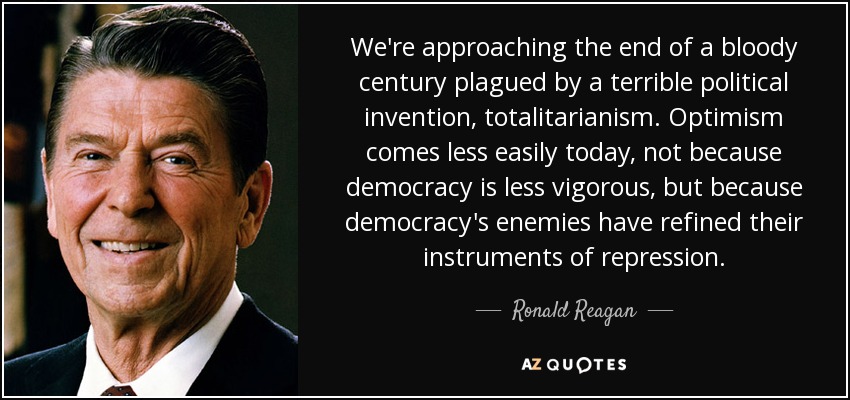
We're approaching the end of a bloody century plagued by a terrible political invention, totalitarianism. Optimism comes less easily today, not because democracy is less vigorous, but because democracy's enemies have refined their instruments of repression.
Yet optimism is in order, because day by day democracy is proving itself to be a not-at-all-fragile flower. From Stettin on the Baltic to Varna on the Black Sea, the regimes planted by totalitarianism have had more than 30 years to establish their legitimacy. But none - not one regime - has yet been able to risk free elections. Regimes planted by bayonets do not take root.
As we know, the balance of the economy of the world, the proportion is crazy. People are probably looking for a balance. The nature pushes people to move from poor and mentally and economically demolished places, from totalitarianism, to places that offer them much more than the fear.
There is a good deal of art that in some traditions of conceptual work are anti-affect, in fact a very large chunk of mainstream art after 1950 took against affect art altogether because they said, "No, we hate affect art because this is how we get manipulated by totalitarianism and therefore artists shouldn't play that game." And a lot of artists agreed to play that game, which I personally believe is to the loss of art.
The difference between neoliberalism and fascism or Nazism or other forms of totalitarianism is that it takes questions of ideology seriously. It takes the educational sphere seriously, and it tells people there's no alternative; that market freedom is really freedom in general; that a rabid kind of individualism is all that matters; that as Ayn Rand used to say, "self interest is the ultimate virtue" - and people believe this stuff. Because they have no other discourse.
The individual who has to justify his existence by his own efforts is in eternal bondage to himself.
Since it is difficult to join them together, it is safer to be feared than to be loved when one of the two must be lacking.
People who live in the post-totalitarian system know only too well that the question of whether one or several political parties are in power, and how these parties define and label themselves, is of far less importance than the question of whether or not it is possible to live like a human being.
In the same way that slavery was a moral challenge for the 19th century and totalitarianism was a challenge for the 20th century, the challenge that women and girls face around the world is the moral challenge of our time.
One leader, one people, signifies one master and millions of slaves.
Inverted totalitarianism, unlike classical totalitarianism, does not revolve around a demagogue or charismatic leader. It finds expression in the anonymity of the Corporate State. It purports to cherish democracy, patriotism, and the Constitution while manipulating internal levers.
Ultimately, totalitarianism is the only sort of politics that can truly serve the sky-god's purpose. Any movement of a liberal nature endangers his authority and that of his delegates on earth. One God, one King, one Pope, one master in the factory, one father-leader in the family at home.
Revolution means democracy in today's world, not the enslavement of peoples to the corrupt and degrading horrors of totalitarianism
Follow AzQuotes on Facebook, Twitter and Google+. Every day we present the best quotes! Improve yourself, find your inspiration, share with friends
or simply: