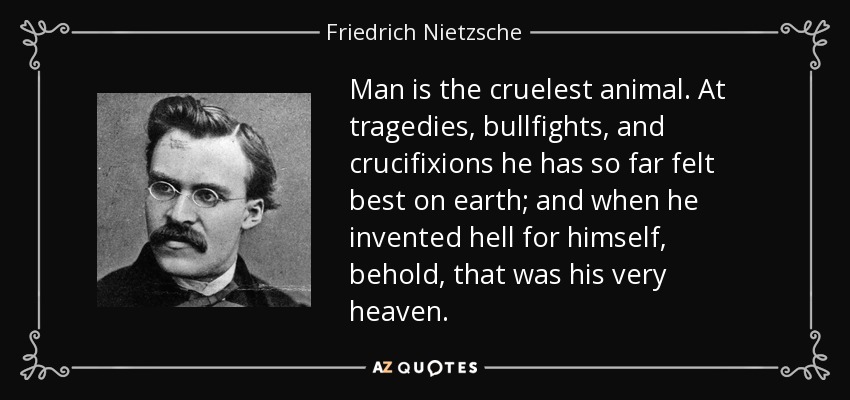
Man is the cruelest animal. At tragedies, bullfights, and crucifixions he has so far felt best on earth; and when he invented hell for himself, behold, that was his very heaven.
Hegel remarks somewhere that all great, world-historical facts and personages occur, as it were, twice. He has forgotten to add: the first time as tragedy, the second as farce.
Every civilization that has ever existed has ultimately collapsed. History is a tale of efforts that failed, or aspirations that weren’t realized. So, as a historian, one has to live with a sense of the inevitability of tragedy.
If you are only moved by color relationships, you are missing the point. I am interested in expressing the big emotions - tragedy, ecstasy, doom.
Laughter keeps you healthy. You can survive by seeing the humor in everything. Thumb your nose at sadness; turn the tables on tragedy. You can’t laugh and be angry, you can’t laugh and feel sad, you can’t laugh and feel envious.
Life is made for the strong. There is no mercy in it for the weak– none...Such is the tragedy of desire.
We are all such accidents. We do not make up history and culture. We simply appear, not by our own choice. We make what we can of our condition with the means available. We must accept the mixture as we find it - the impurity of it, the tragedy of it, the hope of it.
Life’s greatest tragedy consists of men and women who earnestly try, and fail!
A tragedy's first act is crowded with supporting players: witnesses crimping their faces, policemen scribbling in pads and making radio calls, EMS guys unfolding equipment, tubes and wheels.
The reaction against your own thought in itself lends life to thought. How this reaction is born is hard to describe, because it identifies with the very rare intellectual tragedies. The tension, the degree and level of intensity of a thought proceeds from its internal antinomies, which in turn are derived from the unsolvable contradictions of a soul. Thought cannot solve the contradictions of the soul. As far as linear thinking is concerned, thoughts mirror themselves in other thoughts, instead of mirroring a destiny.
Ever since ROME, OPEN CITY, I have maintained a conscious, determined endeavor to try to understand the world in which I live, in a spirit of humility and respect for the facts and for history. What as the meaning of ROME, OPEN CITY? We were emerging from the tragedy of the war. We had all taken part in it, for we were all its victims. I sought only to picture the essence of things. I had absolutely no interest in telling a romanticized tale along the usual lives of film drama. The actual facts were each more dramatic than any screen cliche.
Our government has become too responsive to trivial or ephemeral concerns, often at the expense of more important concerns or an erosion of our liberty, and it has made policy priorities more dependent on where TV journalists happen to point their cameras. . . . As a nation we have lost our sense of tragedy, a recognition that bad things happen to good people. A nation that expects the government to prevent churches from burning, to control the price of bread or gasoline, to secure every job, and to find some villain for every dramatic accident, risks an even larger loss of life and liberty.
We know nothing of the trials, sorrows and temptations of those around us, of pillows wet with sobs, of the life-tragedy that may be hidden behind a smile, of the secret cares, struggles, and worries that shorten life and leave their mark in hair prematurely whitened, and a character changed and almost recreated in a few days. Let us not dare to add to the burden of another the pain of our judgment.
The best lesson which we get from the tragedy of Karbala is that Husain and his companions were rigid believers in God. They illustrated that the numerical superiority does not count when it comes to the truth and the falsehood. The victory of Husain, despite his minority, marvels me!
Time brings an end to everything. We should not mistake for a tragedy what is no more than the passage of time.
Within hours of a tragedy unfolding, journalists and pundits should not manufacture a blood libel that serves only to incite the very hatred and violence they purport to condemn. That is reprehensible.
The tragedy of the civil rights movement is that just as it achieved the beginning of the end of racial segregation, white educated elites became swept up in the glamour of the sexual revolution.
Life's greatest tragedy is not that it will someday end, but that most only live to follow directions and sometimes we end up totally lost.
Last but not least, the happiest people do have their share of stresses, crises, and even tragedies. They may become just as distressed and emotional in such circumstances as you or I, but their secret weapon is the poise and strength they show in coping in the face of challenge.
It is God who enables us to return to life after tragedy-not by eradicating all suffering but by giving us the strength and the courage to heal what we can heal.
What a tragedy is help where it harms what it supports!
Here is something you have to understand about stories: They point you in the right direction but they can't take you all the way there. Stories are crescent moons; they glimmer in the night sky, but they are most exquisite in their incomplete state. Because people crave the beauty of not-knowing, the excitement of suggestion, and the sweet tragedy of mystery.
What I love most about nature is how indifferent it is to us humans and human suffering. While we are here with our little or big tragedies - the wind is blowing, the leaves are rustling in the trees, the flowers bloom, and die - there's a great comfort in that indifference.
We've concocted a system where local trips take an auto. That's our biggest tragedy. Streetcars, such as those used in Portland's Pearl District, and elevated people movers, like those in downtown Miami, are moving people from rail stations to their final destinations. But a new concept, PRT, may help revolutionize urban transportation, providing a cost-effective way to get people from train stations to where they need to go.
Wouldn't it be a tragedy to get to the top of the ladder and find you placed it against the wrong wall?
Follow AzQuotes on Facebook, Twitter and Google+. Every day we present the best quotes! Improve yourself, find your inspiration, share with friends
or simply: