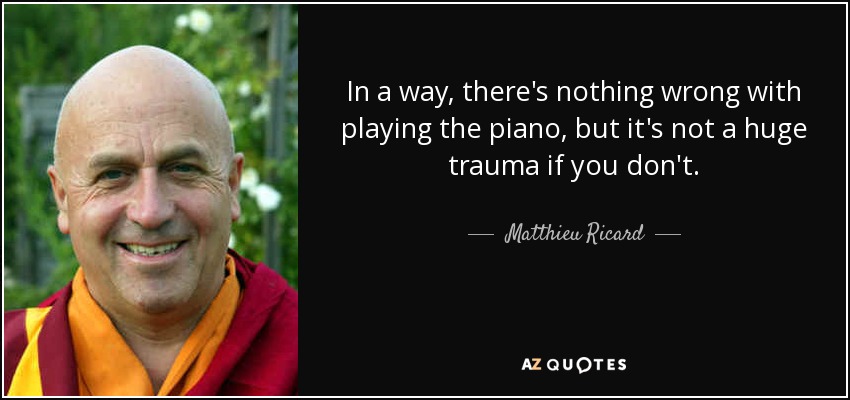
In a way, there's nothing wrong with playing the piano, but it's not a huge trauma if you don't.
If you don't have altruism, inner strength, inner peace, attention, then it's a trauma. It makes a difficult life for you and for others.
I think trauma gets a reductive treatment. We tend to think only violence or molestation or total abandonment qualify as "childhood trauma," but there are so many ruptures and disturbances in childhood that imprint themselves on us. Attachment begets trauma, in that broader sense, and so if we've ever been dependent on anyone, I think there is an Imago blueprint in us somewhere.
Cinema can transform pain and trauma into something beautiful.
That is my job as an intellectual, as an extension of my vocation: to engage in a serious reckoning with the present manifestation of both white supremacy, white refusal to acknowledge culpability, and the attempts of black people to re-describe the harm and trauma we've endured, as well as to say afresh what it is that must be done if we are to be conscientious.
When our response to all trauma is to call the police, then that gets us into a cycle of perpetuating trauma. Mental health trauma is different from somebody breaking into a store. Those are not the same things, and our response has to be different.
I feel a lot of sympathy for the young women I've written about, including Younger Janice. I think that all of them (me in Girlbomb, Samantha in Have You Found Her, and Elizabeth in I, Liar) had some early family trauma that contributed to their dysfunctional methods of dealing with the world, but I wouldn't call them/myself victims - survivors, maybe, but not victims. Nor do I think of them/myself as con artists.
What inspired me most was the resilience of the Cambodian people. The country is still living with the trauma of the brutal Khmer Rouge regime. People lost everything - family, friends. The rich culture of Cambodia was nearly extinguished. They are a nation of survivors. And while poverty and infant mortality affect a disproportionate amount of the people there, those I met were hopeful for the future and doing the best they can with what they had.
Strangely enough, for many many years I didn't talk about my childhood and then when I did I got a ton of mail - literally within a year I got a couple of thousand letters from people who'd had a worse childhood, a similar childhood, a less-bad childhood, and the question that was most often posed to me in those letters was: how did you get past the trauma of being raised by a violent alcoholic?
Well to me growing, up I've had my own psychological war with my parents dying at such a young age. My mother was killed by a drunk driver, then two months later my father drowned. He was out with his friends drinking and on medication for depression, and he didn't come out of the water alive. Growing up with sexual abuse and having to be in gangs and dealing with my own trauma; finding the cultural identity when I was 16, and learning those traditional ways saved me from hurting myself.
We [Americans] have a historical trauma when it comes to the past relationships when it comes to Native Americans and the history of how America was created. With this film, it's nice to see that the trauma is presented from a white male that was in the Civil War and that trauma affects him in a way that still exists.
Those traumas when it comes to the historical past generation to generation; our children, our grandchildren, our future grandchildren learn these behaviors. We have to know that they exist and we have to take care of those traumas and learn to heal from them. This movie shows that perspective from Scott's character, and I love it. It shows the American Indians as the ones who respect and help out when people are needed. It's a nice little twist.
This artistic uprising we had the other night in Washington Square park: there was poetry, there was dance, there was song, there was spoken word; and people left feeling so inspired and so energised. We have to get ourselves out of this syndrome of trauma and being re-traumatised. Art releases this energy. It exposes us to wonder again, and magic again, and ambiguity - all the things we need to really keep going and fighting and resisting in these times.
At the Third Wave Foundation, we were asking questions like, "How can we get more voters registered who support our issues?" or "How do we want to give away of money so that it has the greatest impact?" But, the poems were involved in questions of feeling whole, negotiating sexual trauma, and speaking to what has been lost forever. I've always been a person who feels most energized when I am both creating art and working toward social change, but I often have difficulty talking about the two in the same breath.
I often feel trapped. I often feel like I'm trying to escape some trap, be it a way of thinking, a compulsion, or a way of life. I believe this persistent feeling comes from childhood traumas that stripped away my power. The effect, though, the resulting persistent desire to stretch out of confinement even when confinement is inevitable, is a gift.
It's the feeling right from the beginning that the government is not on your side, the government thinks you're going to use this opportunity to cheat them, even though you've just been through this huge trauma.
As writers and readers, we're drawn to conflict. It's that ancient theory of plot that's written on the whiteboard during every fiction workshop, characters who want something overcoming obstacles as a way to create narrative momentum and suspense. So there's that, that trauma gives us more plot.
Indifference is the saddest state of being. It's like PTSD - you're not gonna fight, you're not gonna run, you're just frozen there, feeling nothing. It's very easy to have conversations when you're sitting there feeling nothing, to talk about the weather or what you had for lunch, to Instagram what you had for lunch. We're all suffering from trauma. This world is so crazy. How do we feel safe here? I think that's the question everybody's asking, "What do I need to do to feel safe? Like I'm okay?" I don't think there's anything wrong with that.
There's no easy path through grief and trauma. Learning from the experiences of people who'd been through similar losses was helpful.
Writing helps us heal in certain way, but it doesn't make the experience of thinking about writing that occasion any less painful. When you revisit trauma, you don't know what's going to be triggering for you because you don't know how it's connected in your mind. So in the same way when we write something, it doesn't completely resolve the experience for us. It can feel therapeutic, but that's not the reason why I do it. I do it to ask a question, or just to find meaning.
I liked trumpet because it's related to boxing, but also it has a capacity to create a different type of beauty. There are fight fans, people who want to see that, but what they're really there to see is pretty rough. They're there for blood, which is fine. It's part of it. I enjoyed having the same type of internal, mental, physical fight, but enduring that sort of trauma or pain to send a message of love. I can still have the fight, but what I'm fighting for is more a reality that I want to create.
I'm not interested in being gratuitously relatable and broadening out what I do in order to reach more people. When I'm going into specific details of the trauma, I think it's the details that connect with people. I'm accidentally relatable - I didn't mean to be, and I didn't think I would be. It feels like what I'm saying on stage is quite shameful and possibly perverted; so for other people to be laughing and go, "Oh, yes, we understand that. We are like that too," is very lovely.
The man Hillary [Clinton] introduced at the meeting goes so far as to say that no amount of trauma to children - or poor parenting or anything in their lives - causes them mental disorders. He says it's all biological and genetic and should be treated by drugs.
Intense asana practice - too much, too soon - can have detrimental effects. It can also promote a dissociation from the personal sensitivity and self awareness that I am trying to encourage. I don't want to contribute to furthering physical or psychological trauma.
There are those uncomfortable things that've passed that you have to deal with or they define you, like childhood trauma. Like when I'm lost, I just feel like somewhere along the line, if you've gone through any childhood trauma, it makes you lose your essence and it takes a while to get that back. There are certain things about that that push my buttons.
Follow AzQuotes on Facebook, Twitter and Google+. Every day we present the best quotes! Improve yourself, find your inspiration, share with friends
or simply: