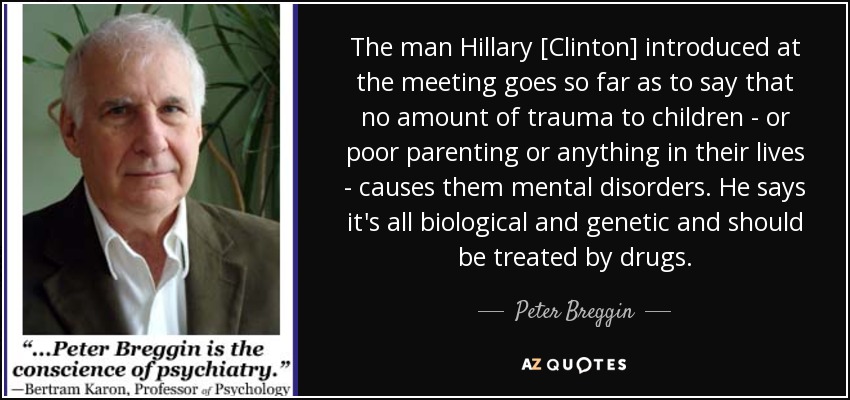
The man Hillary [Clinton] introduced at the meeting goes so far as to say that no amount of trauma to children - or poor parenting or anything in their lives - causes them mental disorders. He says it's all biological and genetic and should be treated by drugs.
It's the feeling right from the beginning that the government is not on your side, the government thinks you're going to use this opportunity to cheat them, even though you've just been through this huge trauma.
In a way, there's nothing wrong with playing the piano, but it's not a huge trauma if you don't.
If you don't have altruism, inner strength, inner peace, attention, then it's a trauma. It makes a difficult life for you and for others.
As writers and readers, we're drawn to conflict. It's that ancient theory of plot that's written on the whiteboard during every fiction workshop, characters who want something overcoming obstacles as a way to create narrative momentum and suspense. So there's that, that trauma gives us more plot.
Indifference is the saddest state of being. It's like PTSD - you're not gonna fight, you're not gonna run, you're just frozen there, feeling nothing. It's very easy to have conversations when you're sitting there feeling nothing, to talk about the weather or what you had for lunch, to Instagram what you had for lunch. We're all suffering from trauma. This world is so crazy. How do we feel safe here? I think that's the question everybody's asking, "What do I need to do to feel safe? Like I'm okay?" I don't think there's anything wrong with that.
I think trauma gets a reductive treatment. We tend to think only violence or molestation or total abandonment qualify as "childhood trauma," but there are so many ruptures and disturbances in childhood that imprint themselves on us. Attachment begets trauma, in that broader sense, and so if we've ever been dependent on anyone, I think there is an Imago blueprint in us somewhere.
All that rejection from Republicans has a bit of a racist element. It was very necessary to have a black president, and it's been a great thing. It will help, in the end, to ease the trauma of slavery and civil war. The war against slavery cost almost 800,000 American lives - that's how strongly they felt about it. And it's not going to go away in a century.
When tragedy strikes, no one is fully prepared to deal effectively with all the responsibilitie s, emotional trauma, and grief that begin to impact people. Our Rapid Response Team exists so that people can find the care and comfort of Jesus Christ in the midst of tragedy.
The signs of good health are an intellect which is free from inhibition and arrogance, a heart which is full of compassion is healthy, a confusion-free mind, a trauma-free memory and a sorrow-free soul.
Never had it occurred to me that the things that had happened to me...might be a kind of trauma.
I began to think that there was a place for 'Footloose' to get retold again, that there was actually a more conducive political climate, an emotional climate to explore a town that has experienced a trauma and a shock, and starts overreacting.
The body stores the trauma of our lives in muscular rigidity, thereby keeping us stuck in the past. When we release the tension in the body and align ourselves with gravity, we take a new stand in life. This allows us to be at ease with ourselves and in harmony in our relationship to others and to our planet.
Thought changes structure... I saw people rewire their brains with their thoughts, to cure previously incurable obsessions and trauma.
My interest, perhaps, came out of the trauma of being a young immigrant in this country and constantly feeling my "resident alien" status. I remember trying to learn English on kindergarten playgrounds. I tried hard to be a convincing American but it was a losing battle. I was labeled weird and that tag never left me - all through high school, I was always the oddball. It was not always an easy path - I just had to tell myself that one day, being on the periphery would become an asset (and I think it finally has, as a creative adult).
Maybe in writing about and through trauma it was therapeutic in a way, but it didn't feel like it at the time. I was in a very dark place, in lots of foreign cities, far from New York. A lot of personal trials and tribulations took over my life in those years. It might be some time before I see what therapeutic function this book did serve. But for now, it's not even easy to read from it.
When you are doing seven shows a week, you have to take care of yourself. There are some moments when you cannot allow yourself to emotionally reenact the issue you're talking about or the experience that you're remembering. I mean that would kill you, you know. To experience a thing, a trauma, every single night, it would probably kill you emotionally.
I love this idea of the body as a trauma archive!
I think generational trauma also plays a big part in the reactions to Israeli politics.
Fear of anti-Semitism almost is part of our religion. Throughout time Jewish people have experienced traumas that we relive in a lot of the things we celebrate.
Many of our holidays revolve around traumas that happened to our people and how we must remember them in specific ways. The way these stories are told and what we take away from them can change, and do in certain contexts, but overall I am not sure whether Jews want to let go of the narrative of the victim.
I'm more interested in the psychic intricacies that they build up and try to run away from, and how they self-construct. A lot of my work is about self-construction. Here, it's those folks who are deeply wounded and bewildered. They're not just victims of trauma; they've been shaken so forcefully that they don't quite know how or where to stand.
I write about how I was attracted to stripping because I didn't feel comfortable with my body, for instance, but there could be plenty of not-so-good reasons why I chose to go into journalism, too. Maybe someone had a trauma in childhood and it led them to become a nurse, or a lawyer, but because people stigmatize sex work they try to find a traumatic moment in your past and say, "There!"
I have witnessed firsthand the anguish of this humanitarian tragedy - in Palestine, Iraq, Syria, Pakistan, and other conflict and post-conflict zones. The destruction of lives and hopes, the emotional trauma, and the economic, social, and political marginalization of the displaced, the human insecurity, with real and potentially devastating consequences over generations, in ever-widening arenas of conflict. We can and must ensure the human rights of the displaced. That begins by making their voices heard.
It's true, we tend to write about the same thing over and over again because this is our trauma. If I had been in World War II, I might have been writing about D-Day over and over again.
Follow AzQuotes on Facebook, Twitter and Google+. Every day we present the best quotes! Improve yourself, find your inspiration, share with friends
or simply: