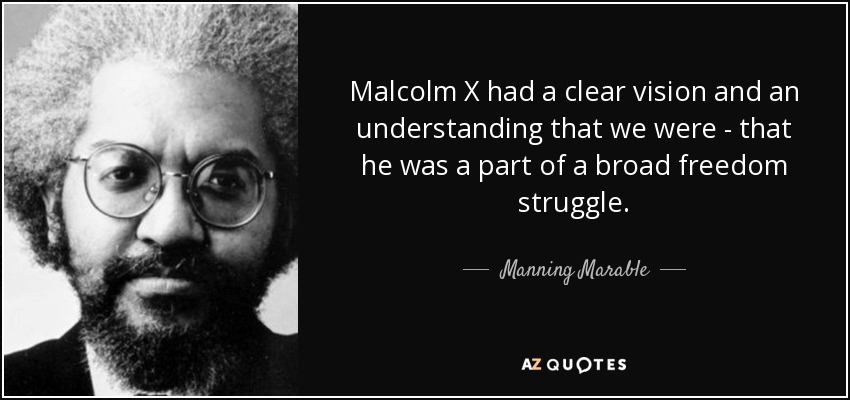
Malcolm X had a clear vision and an understanding that we were - that he was a part of a broad freedom struggle.
I had met Michael Stipe, and he was such a kind person, and extremely understanding, so I asked him if he knew a photographer who would come to Detroit, where I lived, who would be child friendly and who would respect my home. Michael suggested Steven [ Sebring]. One day a knock came at my door, and when I opened it, there was Steven. He's been like a brother ever since.
Activists can get very preachy about things. It's more about understanding people's own experiences and tapping into them.
If the various groups in America had been less selfish and had permitted different representatives from the groups to travel into foreign countries, and broaden their own scope, and come back and educate the movements they represented, not only would this have made the groups to which they belonged more enlightened and more worldly in the international sense, but it also would have given the independent African states abroad a better understanding of the groups in the United States, and what they stand for, what they represent.
There's the unique case of Ronald Reagan, who cited [founders] some 850 times, and in a way that was absolutely fundamental to understanding Reagan's vision for America.
The American founding is not just about a group of people, a group of men. It is about an ideal: Both a vision and understanding of the very essence of democracy, constitutional government, a representative republic, and the remarkably powerful concept of being endowed by our Creator with certain unalienable rights.
It is quite sad, to me, that that ideal, that vision and understanding [of American founding ], doesn't seem to be a part of the current political season.
If you're a realist, you know that people have different roles to play in politics, economics, and this is an important role, but I do think that there has to be an understanding of how what happens here on Wall Street has such broad consequences not just for the domestic but the global economy, so more thought has to be given to the process and transactions and regulations so that we don't kill or maim what works, but we concentrate on the most effective way of moving forward with the brainpower and the financial power that exists here.
You win by struggle, and that requires understanding and serious analysis of the options and the circumstances, and then you can do a lot.
Even though the story [Fences] is set during the 1950s, some contemporary women might have trouble understanding her decision.
For me as a writer, it was understanding that we're so far behind in our way of dealing with death. We put someone in the ground, we bury them or we burn them, and then we're supposed to just move on and kind of get over it.
How you staff, particularly the chief of staff, the national security adviser, your White House counsel, how you set up a process in the system to surface information and generate options for a president, understanding that ultimately the president is going to be the final decision-maker. That's something that has to be attended to right away.
It's a neat experience to go from the blank page to an actor elevating it to the audience understanding it - the full life of that is why I became a writer.
"Am I my brother's keeper?" There you have the whole Biblical understanding that you are your brother's keeper. You also have a whole other understanding in which you are not your brother's keeper. And I've heard some extremely bright people take this position.
What [Franz] Kafka says about the Tower of Babel: In the beginning there were actually many languages, and then as a punishment God gave the world a single language. And then they stopped understanding each other.
I believe in the 12 Jewels and try to provide my childrem with them. That is Knowledge, Wisdom, Understanding, Freedom, Justice, Equality, Food, Clothing, Shelter, Love, Peace and Happiness.
I think that if Essien Udom had something he didn't take it back far enough in history to get at the proper understanding of it.
I used to read more when I was a kid than I do now. It was all sort of fuel for the fire to teach you how to think and how to make things and it informed the architecture that I was doing. It's better coming in with that history and that kind of knowledge and depth of understanding of humanity that is very important for building buildings - for understanding people and how they should live and how you could make your lives better and stuff like that.
I do believe that with more worldwide influences, the coming of the internet age and digital media, the flow of information is far greater, and people's understanding can expand more easily.
When I started, I was aware of using the black as a rhetorical device. It's understanding that black people come in a wide range of colors, but you find instances in a lot of black literature in which the blackness is used as a metaphor.
One concern I had while I was working actively in the intelligence community - being someone who had broad access, who was exposed to more reports than average individuals, who had a better understanding of the bigger picture - was that the post - World War II, post - Cold War directions of societies were either broadly authoritarian or [broadly] liberal or libertarian.
Too often we forget that social and political movements don't happen overnight. They don't bring change immediately - you have to build a critical mass of understanding of the issues.
One contribution scientists can and should make is to be clear and explicit about the limits of scientific understanding, a matter that is particularly important in societies where people are trained to defer to alleged experts.
I really think we were charting a course to having a more sane response to mass incarceration, to drug use, and to understanding that the war on drugs has resulted only in the empowerment of vast criminal enterprises and the destruction of democracies around the world. And all that is coming to a miserable, horrific halt.
We need a legal and political understanding of the right of the refugee, whereby no solution for one group produces a new class of refugees - you can't solve a refugee problem by producing a new, potentially greater refugee problem.
Follow AzQuotes on Facebook, Twitter and Google+. Every day we present the best quotes! Improve yourself, find your inspiration, share with friends
or simply: