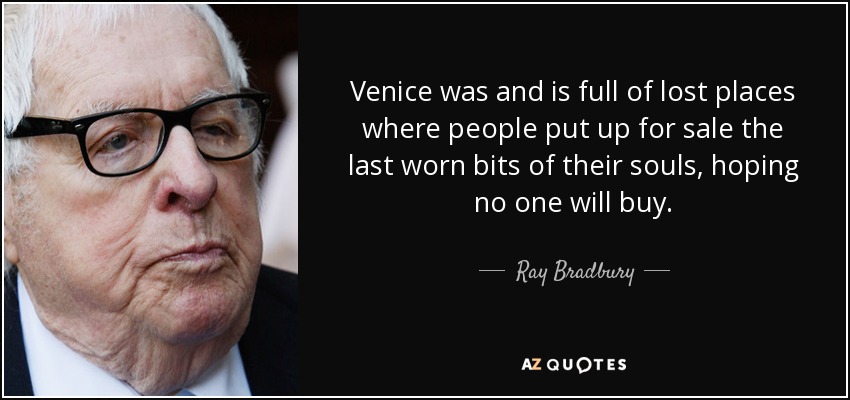
Venice was and is full of lost places where people put up for sale the last worn bits of their souls, hoping no one will buy.
The trouble is, walking in Venice becomes compulsive once you start. Just over the next bridge, you say, and then the next one beckons.
In the city of flesh I travel without maps, a worried tourist: and Ottilie was a very Venice. I stumbled lost in the blue shade of her pavements. Here was a dreamy stillness, a swaying, the splash of an oar. Then, when I least expected it, suddenly I stepped out into the great square, the sunlight, and she was a flock of birds scattering with soft cries in my arms.
Descendants of pigeons once fed by Keats, Byron, George Sand, Chopin and many other famous lovers are still being fed, and the sudden sound when they all rise together, frightened away, is like the sound of giant sails flapping.
To live in Venice is like being domesticated in the heart of an opal.
To go out in a gondola at night is to reconstruct in one's imagination the true Venice, the Venice of the past alive with romance, elopements, abductions, revenged passions, intrigues, adulteries, denouncements, unaccountable deaths, gambling, lute playing and singing.
I don't want to be in my car all day. I love getting up in the morning in Venice and walking my dogs down to the café to get my tea, and then perhaps going to a bookstore and sitting and reading, then walking to the beach.
The perennial wonder of Venice is to peer at herself in her canals and find that she exists-incredible as it seems. It is the same reassurance that a looking-glass offers us: the guarantee that we are real.
First, my frame of reference for the Britten opera shifted. I'd always thought of Britten's approach in Death in Venice as another exploration of the plight of the individual whose aspirations are at odds with those of the surrounding community: his last opera returning to the themes of Peter Grimes. As I read and listened and thought, however, Billy Budd came to seem a more appropriate foil for Death in Venice.
... in the eyes of its visitors, Venice has no reality of its own. Anyone visiting the place has already seen so many pictures of it that they can only attempt to view it via these clichés, and they take home photographs of Venice that are similar to the ones they already knew. Venice [is] becoming like one of those painted backdrops that photographers use in their studio.
Civilization is an active deposit which is formed by the combustion of the Present with the Past. Neither in countries without a Present nor in those without a Past is it to be encountered. Proust in Venice, Matisse's birdcages overlooking the flower market at Nice, Gide on the seventeenth-century quais of Toulon, Lorca in Granada, Picasso by Saint-Germain-des-Prés: there lies civilization and for me it can exist only under those liberal regimes in which the Present is alive and therefore capable of assimilating the Past.
If anything can rival Venice in its beauty, it must be its reflection at sunset in the Grand Canal.
In Venice in the Middle Ages there was once a profession for a man called a codega--a fellow you hired to walk in front of you at night with a lit lantern, showing you the way, scaring off thieves and demons, bringing you confidence and protection through the dark streets.
Venice is beautiful, but like a Bergman movie is beautiful; you can admire it, but you don't really want to live in it.
Go to Venice. Find Scorpia. And you will find your destiny.
Venice would be a fine city if it were only drained.
On December 12, 1829, Paganini wrote his friend Germi: "The variations I've composed on the graceful Neapolitan ditty, 'Oh Mamma, Mama Cara,' outshine everything. I can't describe it!" He was writing from Karlsruhe, in the midst of his triumphal tour through Germany. That letter marks the earliest known mention of the variations that would become famous as "The Carnival of Venice." At the time of his letter, Paganini had already performed the piece in at least four concerts. From then on, it would be one of his most popular compositions.
...... an outlaw gulch, a haven for draft resisters, struggling artists, and drug addicts.....a camp for semi-demented adults.... Venice is like the legendary Phoenix - it always seems to rise again from the ashes.
To me, Venice and Ocean Park were gaiety. I had not been allowed to go to those things as a youngster.
Gentrification and consumerism... have destroyed the character of my favorite American haunts, like North Beach, Berkeley, Venice and Aspen.
When you come to Venice, you do special work.
It's a fault line where the flotsam and energy that washes up from the Pacific collides with all of urban America crashing in from the other direction.
Everything was happening all the time. You never needed television.
This is the only place that I don't feel out of place, because everyone here is out of place.
Venice is a place where the past is still hanging around, waiting for an appointment with the future; but the future hasn't shown up. In the meantime it is a kind of no man's land, given up by default and occupied by irregulars and their dogs.
Follow AzQuotes on Facebook, Twitter and Google+. Every day we present the best quotes! Improve yourself, find your inspiration, share with friends
or simply: