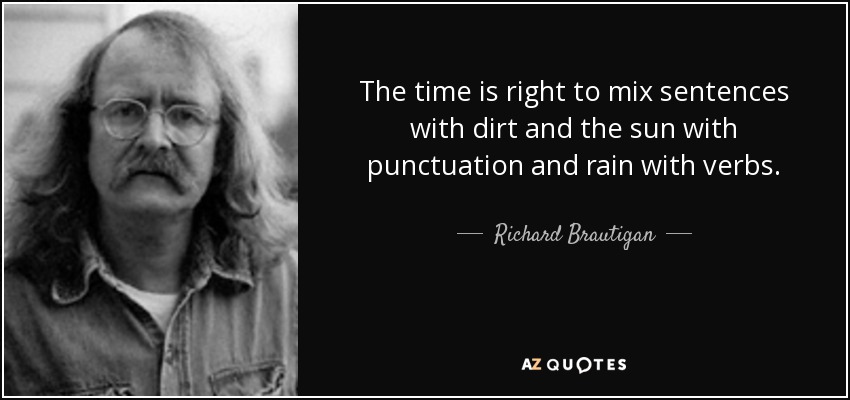
The time is right to mix sentences with dirt and the sun with punctuation and rain with verbs.
The secret of force in writing lies not so much in the pedigree of nouns and adjectives and verbs, as in having something that you believe in to say, and making the parts of speech vividly conscious of it.
No, you used nouns and verbs together in a pleasing but illogical format.
Generally, the shaking is consciously felt in its positive aspects — as the wonderful new heaven and earth which love with its miracle and mystery has suddenly produced. Love is the answer, we sing. Our Western culture seems to be engaged in a romantic - albeit desperate - conspiracy to enforce the illusion that that is all there is to eros.
Want to improve your relationships? See love as a verb rather than as a feeling?
Poetry is perfect verbs hunting for elusive nouns.
Someone has written, Love is a verb. It requires doing -not just saying and thinking. The test is in what one does, how one acts, for love is conveyed in word and deed.
A player who conjugates a verb in the first person singular cannot be part of the squad, he has to conjugate the verb in the first person plural. We. We want to conquer. We are going to conquer. Using the word I when you're in a group makes things complicated.
Love is a verb. Love is something you do: the sacrifices you make, the giving of self. If you want to study love, study those who sacrifice for others. Love - the feeling - is a fruit of love the verb.
Most people use twenty verbs to describe everything from a run in their stocking to the explosion of an atomic bomb. You know the ones: Was, did, had, made, went, looked... One-size-fits-all looks like crap on anyone. Sew yourself a custom made suit. Pick a better verb. Challenge all those verbs to really lift some weight for you.
When your mother starts using the word "party" as a verb about her kid, that's absolutely crazy.
Look for verbs of muscle, adjectives of exactitude.
I don't grasp things this early in the day. I mean, I hear voices, all right, but I can't pick out the verbs.
A person who uses party as a verb is a person who will walk into a shop and walk out wearing a rubber jumpsuit.
The process of unlearning in order to relearn demands a new concept of knowledge not as thing but as a process, not as a noun but as a verb.
I want to see the thirst inside the syllables I want to touch the fire in the sound: I want to feel the darkness of the cry. I want words as rough as virgin rocks.” - Verb.
Saw you walking barefoot taking a long look at the new moon's eyelid later spread sleep-fallen, naked in your dark hair asleep but not oblivious of the unslept unsleeping elsewhere Tonight I think no poetry will serve Syntax of rendition: verb pilots the plane adverb modifies action verb force-feeds noun submerges the subject noun is choking verb disgraced goes on doing now diagram the sentence
What is an adjective? Nouns name the world. Verbs activate the names. Adjectives come from somewhere else. The word adjective (epitheton in Greek) is itself an adjective meaning 'placed on top', 'added', 'appended', 'foreign'. Adjectives seem fairly innocent additions, but look again. These small imported mechanisms are in charge of attaching everything in the world to its place in particularity. They are the latches of being.
The boy spoke two words, the first a short guttural verb, the second “you.
...she had always known under her mind and now she confessed it: her agony had been, half of it, because one day he would say farewell to her, like that, with the inflexion of a verb. As, just occasionally, using the word 'we' - and perhaps without intention - he had let her know that he loved her.
The verb 'to love' in Persian is 'to have a friend.' 'I love you' translated literally is 'I have you as a friend,' and 'I don't like you' simply means 'I don't have you as a friend.
It is told that Buddha, going out to look on life, was greatly daunted by death. "They all eat one another!" he cried, and called it evil. This process I examined, changed the verb and said, "They all feed one another," and called it good.
Whatever one wishes to say, there is one noun only by which to express it, one verb only to give it life, one adjective only which will describe it. One must search until one has discovered them, this noun, this verb, this adjective, and never rest content with approximations, never resort to trickery, however happy, or to vulgarism, in order to dodge the difficulty.
Cuisine has become too complicated - this is about subject, verb, adjective: duck, turnips, sauce.
James Blish told me I had the worst case of "said bookism" (that is, using every word except said to indicate dialogue). He told me to limit the verbs to said, replied, asked, and answered and only when absolutely necessary.
Follow AzQuotes on Facebook, Twitter and Google+. Every day we present the best quotes! Improve yourself, find your inspiration, share with friends
or simply: