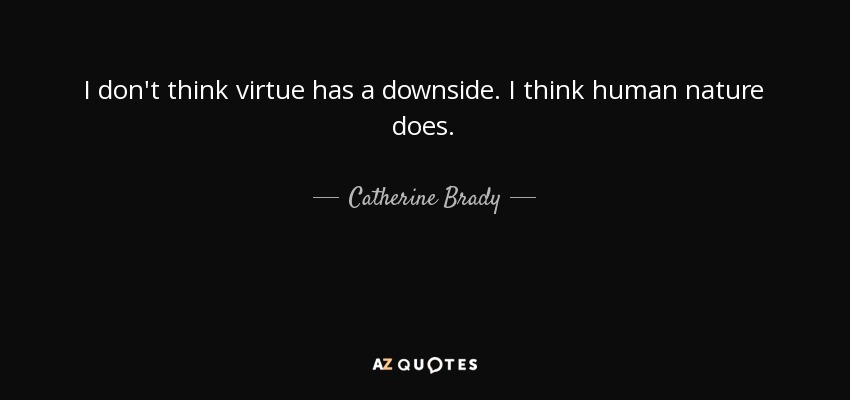
I don't think virtue has a downside. I think human nature does.
As an artist, I identify with Sandro Botticelli. We know him as the man who painted Primavera and The Birth Of Venus. The goddesses and ancient subjects he chose represented virtues which were meant to inspire people. Then he went through a dark phase when he was listening to the sermons of Savonarola, who preached against the worldly pleasures of the Renaissance. But Botticelli's works live on, inspiring people to this day. Five hundred years after his death, he still has thousands of fans!
Citizens should be looked to for what they can give of their own nobility, virtue, creative thinking, passion, and natural talent for community building and relating to others.
We talk of the enormous virtues of work, but it turns out that that is mostly for the poor. If you're rich enough or if you're a college professor, the virtue lies in leisure and the use you make of your leisure time.
The 'phenomenal concept' issue is rather different, I think. Here the question is whether there are concepts of experiences that are made available to subjects solely in virtue of their having had those experiences themselves. Is there a way of thinking about seeing something red, say, that you get from having had those experiences, and so isn't available to a blind person?
Internalist approaches to epistemology, I believe, have a great deal of intuitive appeal. Internalists believe that the features in virtue of which a belief is justified must somehow be internal to the agent. On some views, this amounts to the claim that these features must be accessible to introspection and armchair reflection. On others, it amounts only to the claim that they must be mental features.
I can't possibly predict precisely what the unemployment rate will be at the end of one year. I can tell you that over a period of four years, by virtue of the policies that we'd put in place, we'd get the unemployment rate down to 6%, and perhaps a little lower.
What intrigued me most was not the technology as such but the questions about the human goods, the fundamental human values and virtues that are raised by debates over biotechnology.
In fact, there is only one true and holy religion, founded and instituted by Christ Our Lord. Mother and Nurse of the virtues, Destroyer of vice, Liberator of souls, Guide to true happiness, she is called Catholic, Apostolic, and Roman.
There is nothing that does not have something perfect in it; and it is the happiness of good taste to be able to find this perfection in all things. But there is a natural malignity that often discovers a vice in the midst of several virtues, in order to reveal and proclaim the discovery to all the world - a quality that is more the mark of a naturally evil temperament than a superior sense of discrimination. And it is truly an evil lot, to pass one's life always feeding off the imperfections of others.
Virtue is not always where it seems to be. People sometimes acknowledge favors only to maintain their reputations, and to make themselves more impudently ungrateful for favors that they do not wish to acknowledge.
We are more put off by people who parade their dignity than by people who show off their wardrobes. When people have to trick themselves out to gain attention, it is a sure sign that they are unworthy of it. If we want to make ourselves worthy, we can do so only by the innate eminence conferred by virtue. We hold great people in esteem more for the qualities of their soul than for the qualities of their fortune.
Those who foolishly pride themselves on their nobility mistake that which makes them noble, for it is only the virtue of their ancestors that gives them noble blood.
Moral education, as I understand it, is not about inculcating obedience to law or cultivating self-virtue, it is rather about finding within us an ever-increasing sense of the worth of creation. It is about how we can develop and deepen our intuitive sense of beauty and creativity.
A virtue which is divine is humility. A person who could do great things and still maintain humility of the heart, charity of the heart, goodness of the heart is a person who could actually make a difference in peoples lives in a very positive way.
The allure of immodesty is not in what is seen but what is not seen. Modesty issues a challenge for one man to romantically earn your virtue.
Virtue is the master of talent, talent is the servant of virtue. Talent without virtue is like a house where there is no master and their servant manages its affairs. How can there be no mischief?
Diligence means to be keen in matters of virtue and justice, but worldly people use diligence to solve their economic difficulties. Frugality means to have little desire for material goods, but worldly people use frugality as a cover for stinginess. Thus do watchwords of enlightened life turn into tools for the private business of small people. What a pity!
I think there are probably a lot of actors like me who I think probably struggle to feel comfortable in their own lives, and acting in some ways provides a safe context for them to live out emotions that they possibly repress or live out experiences that they are not afforded by virtue of circumstance.
Another of our highly prized virtues is fidelity. We are immensely pleased with ourselves when we are faithful.
I did think Justice [Antony] Kennedy's opinion on Lawrence was critical to that because it really, what Lawrence in one sense was, of course, about consensual sex being something that the government can't regulate. But really in a more fundamental sense, what it was saying, "Look. Gay people are normal people, and they get to live normal lives. They're not criminals by virtue of the fact of being gay."
Admittedly, having a bit of disposable cash in the bank can give you a sense of Buddhistic calm, and despite the fallacy involved, that's probably preferable to the bonafide adventure of robbing a bank. A better alternative, however, is to learn to be at peace even when common sense (a highly overrated virtue) would lead you to believe that someone in your situation ought to feel threatened and insecure.
I do think vulnerability is a virtue.
Arguably, if you view a real barn in bright sunlight and close by, while fully alert and otherwise in good shape, then you do know whether or not you see a barn. You have "animal" knowledge, says my virtue theory, through the first-order aptness of your judgment.
I would say that by virtue of transforming politics, [Dalai Lama] is in fact easily underestimated.
Follow AzQuotes on Facebook, Twitter and Google+. Every day we present the best quotes! Improve yourself, find your inspiration, share with friends
or simply: