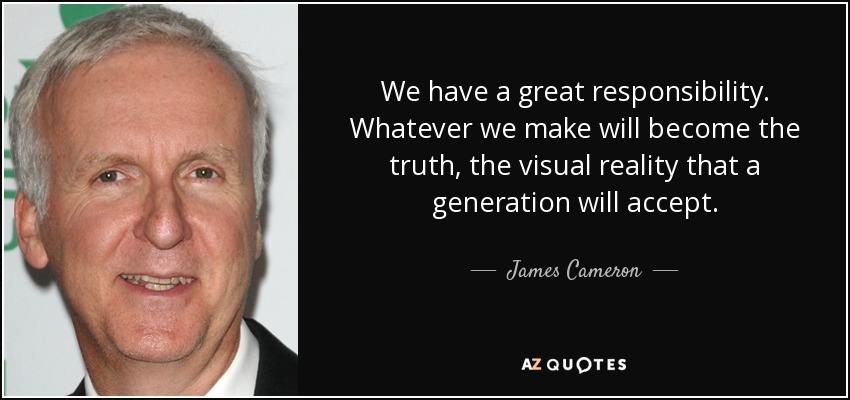
We have a great responsibility. Whatever we make will become the truth, the visual reality that a generation will accept.
Marilyn Monroe and Vivienne Leigh are real icons of mine. In terms of visual culture, they are both so iconic. There weren't any paparazzi shots of them falling out of taxis, so they will always look so incredible.
An illustration is a visual editorial - its just as nuanced. Everything that goes into it is a call you make: every color, every line weight, every angle.
I think it's very, very important that people outside the capital cities, not just Sydney and Melbourne but also Brisbane Perth Adelaide and so on, have the greatest access to the best cultural experiences they can in both the performing arts and the visual arts.
I really have fun doing music for visuals and stuff.
I'm not trying to be in your face and take a picture that is like a journalistic kind of image. I got interested in a kind of complicated, compiled, visual field.
We share a huge visual memory bank, mostly through painting and other images in history. I think when a modern photograph taps into those, sometimes very subliminally, it makes people respond.
The assumption that seeing is believing makes us susceptible to visual deception.
If you're going to be a visual artist, then there has to be something in the work that accounts for the possibility of the invisible, the opposite of the visual experience. That's why it's not like a table or a car or something. I think that that might even be hard for people because most of our visual experiences are of tables. It has no business being anything else but a table. But a painting or a sculpture really exists somewhere between itself, what it is, and what it is not-you know, the very thing. And how the artist engineers or manages that is the question.
It's a lot more than clicking the shutter...it's the ideas, it's the visual voice, it's the telling the story, it's kind of going beyond that initial thing that just means you happened to be there at the right time.
David Fincher is probably the best comprehensive director in terms of being a manger of a process that must drive forward. He has such confident command of cinema language and visual language and script and performance. He knows more about f-stops than any cameraman, he knows more about lighting than any gaffer, he is a wonderful writer, and he can give you a good line reading. Under pressure, he is the kind of guy who you will just dive in with and trust and follow because his vision is so intense.
No other creative field is as closed to those who are not white and male as is the visual arts. After I decided to be an artist, the first thing that I had to believe was that I, a black woman, could penetrate the art scene, and that, further, I could do so without sacrificing one iota of my blackness or my femaleness or my humanity.
The theme, or harmony, of a painting can be created by any one of its visual elements. A single colour... repetition of shapes... Light can be a theme.
I am a hobbyist photographer so I relate to the visual arts that way, but Im not a painter.
The primary purpose of the Museum is to help people enjoy, understand, and use the visual arts of our time.
My picture-poems are linguistic margins on visual atolls.
When you combine the great stories from the comics with the action and visual excitement of the movies, it doesn't get any better!
I don't see perfection as far as a visual image of perfection. "Perfection" to me is, I walk away from a situation and say, "I did everything I could do right there. There was nothing more that I could do." Like, I worked as hard as I possibly could have. That's perfection.
I love composing and writing music and dancing and performing and conceptualizing creatively for visual mediums. I love to create.
You've got to bring the emotion, and you have to understand that you can't touch other people if you're not touched. You can't move other people if you're not moved. So if you're just giving some frickin talk you've memorized over and over again, you're going to have a flat affect. If you've just got a bunch of visuals on the screen that are leading your talk, hang up your shoes and get the hell out of there.
What quality is shared by all objects that provoke our aesthetic emotions? Only one answer seems possible— significant form. In each, lines and colors combined in a particular way; certain forms and relations of forms, stir our aesthetic emotions. These relations and combinations of lines and colors, these aesthetically moving forms, I call ‘Significant Form’; and ‘Significant Form’ is the one quality common to all works of visual art.
The musician of disordered sound, the poet of decomposed language, the painter and sculptor of the fragmented visual and tactile world: they all portray the break up of the self and, through the rearrangement and reassemble of the fragments, try to create new structures that possess wholeness, perfection, new meaning.
The most inspiring objects are books. I have about 5,000 volumes in my home library. It's an unending source of visuals and ideas.
The small visual inconvenience of e-books is made up for with find and search functions, and the fungibility of digital text.
I enjoy the drawing more than the writing, so I try to think of ideas that will allow me to develop the visual side of the strip as fully as possible.
Follow AzQuotes on Facebook, Twitter and Google+. Every day we present the best quotes! Improve yourself, find your inspiration, share with friends
or simply: