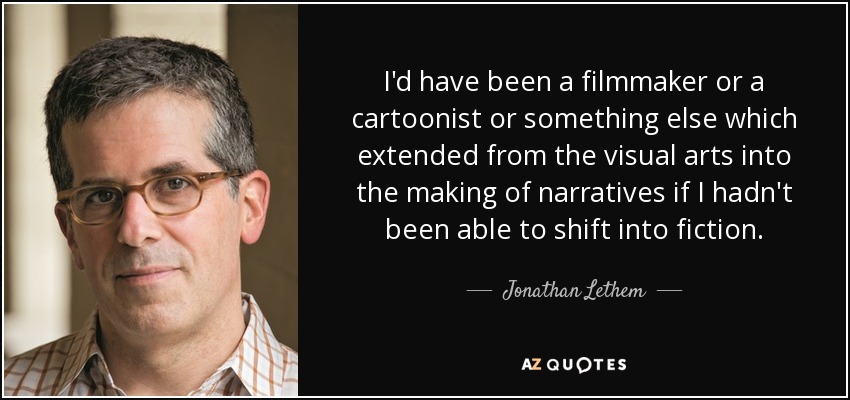
I'd have been a filmmaker or a cartoonist or something else which extended from the visual arts into the making of narratives if I hadn't been able to shift into fiction.
I wasn't a big fan of social anthropology. And, luckily, that created room for me to work in visual arts because I sort of ignored my requirements. I think I was attracted to social anthropology because I liked to travel and was always interested in far-off places.
Neither camera, nor lens, nor film determine the quality of pictures; it is the visual perception of the man behind the mechanism which brings them to life. Art contains the allied ideas of making and begetting, of being master of one's craft and able to create. Without these properties no art exists and no photographic art can come into being
I found that it wasn't so oddball to like music and poetry and visual arts, they're kindred spirits.
I'm never going to be one of those people who is good at organization. But I'm very visual. I have a catalog in my head of things I already own, so it's easy to shop and I always know exactly what I'm looking for.
One advantage of photography is that it's visual and can transcend language.
Smells are so powerful and evocative, sometimes stronger than visual cues.
Well, I have an idea, usually a visual image of some sort. A setting. A particular, I don't know, urban scene, a particular time of day. Something that grips my imagination for some reason.
Beyond the pervasive disinterest in the visual arts among the Protestant community, the core problem lies in the fact that the art world rejects on several grounds work that is in any way explicitly Christian in content and also shrugs off as naive anything that has the semblance of hope or optimism in outlook.
We are a band that stylistically crosses a lot of barriers and generational gaps. The heavier portion of the band, the modern music elements, the visual part of the band appeal to a younger audience. For an older audience, we have chops and great songs that are reminiscent of the things that were great about rock and roll when they enjoyed it. We're the kind of band that can cross those lines.
To write well, to have style ... is to paint. The master faculty of style is therefore the visual memory. If a writer does not see what he describes-countrysides and figures, movements and gestures-how could he have a style, that is originality?
The creation of the island, or the impression of the island, as it changes in the mind of the character also came in to play... there was another very important collaborator, Rob Legato, on special visual effects. And then ultimately there's Thelma Schoonmaker, who keeps me focused during the editing of the picture.
I write on a visual canvas, 'seeing' a scene in my thoughts before translating it into language, so I'm a visual junkie.
My exposure to visual art all my life was intensive.
Color, like everything else concerning visual expression, usually boils down to a gift, an innate sensibility and sensitivity. Ultimately, artists develop their own palette and color sense.
I think the power of the short film is incredibly underrated. It is way easier to get someone to watch a 15-minute film then a full-length feature. In those 15 minutes you have the opportunity to express your voice as an artist and hopefully connect with your audience. If you are trying to be a first time feature director then a short film that demonstrates you have a grasp on the themes and concepts of the movie you want to direct is a no-brainer. Whether they are collaborators or potential investors, filmmaking is a visual art form so you obviously need visuals to show them!
I learned capacity for self-reflection very early, finding it through interior monologues that books are so good at and that visual media is so bad at because it's so boring - nothing's happening. In a book, you can be inside the narrator's head for 50 pages, and nothing needs to happen. Then you learn to be inside your own head without something needing to happen. It's a very good antidote to a crazy, restless, "what's next?" culture - that you can just be in your own head and nothing is happening except that this is a rich place. I love that.
I think that being a film composer, someone that gets it and actually applies the music, it allows you to open up a spectrum of feeling. You're now allowed to approach the music from an audio visual perspective.
Visual journaling allows us to access our inner language of imagery and express it both verbally and visually, while exploring the connection between image and word.
I love doing film soundtracks and working with directors on how they want the scene to be portrayed on audio as opposed to visual. I like the collaborative effort of working with people.
I knew I had to write a good screenplay to be taken seriously, and I knew I needed to present Mississippi on visuals instead of just saying, 'Hey I wanted to film it in Mississippi.' It would seem like it was a hometown boy just wanting to be home.
I like doing clay work. It's different from drawing on a page because you have something to mold into different shapes. It's quite visual, it's a thing you can hold and feel, and that makes it different from drawing.
What I so like about Poussin and Cezanne is their sense of organization. Ilike the way in which they develop space and shape in architecturalcontinuity - the rhythm across their paintings. When I paint a landscape, Iget the greatest pleasure out of composing it. As I paint, I try to work outa visual sonata form or a fugue, with realistic images.
Well, visual language is another boring discussion about the nature of film.
Concrete poets continue to turn out beautiful things, but to me they're more visual than oral, and they almost really belong on the wall rather than in a book. I haven't the least idea of where poetry is going.
Follow AzQuotes on Facebook, Twitter and Google+. Every day we present the best quotes! Improve yourself, find your inspiration, share with friends
or simply: