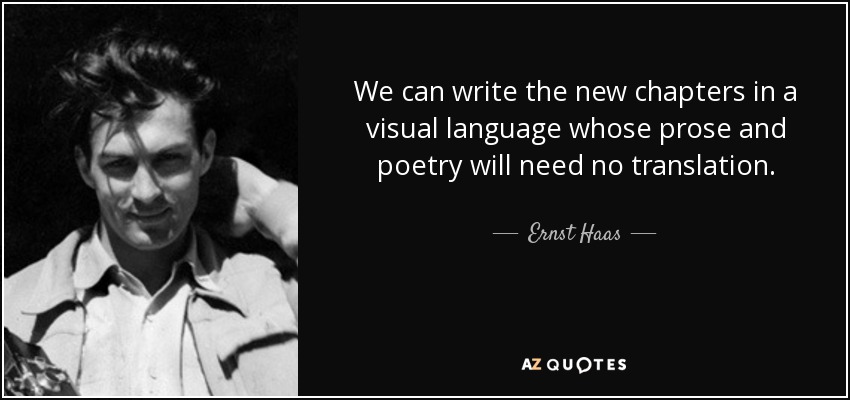
We can write the new chapters in a visual language whose prose and poetry will need no translation.
The tone of the picture and the atmosphere was in my head and in my blood in a way once I'd decided to make the picture. I had to find my way through that to choose, select, emphasise certain visual elements and sound.
Words are a big deal to me. I'm verbal and visual and I'm always struggling to find a way to smash those two parts of my cerebral cortex together. Sometimes it works, sometimes it feels mentally disjunctive.
A visual experience is vitalizing. Whereas to write great poetry, to draw continuously on one's inner life, is not merely exhausting, it is to keep alight a consuming fire.
I saw a commercial for the maxi pads for the bigger gals they're making now. That was a nice visual while I was eating.
I think the story should always determine the visual approach. There are situations where you want things to feel alive and like life, and there are situations that should have some magic and the separation with the grain.
There are certain things that I will do viscerally to affect people emotionally, with speed changes and sound, and various other things. Sure there are links; the same kind of sensibilities went into it and I worked on writing that script as well so there was an emphasis on a minimalisation of dialogue as far as possible, to focus on the visual and to put it in another language, of course.
That's just how I see things on a base level: there's so much going on. Or at least I like to have that feeling. It's part of being interested in notions of reality apart from storytelling. I don't know if it has something to do with having an art school education, which makes you aware of the way visuals speak, or makes you trust them more.
I'm a great believer in visual distinctions.
If you take text and image and you put them together, the multiple readings that are possible in either poetry or in something visual are reduced to one specific reading. By putting the two together, you limit the possibilities. Text and image don't always work together in the way music and song lyrics become part of each other.
The less you offer, the more readers are forced to bring the world to life with their own visual imaginings. I personally hate an illustration of a character on a jacket of a book. I never want to have someone show me what the character really looks like - or what some artist has decided the character really looks like - because it always looks wrong to me. I realize that I prefer to kind of meet the text halfway and offer a lot of visual collaborations from my own imaginative response to the sentences.
My bottom line is that I think Ridley Scott is one of the greatest visual artists of our time and I feel very privileged that he wants to work with me, so I go with that flow.
And luckily, for whatever reason, I've found people who are interested in living with and owning and existing around the DNA of my mind, which is my visual work. I've found collectors who are willing to put money down to live with my work. So I can't criticize the whole mechanism. But I can criticize it as an artist, in spite of the fact that I benefit from it. And there are problems with it.
In the past, people couldn't place me. They thought that I was Danish or English or French. They never got that I am Italian. I'm not typical, maybe because my visual education was very mixed. There was a lot of London in my aesthetic: The Face, i-D, British music, and a lot of British fashion . . . But I really enjoy this contrast.
There are two categories of writers, it could be said: The author who is just a voice, and the one who is also creating a picture. I belong to the latter, because I have an acute visual sense.
I hope that many visual journalists will be hired or funded along the way as well - we urgently need their perspectives.
The images are visual, auditory, olfactory, kinesthetic. They aren't laid down on the same tracks as thought. And sometimes, when they return to you, it is as if you feel them for the very first time. Memory lives on in the details, like the color of a room, a tone of a voice, the touch of a child, the smell of a man.
I write my novels longhand. I love the feeling of writing; I love to see pen on paper. It feels more creative than typing, and it's a more visual process for me - I can picture the entire scene in my head and am merely writing what I see.
I someday hope to find the time and coin to invest more of my creative energy towards the visual media side of releasing music. I'd love to make short film videos pushing the conventional standards of what a country music video can be.
It frequently happens that I begin a novel with just a visual image of something, a vague sense of people in three dimensional space.
The creation of the island, or the impression of the island, as it changes in the mind of the character also came in to play... there was another very important collaborator, Rob Legato, on special visual effects. And then ultimately there's Thelma Schoonmaker, who keeps me focused during the editing of the picture.
I think the power of the short film is incredibly underrated. It is way easier to get someone to watch a 15-minute film then a full-length feature. In those 15 minutes you have the opportunity to express your voice as an artist and hopefully connect with your audience. If you are trying to be a first time feature director then a short film that demonstrates you have a grasp on the themes and concepts of the movie you want to direct is a no-brainer. Whether they are collaborators or potential investors, filmmaking is a visual art form so you obviously need visuals to show them!
I like to hide my camera and use a remote control, because then no one knows when I'm actually imprisoning their souls in the visual plane of thought or just sitting there, waiting, and then making time stop. The printed film is like a bell used to symbolize its hour. Except it stands for both that hour's and everything's sudden stopping.
The goal is to align with your core group of collaborators, who understand your vision and aesthetics. I usually show them visual material of what I have in mind, as well as a color spectrum of mood boards.
I loved all those Doris Day visuals of her being a tomboy and then changing into this gorgeous girl in a ballgown.
Follow AzQuotes on Facebook, Twitter and Google+. Every day we present the best quotes! Improve yourself, find your inspiration, share with friends
or simply: