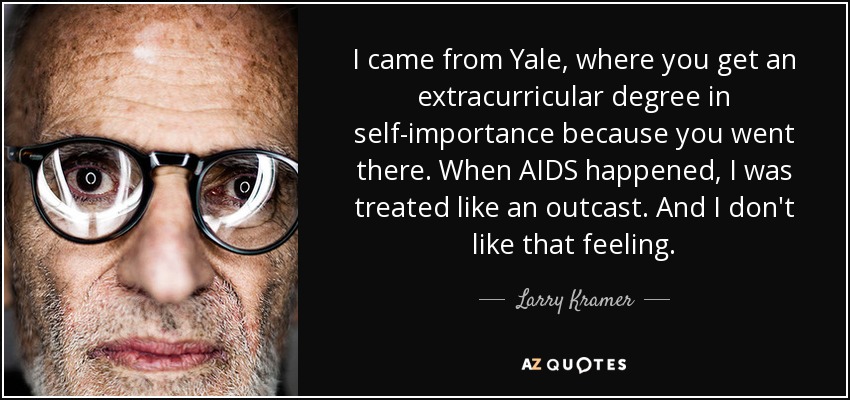
I came from Yale, where you get an extracurricular degree in self-importance because you went there. When AIDS happened, I was treated like an outcast. And I don't like that feeling.
I was at Yale from 1953 to 1957, and I tried to commit suicide in my freshman year because I was gay, and I thought I was the only person in the school who was. I was just totally and utterly miserable.
School is very important; it was very important for me. It gave me an enormous amount of confidence, especially at Yale where we were dealing with all the classics. In dealing with the classics, you are dealing with the very best.
Shutting down governments on your computer is just as much as fun as going to a riot at Yale.
I would love to see writing taught online because at university like Yale, there are not enough teachers who are able to teach writing well, or in some cases, there are none.
To cite my own alma mater, it's shocking to me that Yale University can teach what it teaches at the Yale School of Environmental Studies and utterly fail to mirror those values in any way in its investment practices.
Butterfield 8, with its call-girl heroine working her way down the alphabet of men from Amherst to Yale, appeared at a very formative moment in my adolescence and impressed me forever with the persona of the prostitute, whom I continue to revere. The prostitute is not, as feminists claim, the victim of men, but rather their conqueror, an outlaw, who controls the sexual channels between nature and culture.
Telling the complete story of VeggieTales would require much more time than we have before us tonight. Since this is Yale, I decided to craft a shorter version of the story, using very large words. Remembering though that I was kicked out of Bible College before I'd had a chance to learn many very large words, I concluded that my only remaining option was to tell the story simply, using simple words, and chance the consequences.
He's just intelligent-sort of a nerd, actually. He's the only brother I know who made a 1420 on the SAT. I don't think Chris Dudley did that, and Mr. Smarty Pants went to Yale. Kobe doesn't hang out. He doesn't go to the clubs. He doesn't ride around. He doesn't put rims on his car. He's just him. He's a sophisticated kid. Damn mature for his age.
The reputation Hillary Clinton had at Wellesley and Yale was, "My God, this woman single-handedly could end up running the world! This is the smartest woman!"
Hillary Clinton lived at Wellesley and Yale. Her circle of friends was that Ivy League bunch, and they were all being trained for lives in government. They were all being trained for lives of government: CIA, State Department.
I'm not a plumber who accidentally blew up or a math professor who accidentally backed into notoriety. I have a master's from Yale drama, and I auditioned for this. So obviously I want to be in the limelight in some capacity, or I want to be in entertainment in some capacity.
I can tell you about Hillary Clinton's heart. This is a woman, who, after law school, went down to my native South. She went down, after graduating from Yale Law School, to help poor kids, to help disabled kids.
First, my congratulations to Yale on their success this year. The more film we watched, the more we realized what a good lacrosse team they were. They don't have any weaknesses. We told the guys all week long, we're going to have to roll up our sleeves and work hard to get this one. Congrats to them for their season.
I began working within the streets of Harlem, where, after graduating from Yale [University, New Haven, CT], I became the artist in residence at the Studio Museum in Harlem [New York, NY]. I wanted to know what that was about. I would actually pull people from off of the streets and ask them to come to my studio.
Mel [ Bochner] held large-form meetings with students. But the stronger points came through when we had the one-on-one critiques. And that's the system that works at Yale. There's the group critiques, and then there's the one-on-one critiques that happen in studio.
The work that I wanted to create wasn't being done then. I was too much concerned about fellow students, professors, institutional style [in Yale].
In the Studio Museum in Harlem, when I was dealing with that community and dealing with my peers in the streets, it allowed for me to get outside of Yale, to get outside of art-speak, and to really think about art as a material practice that has very useful and pragmatic material precedent.
I was so unhappy as a child in Washington I figured if I'm going to Yale, I am going to start a new life. I'll change my name to my middle name. So I was known for my four years at Yale as David Kramer.
When I graduated [from Yale], I went back to Larry [Kramer]. But when I go to Yale reunions, there are still people who call me David.
That's why I tried to kill myself when I was a student [in Yale]. I thought I was the only one there.
Larry [Kramer] and I often disagree. There was the whole meshuggaas we went through about his donating his papers to Yale, and I disagreed with him on a number of things about that. You wanted a gay center.
Those people are seen, I assume, by Larry [Kramer] as writing partly about gay issues and problems, whether it's on the surface or not, and I am not. But another thing is when we met, there still wasn't exactly a gay/straight divide in the minds of a lot of straight people. There weren't any gay people, as far as we knew, at Yale.
One of the few nice things about [time in Yale] was you got to know people before there were labels on them, so you got to know them as people, not as either gay or straight. Because as far as we knew, we thought everyone was straight.
If someone had come up to me at Yale and asked me how many homosexuals there were in my class, I would have said I don't think there are any. There may have been a few who were shy with girls. You have to understand, this was the 1950s.
Follow AzQuotes on Facebook, Twitter and Google+. Every day we present the best quotes! Improve yourself, find your inspiration, share with friends
or simply: