
To disguise nothing, to conceal nothing, to write about those things that are closest to our pain, our happiness; to write about our sexual clumsiness, the agonies of Tantalus, the depth of our discouragement-what we glimpse in our dreams-our despair. To write about the foolish agonies of anxiety, the refreshment of our strength when these are ended; to write about our painful search for self, jeopardized by a stranger in the post office, a half-seen face in a train window, to write about the continents and populations of our dreams, about love and death, good and evil, the end of the world.
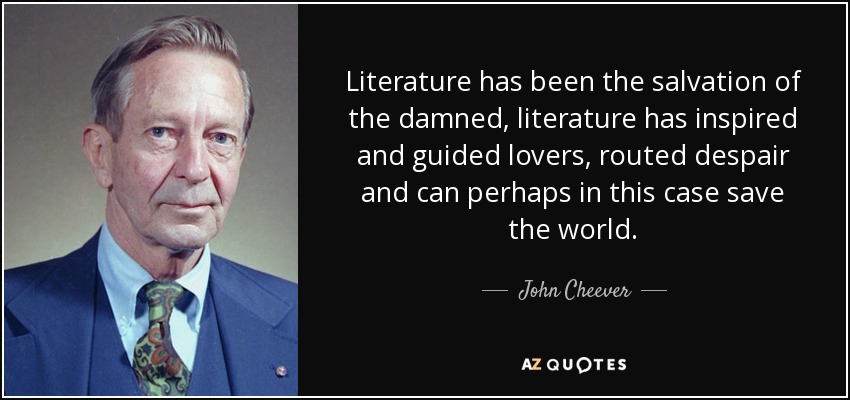
Literature has been the salvation of the damned, literature has inspired and guided lovers, routed despair and can perhaps in this case save the world.
The constants that I look for are a love of light and a determination to trace some moral chain of being.
How can a people who do not mean to understand death hope to understand love, and who will sound the alarm?
Homesickness is nothing. Fifty percent of the people in the world are homesick all the time.
When I remember my family, I always remember their backs. They were always indignantly leaving places.
I was here on earth because I chose to be.
All things of the sea belong to Venus; pearls and shells and alchemists' gold and kelp and the riggish smell of neap tides, the inshore green, and purple further out and the joy of distances and the roar of falling masonry, all these are hers, but she doesn't come out of the sea for all of us.
When the beginnings of self destruction enter the heart, it seems no bigger than a grain of sand.
My veins are filled, once a week with a Neapolitan carpet cleaner distilled from the Adriatic and I am as bald as an egg. However I still get around and am mean to cats.
For lovers, touch is metamorphosis. All the parts of their bodies seem to change, and they seem to become something different and better.
Who reads short stories? one is asked, and I like to think that they are read by men and women in the dentist's office, waiting to be called to the chair; they are read on transcontinental plane trips instead of watching banal and vulgar films spin out the time between our coasts; they are read by discerning and well-informed men and women who seem to feel that narrative fiction can contribute to our understanding of one another and the sometimes bewildering world around us.
Sometimes the easiest-seeming stories to a reader are the hardest kind to write.
Love with its paraphernalia of sexuality, jealousy, nostalgia and exaltation was easier to reognize than friendship, which seemed to have (excepting athletic equipment) no paraphernalia at all.
My God, the suburbs! They encircled the city's boundaries like enemy territory and we thought of them as a loss of privacy, a cesspool of conformity and a life of indescribable dreariness in some split-level village where the place name appeared in the New York Times only when some bored housewife blew off her head with a shotgun.
The novel remains for me one of the few forms where we can record man's complexity and the strength and decency of his longings. Where we can describe, step by step, minute by minute, our not altogether unpleasant struggle to put ourselves into a viable and devout relationship to our beloved and mistaken world.
A collection of short stories is generally thought to be a horrendous clinker; an enforced courtesy for the elderly writer who wants to display the trophies of his youth, along with his trout flies.
I sometimes go back to walk through the ghostly remains of Sutton Place where the rude, new buildings stand squarely in one another's river views.
There is a terrible sameness to the euphoria of alcohol and the euphoria of metaphor.
It is not, as somebody once wrote, the smell of corn bread that calls us back from death; it is the lights and signs of love and friendship.
She cried for herself, she cried because she was afraid that she herself might die in the night, because she was alone in the world, because her desperate and empty life was not an overture but an ending, and through it all she could see was the rough, brutal shape of a coffin.
The fear of death is for all of us everywhere, but for the great intelligence of the opium eater it is beautifully narrowed into the crux of drugs.
Avoid kneeling in unheated stone churches. Ecclesiastical dampness causes prematurely grey hair.
Everything outside was elegant and savage and fleshy. Everything inside was slow and cool and vacant. It seemed a shame to stay inside.
Fiction is experimentation; when it ceases to be that, it ceases to be fiction.
Follow AzQuotes on Facebook, Twitter and Google+. Every day we present the best quotes! Improve yourself, find your inspiration, share with friends
or simply: