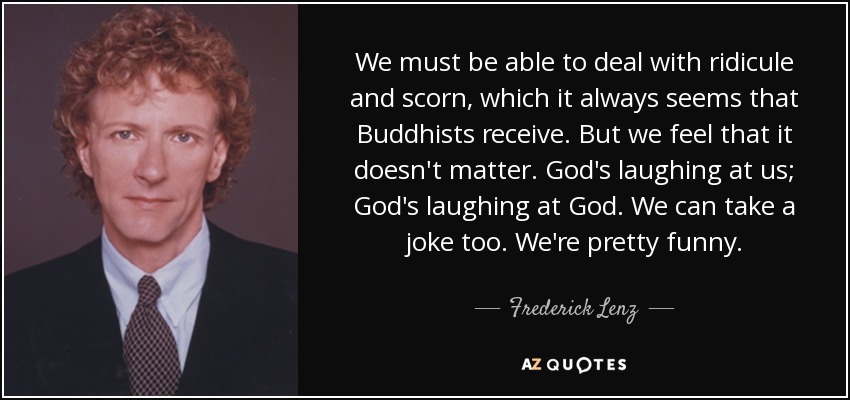



We must be able to deal with ridicule and scorn, which it always seems that Buddhists receive. But we feel that it doesn't matter. God's laughing at us; God's laughing at God. We can take a joke too. We're pretty funny.
You don't want to become so sensitive that you can't interact with people in the world. If you get to that point, you are not practicing psychic development. You are running away from the world, and you've made yourself weak.
Self-discover is not as someone would have us think, a heavy, awesome, moral process where everyone sits around and frowns. As you progress towards enlightenment, you become funny.
Enlightenment is not about being political. It is not a social club. Ashrams often turn into that, I know. Societies of enlightenment often just become cliques.
I think cosmopolitan spirituality is the best, where we go beyond "My teacher is better than yours" or "My meditation form is better than yours." It's not Ford versus Chevy. But it's rather the transition of our limited awareness into eternity.
Feel the underlying meaning of the teachings that are espoused by me or anyone else. The word's don't mean much. Words are supposed to be catalysts for higher states of attention. That is where the action is.
This is Zen, and in Zen, as we all know ... anything goes!
There is no letter of the law to follow in Zen. There is a lot of etiquette, but there are no rules.
Zen is discipline - the discipline of living life, the discipline of taking a breath, the discipline of not knowing and not trying to know.
Zen is about breaking out of your ideas and experiencing life and not ideas.
Nothing is any particular way. It's your state of mind that creates reality.
Zen is a very quick path. Zen is the path of meditation. The word Zen means emptiness or fullness, meditation. Meditation is the quickest path to enlightenment.
Zen was a reaction. Just as Buddha came into the world and spoke against the fall of Vedanta, so Buddhism lost its essence and became ritual. Zen was a reaction to that.
Zen was an attempt to get back to the purest teachings of the Buddha -enlightenment without strings.
In the old days, Zen was not really practiced so much in a monastery. The Zen Master usually lived up on a top of the mountain or the hill or in the forest or sometimes in the village.
He would usually study with a small group of students, men and women.
They would spend a lot of their time simply walking around in the woods or in the cities, or they would come over to his house and he would teach them with a great deal of humor and laughter about the nature of existence.
According to Zen Buddhist cosmology there are ten thousand different states of mind to view and understand life through.
Each of the ten thousand states of mind presents you with a different view of essence and experience.
Opportunities, creative ideas or the lack of them, happiness, frustration, brilliance, talent, success and failure - all are determined by the state of mind that you're in.
Most persons spend their lives stuck in relatively low states of mind. In these states of mind their views of themselves and the world around them are often severely limited.
Through the study of Zen you can learn to move from lower to higher states of mind at will. Higher states of mind offer you a much more accurate picture of reality.
In advanced Zen a person comes to realize that the existence of things and their ability to perceive them correctly is completely dependent upon their state of mind.
Zen is the study of mind in all of its manifestations. The purpose of Zen is to be happy.
There is a beautiful flow to the study of Zen. If it is not making you happier, then you are not practicing correctly.
Follow AzQuotes on Facebook, Twitter and Google+. Every day we present the best quotes! Improve yourself, find your inspiration, share with friends
or simply: