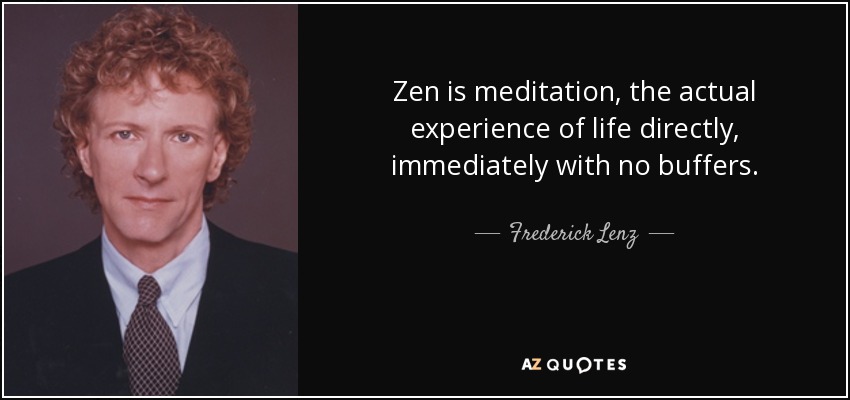


Zen is meditation, the actual experience of life directly, immediately with no buffers.
According to Zen philosophy each human being has two minds, a finite mind and an infinite mind.
In the study of Zen you can learn how to strengthen and clarify your finite mind. Your finite mind is like a muscle; when exercised it becomes stronger.
After this happens again and again, we reach a point were there is nothing but satori, which is what nirvikalpa samadhi is like.
In Zen the emphasis is on meditation and developing your body, mind and spirit to find inner peace, strength, clarity and enlightenment.
There are two primary ways of studying Zen. Either an individual will enter into a Zen monastery and study with a Zen master there, or they will study with a Zen master who lives in the contemporary world.
There is a sense of competition in Zen. You are competing with your thoughts and trying to overcome them.
Zen is a very quick path to enlightenment and development of the mind and all its facilities.
Zen is the fastest method I know of, aside from mysticism, of dissolving the fixations people have about spiritual practice and themselves.
With Zen we do it more through slight of hand, a very subtle and delicate shift in consciousness, which shifts the world. It's kind of done from the inside out.
Both Zen and mysticsm have this beautiful quality of happiness and laughter, which I think is so necessary in our modern age.
A person who undertakes the study of Zen and learns concentration and meditation is like a gymnast. You become a gymnast of the mind.
There are ten thousand aspects of your mind. Your awareness has ten thousand forms. There is something else. You have to step outside of perception itself.
From the highest state of mind you have a window whereby you could perhaps move beyond all states of mind, to enlightenment.
Zen is a very fast path to enlightenment, fast in comparison to some other paths, not fast for the person who practices it. There is no sense of speed.
Zen is the way of splitting the self again and again, untilt there is nothing left.
Zen doesn't believe in the reconciliation of opposites because from the point of view of Zen, there is no point of view.
People who practice Zen correctly are not spaced-out or unrealistic. They are balanced and grounded.
There are monasteries in Japan where they teach Zen with rules, more rules than you can imagine, and you might feel comfortable with that. I don't teach that type of Zen.
Bodhidharma who brought Zen from India to the Orient, taught a very pure Zen - in that it was pure Zen. He wanted to show that the way still existed and wanted to get back to its essence.
Now when I speak about Zen, I have a problem, in the sense that the Zen of today has lost the essence, in my estimation, of what I call "old Zen."
Zen has lost its zip, if you will, or its nothingness and has become ritualistic Its established in monastaries with strict codes of koan study.
Old Zen is the way of nothingness, the way of having a good time.
Old Zen was the reduction of concepts to absurdity.
Different schools of Zen have evolved, principally the Rinzai and Soto orders. A whole hierarchy has developed for the teaching and practice of Zen. Zen has become, to a certain degree, institutionalized.
Follow AzQuotes on Facebook, Twitter and Google+. Every day we present the best quotes! Improve yourself, find your inspiration, share with friends
or simply: