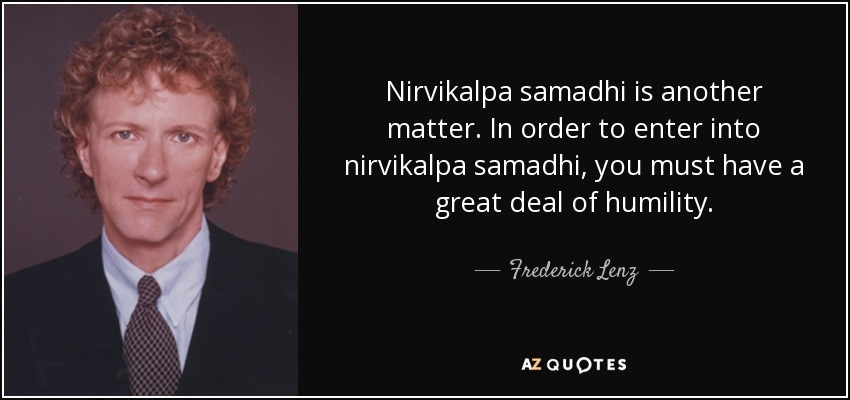


Nirvikalpa samadhi is another matter. In order to enter into nirvikalpa samadhi, you must have a great deal of humility.
When you eneter into samadhi and seek to make that magical walk between salvikalpa and nirvikalpa samadhi, it's necessary to focus your awareness not on being or nonbeing.
You must realize you are not the doer, that you are not the action.
Now that you've reached everything, you must slay this illusion without slaying it - without becoming caught up in the illusion of slaying illusions.
Nirvikalpa samadhi is a state of no mind, beyond the ten thousand states of mind, where there is nothing but perfection, where the self no longer exists...the ego dissolves into immortality.
Nirvikalpa Samadhi means you are sitting in meditation and you go beyond the planes of light to nirvana. Then you come back and here you are "back in the saddle again".
Sahaja samadhi means that you have just gone back and forth so many times that there is no back and forth. All you see is enlightenment in this world and the other side. There is no other side anymore. It means that you are wakeful.
To be fixated on Sahaja Samadhi is to be fixated. To be fixated on the idea of being not fixated is fixation too. All these ideas and definitions about enlightenment become silly.
The best meditation I ever had, I haven't had yet. It's in the future, which as anyone knows doesn't exist - anyone who meditates knows. But yet, I will have it someday.
The Buddha taught three cycles of teachings. His first cycle of teachings cover the basics, the prerequisites. This would include the Dharmapada.
His second cycle of teachings discusses the cosmology of the universes. But in his later years, he wrote the tantric texts.
The tantras can be very confusing for a person who is new to Buddhism, and for several thousand years the rule was not to expose a person or a new monk to the tantras until they had practiced for many, many years.
The tantras are ancient sacred books of India and Tibet. The tantras detail specific means for attaining liberation.
The Dali Lama and other notable Buddhist teachers have now indicated that since the world has plunged into a dark age, the information available in the tantras, which include the very, very powerful Kundalini release techniques, should be made available to the public.
Tantric Buddhism means that we become mature adults and we learn the reality of chaos theory.
The human mind and the entire life process is chaotic. Chaos is not something that lacks order; chaos has varieties of order within it.
Everything is subtle. Everything has a million sides. Everything is a manifestation of god. Everything is light. All beings are infinite. All things are perfect, in their own way.
Everything aids everything, because all things are a reflection of the Buddha mind, of the mind of Enlightenment.
In Tantric Buddhism we call the inherent knowledge that all animate and inanimate objects possess of themselves - their emptiness.
Our failure to see and access the pure joy and radiance of life is owning to a lack of awareness. In any situation there is beauty. Even at the moment of one's death there is beauty.
Tantra is the left-handing path, meaning it is the road less taken.
People who are capable of practicing tantra are individuals who have meditated for many, many years and developed very strong and powerful states of attention.
Some people go into tantra with the idea, sort of an intellectual approach, that now they can just do everything and stay high. That doesn't work at all.
Tantra is not sexual yoga. When the word tantra is used in the West, very often people immediately associate it with some kind of sexual yoga in which you use sex as a vehicle for enlightenment.
Sexuality, for the person who practices tantra, is a marvelous way to experience illusion. Illusion is just another way of seeing things. There are no illusions because there is no self.
Follow AzQuotes on Facebook, Twitter and Google+. Every day we present the best quotes! Improve yourself, find your inspiration, share with friends
or simply: