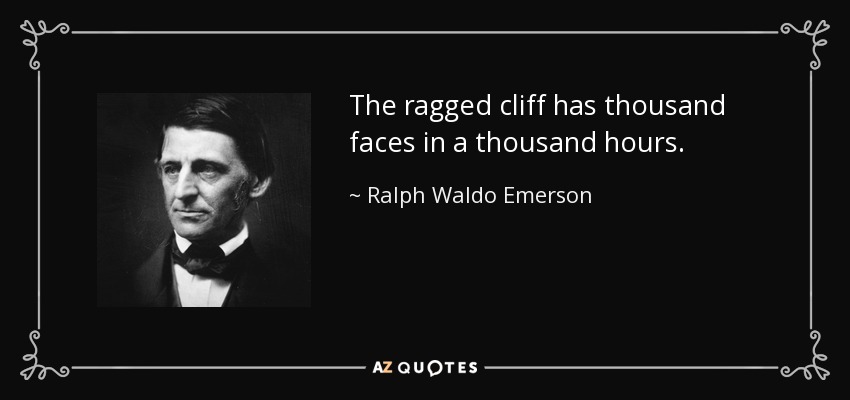
The ragged cliff has thousand faces in a thousand hours.
Nature ever faithful is To such as trust her faithfulness.
In every situation do the thing you fear. If you do the thing you fear, the death of fear is certain.
A beautiful soul always dwells in a beautiful world.
There comes a time in each man's education in which he comes to the conclusion that envy is ignorance, imitation is suicide, and society in in conspiracy against each one of its members.
We are not very much to blame for our bad marriages. We live amid hallucinations, and especial trap is laid to trip up our feet with, and all are tripped up first or last. But the mighty mother, who had been so sly with us, as if she felt she owed us some indemnity, insinuates into the Pandora box of marriage some deep and serious benefits, and some great joys.
We must have kings, we must have nobles; nature is always providing such in every society; only let us have the real instead of the titular. In every society some are born to rule, and some to advise. The chief is the chief all the world over, only not his cap and plume. It is only this dislike of the pretender which makes men sometimes unjust to the true and finished man.
Prudence is the virtue of the senses. It is the science of appearances. It is the outmost action of the inward life.
Spurious prudence, making the senses final, is the god of sots and cowards, and is the subject of all comedy. It is nature's joke, and therefore literature's. True prudence limits this sensualism by admitting the knowledge of an internal and real world.
Would we codify the laws that should reign in households, and whose daily transgression annoys and mortifies us, and degrades our household life, we must adorn every day with sacrifices. Good manners are made up of petty sacrifices.
Self-love is, in almost all men, such an over-weight that they are incredulous of a man's habitual preference of the general good to his own; but when they see it proved by sacrifices of ease, wealth, rank, and of life itself, there is no limit to their admiration.
No nation has produced anything like his equal. There is no quality in the human mind, there is no class of topics, there is no region of thought, in which he has not soared or descended, and none in which he has not said the commanding word.
What king has he not taught state, as Talma taught Napoleon? What maiden has not found him finer than her delicacy? What lover has he not outloved? What sage has he not outseen? What gentleman has he not instructed in the rudeness of his behavior?
The passages of Shakespeare that we most prize were never quoted until within this century.
Slavery is no scholar, no improver; it does not love the whistle of the railroad; it does not love the newspaper, the mailbag, a college, a book or a preacher who has the absurd whim of saying what he thinks; it does not increase the white population; it does not improve the soil; everything goes to decay.
I have just been conversing with one man, to whom no weight of adverse experience will make it for a moment appear impossible that thousands of human beings might exercise towards each other the grandest and simplest sentiments, as well as a knot of friends, or a pair of lovers.
Besides the general infusion of wit to heighten civility, the direct splendor of intellectual power is ever welcome in fine society, as the costliest addition to its rule and its credit.
Human society is made up of partialities. Each citizen has an interest and a view of his own, which, if followed out to the extreme, would leave no room for any other citizen.
Economy does not consist in saving the coal, but in using the time while it burns.
English history is aristocracy with the doors open. Who has courage and faculty, let him come in.
Milton says, that the lyric poet may drink wine and live generously, but the epic poet, he who shall sing of the gods, and their descent unto men, must drink water out of a wooden bowl. For poetry is not "Devil's wine," but God's wine.
To the birds and trees he talks: Caesar of his leafy Rome, There the poet is at home.
For this present, hard Is the fortune of the bard, Born out of time; All his accomplishment, From Nature's utmost treasure spent, Booteth not him.
A state of war or anarchy, in which law has little force, is so far valuable, that it puts every man on trial. The man of principle is known as such, and even in the fury of faction is respected.
In old Egypt, it was established law, that the vote of a prophet be reckoned equal to a hundred hands. I think it was much under-estimated.
Follow AzQuotes on Facebook, Twitter and Google+. Every day we present the best quotes! Improve yourself, find your inspiration, share with friends
or simply: