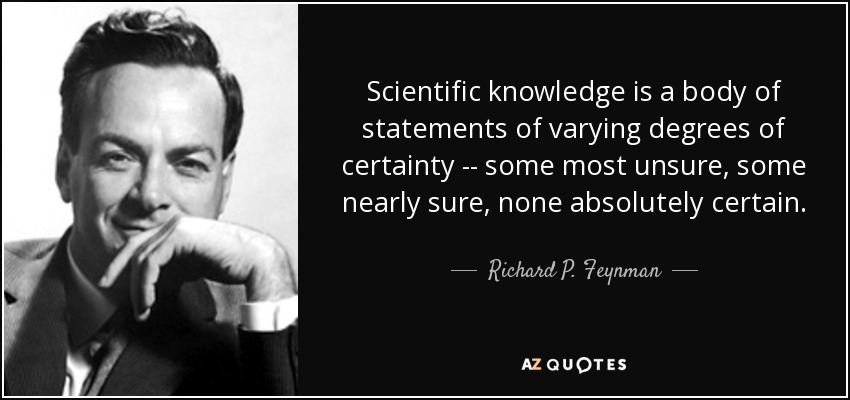

Scientific knowledge is a body of statements of varying degrees of certainty -- some most unsure, some nearly sure, none absolutely certain.
Looking back at the worst times, it always seems that they were times in which there were people who believed with absolute faith and absolute dogmatism in something. And they were so serious in this matter that they insisted that the rest of the world agree with them. And then they would do things that were directly inconsistent with their own beliefs in order to maintain that what they said was true.
I think it's much more interesting to live not knowing than to have answers which might be wrong. I have approximate answers, and possible beliefs, and different degrees of uncertainty about different things, but I am not absolutely sure of anything. There are many things I don't know anything about, such as whether it means anything to ask "Why are we here?" I might think about it a little bit, and if I can't figure it out then I go on to something else. But I don't have to know an answer. I don't feel frightened by not knowing things, by being lost in the mysterious universe without having any purpose - which is the way it really is, as far as I can tell.
The thing that doesn't fit is the thing that is most interesting.
If you thought that science was certain - well, that is just an error on your part.
The truth always turns out to be simpler than you thought.
Nobody ever figures out what life is all about, and it doesn't matter. Explore the world. Nearly everything is really interesting if you go into it deeply enough.
What is not surrounded by uncertainty cannot be the truth.
We have this terrible struggle to try to explain things to people who have no reason to want to know.
The "paradox" is only a conflict between reality and your feeling of what reality "ought to be."
Have no respect whatsoever for authority; forget who said it and instead look what he starts with, where he ends up, and ask yourself, "Is it reasonable?"
Progress in science comes when experiments contradict theory.
I, a universe of atoms, an atom in the universe.
To develop working ideas efficiently, I try to fail as fast as I can.
What I cannot create, I do not understand.
Science is the organized skepticism in the reliability of expert opinion
There is no learning without having to pose a question. And a question requires doubt.
I wonder why. I wonder why. I wonder why I wonder.
Teach principles not formulas.
You can know the name of a bird in all the languages of the world, but when you're finished, you'll know absolutely nothing whatever about the bird... So let's look at the bird and see what it's doing -- that's what counts.
It does not matter who you are, or how smart you are, or what title you have, or how many of you there are, and certainly not how many papers your side has published, if your prediction is wrong then your hypothesis is wrong. Period.
Nature uses only the longest threads to weave her patterns, so that each small piece of her fabric reveals the organization of the entire tapestry.
When things are going well, something will go wrong. / When things just can't get any worse, they will. / Anytime things appear to be going better, you have overlooked something.
Outside of their particular area of expertise scientists are just as dumb as the next person.
Another of the qualities of science is that it teaches the value of rational thought, as well as the importance of freedom of thought; the positive results that come from doubting that all the lessons are true... Learn from science that you must doubt the experts. As a matter of fact, I can also define science another way: Science is the belief in the ignorance of experts.
Follow AzQuotes on Facebook, Twitter and Google+. Every day we present the best quotes! Improve yourself, find your inspiration, share with friends
or simply: