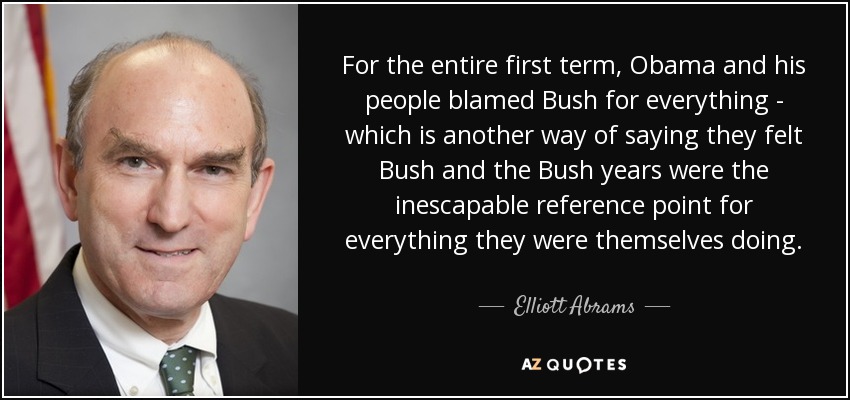


For the entire first term, Obama and his people blamed Bush for everything - which is another way of saying they felt Bush and the Bush years were the inescapable reference point for everything they were themselves doing.
Pessimism is rife in Israel.
The Obama administration rarely demonstrated the ability to shift gears and change policy in its first year. Even in the face of historic events such as the continuing demonstrations against Iran's regime, it stuck devotedly to prior plans.
Persecution of Christians is growing around the world, and Congress needs to pay more attention to it.
Iran exports about 2.2 million barrels a day.
The anchors of the Arab consensus have long been Egypt and Saudi Arabia, and both are now weakened forces in Arab politics and diplomacy.
Libya as a country is a relatively new concept. The period of Libya as a modern nation really starts after World War II.
Dubai must crack down on rampant smuggling, and the U.A.E. federal government has significantly stepped up pressure.
After 9/11, we did see Palestinian terrorism in the context of all terrorism.
On taking office in 2009, U.S. President Barack Obama put Israeli settlements at the center of U.S. policy in the Middle East.
In Iran, there is no freedom of the press, no freedom of speech, no independent judiciary, no free elections. There is no freedom of religion - not even for Shiites, who are forced by Irans theocracy to adhere to one narrow set of official rules.
The intersection of religion and world politics has often been a bloody crossroads.
Oil policy, policy toward the United States, policy toward Iran, Bahrain, Yemen, very unlikely, I think, to see significant change. These policies were the policies that had a wide family consensus. The question I think would be if the king becomes sick, whether you have weak Saudi leadership in the Arab world and the Middle East rather than strong Saudi leadership, but I think the fundamental policies will continue, the ones we’re familiar with under King Abdullah.
It’s unlikely to change – there’s nothing in King Salman’s past as governor of Riyadh for about forty years that suggests that he was particularly a reformer, not on the role of women, not on democratic development. There’s been a rumor in the last couple of days that he said to someone in an e-mail that he’s in favor of a constitutional monarchy, but I would be surprised if the level of repression started to go down … I think the kind of thing that we would view as significant reforms is unlikely.
When you work in the White House you talk to the White House staff all day, so you're talking to the guy who handles the congressional liaison and the guy who's handling domestic politics and the guy who's handling the American economy and so forth.
I grew up in Queens, in New York City, in a middle class Jewish family. My mother was a public school teacher, my father was a lawyer. They were Democrats - kind of middle-of-the-road democrats.
There are examples of fraternal dictatorships, or one, anyway: the passing of power from Fidel to Raul Castro.
Syria's population is 74% Sunni Muslim.
Two presidents pursued human rights policies that were serious and effective, Reagan and George W. Bush. They understood that American support for human rights activists is a moral imperative for us and also makes the world safer for us.
Those who cannot remember the past are condemned, it seems, to direct the Middle East policy of the Obama administration.
Israel's flexibility is dependent on its sense of security.
There are no Muslim ghettos in the U.S.
What does 'politicizing intelligence' mean? Using intel, or more often, partial intel, to produce an effect in line with White House policies rather than giving a full picture of a particular situation.
There is no way around the contradictions and dangers inherent in Israel's decision to free over 1,000 prisoners in order to liberate Gilad Shalit.
Moammar Gaddafi, who has called himself the 'Guide of the First of September Great Revolution of the Socialist People's Libyan Arab Jamahiriya,' should go down in history with the Emperor Bokassa and Idi Amin as a grotesque reminder of why people have the right to change their government.
Follow AzQuotes on Facebook, Twitter and Google+. Every day we present the best quotes! Improve yourself, find your inspiration, share with friends
or simply: