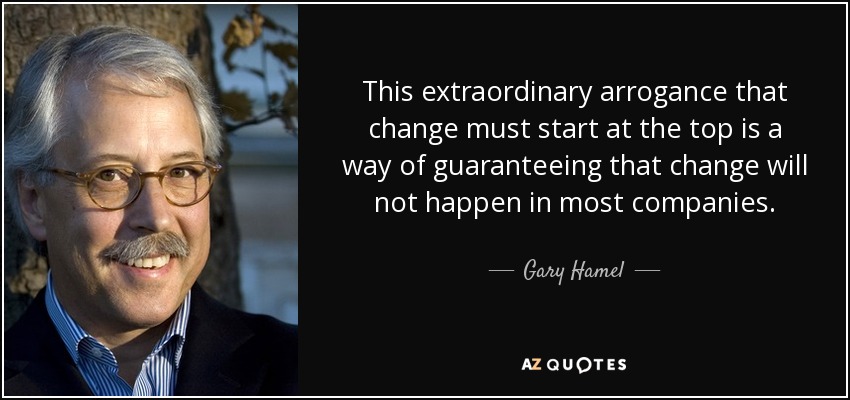





This extraordinary arrogance that change must start at the top is a way of guaranteeing that change will not happen in most companies.
Are we changing as fast as the world around us?
It doesn't matter much where your company sits in its industry ecosystem, nor how vertically or horizontally integrated it is - what matters is its relative 'share of customer value' in the final product or solution, and its cost of producing that value.
people are all there is to an organization
Like a child star whose fame fades as the years advance, many once-innovative companies become less so as they mature.
Strategy is, above all else, the search for above average returns.
As human beings, we are the genetic elite, the sentient, contemplating and innovating sum of countless genetic accidents and transcription errors.
What matters in the new economy is not return on investment, but return on imagination
Remarkable contributions are typically spawned by a passionate commitment to transcendent values such as beauty, truth, wisdom, justice, charity, fidelity, joy, courage and honor.
Most of us understand that innovation is enormously important. It's the only insurance against irrelevance. It's the only guarantee of long-term customer loyalty. It's the only strategy for out-performing a dismal economy.
We like to believe we can break strategy down to Five Forces or Seven Ss. But you can't. Strategy is extraordinarily emotional and demanding.
To be embraced, a change effort must be socially constructed in a process that gives everyone the right to set priorities, diagnose barriers, and generate options.
Our biggest challenge is how to create a self-renewing company.
Whatever you shoot is dead for a while before it starts to stink. The same goes for strategies. How many organizations carry this dead thing around with them, unaware of its irrelevancy until it is too late?
Any company that cannot imagine the future won't be around to enjoy it.
The real damper on employee engagement is the soggy, cold blanket of centralized authority. In most companies, power cascades downwards from the CEO. Not only are employees disenfranchised from most policy decisions, they lack even the power to rebel against egocentric and tyrannical supervisors.
When a politician bends the truth or a CEO breaks a promise, trust takes a beating.
Alan Kay's famous aphorism is that perspective is worth 80 IQ points. An innovative insight is not the product of an individual's brilliance. It's not as if innovators' heads are wired in different ways. Innovation typically comes from looking at the world through a slightly different lens.
An uplifting sense of purpose is more than an impetus for individual accomplishment, it is also a necessary insurance policy against expediency and impropriety.
In the age of revolution you have to be able to imagine revolutionary alternatives to the status quo. If you can't, you'll be relegated to the swollen ranks of keyboard-pounding automatons.
At the heart of every faith system is a bargain: on one side there is the comfort that comes from a narrative that suggests human life has cosmic significance, and on the other a duty to yield to moral commands that can, in the moment, seem rather inconvenient.
The problem is not one of prediction. It is one of imagination.
In most companies, the formal hierarchy is a matter of public record - it's easy to discover who's in charge of what. By contrast, natural leaders don't appear on any organization chart.
We live in a moment that is pregnant with possibility.
One way of building private foresight out of public data is looking where others aren't ... if you want to see the future, go to an industry confab and get the list of what was talked about. Then ask, "What did people never talk about?" That's where you're going to find opportunity.
Follow AzQuotes on Facebook, Twitter and Google+. Every day we present the best quotes! Improve yourself, find your inspiration, share with friends
or simply: