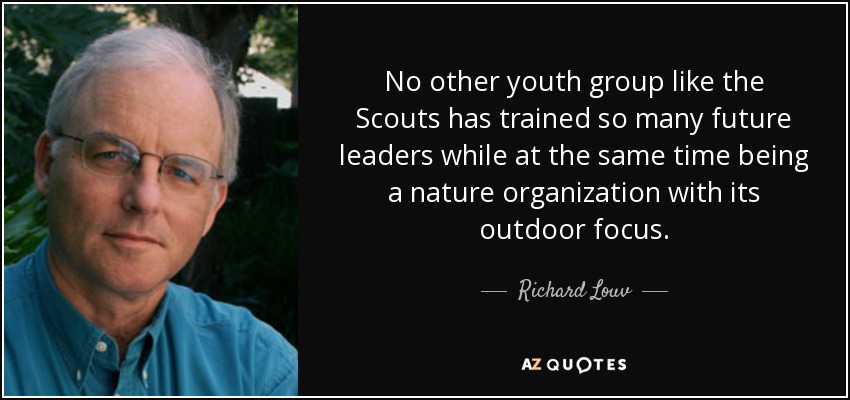


No other youth group like the Scouts has trained so many future leaders while at the same time being a nature organization with its outdoor focus.
In medieval times, if someone displayed the symptoms we now identify as boredom, that person was thought to be committing something called acedia, a 'dangerous form of spiritual alienation' -- a devaluing of the world and its creator.
It's easy to blame the nature-deficit disorder on the kids' or the parents' back, but they also need the help of urban planners, schools, libraries and other community agents to find nature that's accessible.
Quite simply, when we deny our children nature, we deny them beauty.
Progress does not have to be patented to be worthwhile. Progress can also be measured by our interactions with nature and its preservation. Can we teach children to look at a flower and see all the things it represents: beauty, the health of an ecosystem, and the potential for healing?
Each of us-adult or child-must earn nature's gift by knowing nature directly, however difficult it may be to glean that knowledge in an urban environment.
Unlike television, reading does not swallow the senses or dictate thought. Reading stimulates the ecology of the imagination. Can you remember the wonder you felt when first reading The Jungle Book or Tom Sawyer or Huckleberry Finn? Kipling’s world within a world; Twain’s slow river, the feel of freedom and sand on the secret island, and in the depths of the cave?
As a species, we are most animated when our days and nights on Earth are touched by the natural world. We can find immeasurable joy in the birth of a child, a great work of art, or falling in love.
Nature has been taken over by thugs who care absolutely nothing about it. We need to take nature back.
How can our kids really understand the moral complexities of being alive if they are not allowed to engage in those complexities outdoors?
Our kids are actually doing what we told them to do when they sit in front of that TV all day or in front of that computer game all day. The society is telling kids unconsciously that nature's in the past. It really doesn't count anymore, that the future is in electronics, and besides, the bogeyman is in the woods.
The pleasure of being alive is brought into sharper focus when you need to pay attention to staying alive.
We attempt to remember our collective American childhood, the way it was, but what we often remember is a combination of real past, pieces reshaped by bitterness and love, and, of course, the video past--the portrayals of family life on such television programs as "Leave it to Beaver" and "Father Knows Best" and all the rest.
Kids are absolutely starved for positive adult contact.
Here is the beginning of understanding: most parents are doing their best, and most children are doing their best, and they're doing pretty well, all things considered.
The real cultural war is between the culture of narcissism and what might be called the culture of renewal.
In every bio-region, one of the most urgent tasks is to rebuild the community of naturalists - so radically depleted in recent years, as young people have spent less time in nature, and higher education has placed less value on such disciplines as zoology……The times are right for the return of the amateur, twenty-first-century, citizen naturalist. To be a citizen naturalist is to take personal action, to both protect and participate in nature.
As the young spend less of their lives in natural surroundings, their senses narrow, physiologically and psychologically and this reduces the richness of human experience we need contact with nature.
Natural playgrounds may decrease bullying.
Increasingly the evidence suggests that people benefit so much from contact with nature that land conservation can now be viewed as a public health strategy.
Kids and adults pay a price for too much tech, and it's not wholesale.
A lot of people think they need to give up nature to become adults but that's not true. However, you have to be careful how you describe and define 'nature.
Something else was different when we were young: our parents were outdoors. I’m not saying they were joining health clubs and things of that sort, but they were out of the house, out on the porch, talking to neighbors. As far as physical fitness goes, today’s kids are the sorriest generation in the history of the United States. Their parents may be out jogging, but the kids just aren’t outside.
In a famous Middletown study of Muncie, Indiana, in 1924, mothers were asked to rank the qualities they most desire in their children. At the top of the list were conformity and strict obedience. More than fifty years later, when the Middletown survey was replicated, mothers placed autonomy and independence first. The healthiest parenting probably promotes a balance of these qualities in children.
I do not mean to imply that the good old days were perfect. But the institutions and structure--the web--of society needed reform,not demolition. To have cut the institutional and community strands without replacing them with new ones proved to be a form of abuse to one generation and to the next. For so many Americans, the tragedy was not in dreaming that life could be better; the tragedy was that the dreaming ended.
Follow AzQuotes on Facebook, Twitter and Google+. Every day we present the best quotes! Improve yourself, find your inspiration, share with friends
or simply: