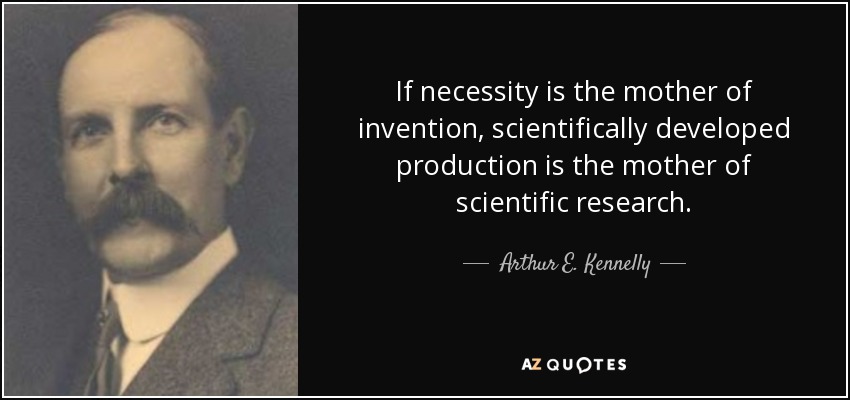
If necessity is the mother of invention, scientifically developed production is the mother of scientific research.
In the earliest ages science was poetry, as in the later poetry has become science.
It is a fraud of the Christian system to call the sciences human invention; it is only the application of them that is human.
It is not the business of science to inherit the earth, but to inherit the moral imagination; because without that, man and beliefs and science will perish together.
It is ... a sign of the times-though our brothers of physics and chemistry may smile to hear me say so-that biology is now a science in which theories can be devised: theories which lead to predictions and predictions which sometimes turn out to be correct. These facts confirm me in a belief I hold most passionately-that biology is the heir of all the sciences.
Only when he has published his ideas and findings has the scientist made his contribution, and only when he has thus made it part of the public domain of scholarship can he truly lay claim to it as his own. For his claim resides only in the recognition accorded by peers in the social system of science through reference to his work.
Positivism is a theory of knowledge according to which the only kind of sound knowledge available to human kind is that if science grounded in observation.
Reliable scientific knowledge is value free and has no moral or ethical value. Science tells us how the world is. ... Dangers and ethical issue arise only when science is applied as technology.
Science deals exclusively with things as they are in themselves; and art exclusively with things as they affect the human sense and human soul.
Science has but one fashion-to lose nothing once gained.
Science is feasible when the variables are few and can be enumerated; when their combinations are distinct and clear. We are tending toward the condition of science and aspiring to do it. The artist works out his own formulas; the interest of science lies in the art of making science.
Science is not addressed to poets.
Science repudiates philosophy. In other words, it has never cared to justify its truth or explain its meaning.
The ancients had a taste, let us say rather a passion, for the marvellous, which caused grouping together the lofty deeds of a great number of heroes, whose names they have not even deigned to preserve, and investing the single personage of Hercules with them. In our own time the public delight in blending fable with history. In every career of life, in the pursuit of science especially, they enjoy a pleasure in creating Herculeses.
The birth of science was the death of superstition.
The idea of a method that contains firm, unchanging, and absolutely binding principles for conducting the business of science meets considerable difficulty when confronted with the results of historical research. We find, then, that there is not a single rule, however plausible, and however firmly grounded in epistemology, that is not violated at some time or another.
The most remarkable discovery made by scientists is science itself. The discovery must be compared in importance with the invention of cave-painting and of writing. Like these earlier human creations, science is an attempt to control our surroundings by entering into them and understanding them from inside. And like them, science has surely made a critical step in human development which cannot be reversed. We cannot conceive a future society without science.
Tobacco has not yet been fully tried before the bar of science. But the tribunal has been prepared and the gathering of evidence has begun and when the final verdict is rendered, it will appear that tobacco is evil and only evil; that as a drug it is far more deadly than alcohol, killing in a dose a thousand times smaller, and that it does not possess a single one of the quasi merits of alcohol.
Toil of science swells the wealth of art.
We men who serve science serve only a reflection in a mirror.
Well-observed facts, though brought to light by passing theories, will never die; they are the material on which alone the house of science will at last be built.
When science advances religion goes along with it; science builds the altar at which religion prays.
You have ... been told that science grows like an organism. You have been told that, if we today see further than our predecessors, it is only because we stand on their shoulders. But this [Nobel Prize Presentation] is an occasion on which I should prefer to remember, not the giants upon whose shoulders we stood, but the friends with whom we stood arm in arm ... colleagues in so much of my work.
My mind's sunk so low, Claudia, because of you, wrecked itself on your account so bad already, that I couldn't like you if you were the best of women, -or stop loving you, no matter what you do.
Belief is with them mechanical, voluntary: they believe what they are paid for - they swear to that which turns to account. Do you suppose, that after years spent in this manner, they have any feeling left answering to the difference between truth and falsehood?
Follow AzQuotes on Facebook, Twitter and Google+. Every day we present the best quotes! Improve yourself, find your inspiration, share with friends
or simply: