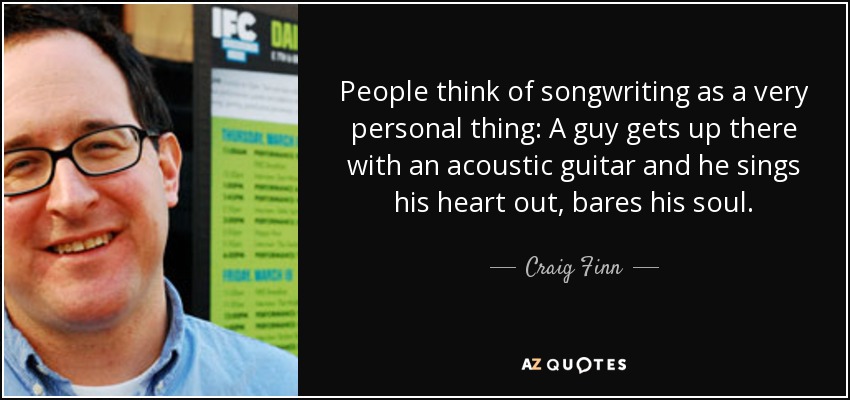
People think of songwriting as a very personal thing: A guy gets up there with an acoustic guitar and he sings his heart out, bares his soul.
To me, there's never been a difference between electronic and acoustic. I've always had this idea that electricity is another element like wind or fire or water.
Saying that you've got acoustic instruments and that's traditional and so people will think it's more intimate, that will always be the case. It's a more intimate sound, so it's going to sound more direct whatever you're singing about.
After tea, we discussed a variety of topics before the fire; and Mrs. Micawber was good enough to sing us (in a small, thin, flat voice, which I remembered to have considered, when I first knew her, the very table-beer of acoustics) the favourite ballads of "The Dashing White Sergeant", and "Little Tafflin".
I was being musically mentored by a lot of people who were obviously more talented and skilled than I was, and I thought that I would just kind of learn the ropes of songwriting there - like how to do acoustic, country-esque songs, which I like because there's so much story in them.
I practice on the acoustic guitar a little bit, but I think I have reached the peak of my talent.
I tried playing electric for awhile and it just didn't work out. My reflexes are centered on the six string acoustic. I just played the electric too hard and it sounded awful, so I gave it up.
I have always wanted to do an acoustic record from the very beginning of my career. I was a coffeeshop artist where everything I did was acoustic.
That's one of our biggest challenges is finding out how to do that. There are times when you have to scale back. You might be performing on a five-by-five stage in front of 12 people. That's an exaggeration but there are times when you have to turn the corner and do an acoustic set.
If you were a performer that only had an acoustic instrument, back in the day you couldn't hide behind your guitar pedals or the production or the vibe. There was performance and then there was the song, and that was all that you had.
I don't touch electric guitars. It's just not my thing - I stick with acoustic guitars only.
I'm gonna design my own fleet of trailers. No! I'm gonna record an album like Jennifer Lopez. It'll be an acoustic version of K.C. and the Sunshine Band. Then maybe I'll design a line of clothes like Puff Daddy, but all in synthetic fur.
The hole on the face of an acoustic guitar is called the sound hole. The one of the face of its player is called the sincerity hole.
Well, Smoke n' Mirrors has very much a world music flavor and it doesn't park itself in one country. It borrows heavily from the Brazilian angle, which is dear to my heart, and I recorded several albums with that flavor. Probably even more so than the Brazilian flavor, there's an African, South African and West African influence and on a couple of other tracks there's some Latin flavor and there's some Indian tables on one track, all centered around my jazz guitar and acoustic guitars, and very much a Lee Ritenour sound.
Well, I have been playing electric guitar all these years and acoustic was something new to me.
I went to high school right outside Dallas, and (songwriter and performer) Michael Martin Murphey was a senior there when I was a sophomore or junior, really into folk and acoustic music. Larry Gross, who's the host of "Mountain Stage" on public radio, and B.W. Stevenson, also a musician, were there at the same time, too. Michael was a big inspiration -- through him I discovered Woody Guthrie, Dylan, Jimmy Rogers. Then I ran into Jerry Jeff Walker there in Dallas back when he was just a folk singer. Those are my earliest influences.
You just make different music on a computer. And you can make wonderful music on a computer, but don't pretend that the machinery is transparent. It makes as much difference to what you're doing as it does if you play an acoustic guitar as opposed to a kettledrum. You're not going to make the same music.
My guitar playing is a synthesis of traditional American acoustic style and Urban Pop and RB.
With a live performance, you feel nervous because there's a sense it could do well or badly based on how well you are performing, whereas the only variable with a film premiere is technical, which invariably you have very little control over, whether the sound is good, whether the acoustics of the room are good.
Geography is crucial for my work. I went to Antarctica and took a studio to several of the main ice fields to make field recordings of ice to create a symphony - acoustic portraits of ice.
I grew up in the suburbs and was raised on rap radio, so it took me a long time to stumble upon the acoustic guitar as a resource for anything.
I always lived with guitarists. When they would leave, I would just pick up their acoustic guitars and start doing finger picking and write.
I've sung since I talked, when I'm two, but what I sang was ballads, because it's very hard to do a dance track with your little acoustic guitar when you're a kid.
Sting I've seen a few times, and he really inspired me in the sense that he breaks the songs down a lot and will take a different approach. He'll take an acoustic approach to them; he'll rearrange them for the live stage.
In the early 60s, folk music seemed to be very popular. In the early 70s, people like James Taylor, John Denver, Jim Croce and Cat Stevens brought back the interest in acoustic music. Today, we don't hear anything.
Follow AzQuotes on Facebook, Twitter and Google+. Every day we present the best quotes! Improve yourself, find your inspiration, share with friends
or simply: