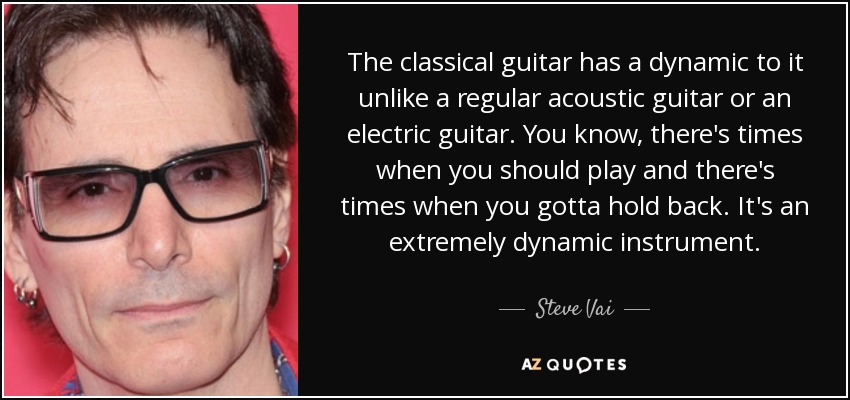
The classical guitar has a dynamic to it unlike a regular acoustic guitar or an electric guitar. You know, there's times when you should play and there's times when you gotta hold back. It's an extremely dynamic instrument.
Believe me, I know all about bottle acoustics. I spent much of the sixth century in an old sesame oil jar, corked with wax, bobbing about in the Red Sea. No one heard my hollers. In the end an old fisherman set me free, by which time I was desperate enough to grant him several wishes. I erupted out in the form of a smoking giant, did a few lightning bolts, and bent to ask him his desire. Poor old boy had dropped dead of a heart attack. There should be a moral there, but for the life of me I can't see one.
I told myself: 'I am surrounded by unknown things.' I imagined man without ears, suspecting the existence of sound as we suspect so many hidden mysteries, man noting acoustic phenomena whose nature and provenance he cannot determine. And I grew afraid of everything around me – afraid of the air, afraid of the night. From the moment we can know almost nothing, and from the moment that everything is limitless, what remains? Does emptiness actually not exist? What does exist in this apparent emptiness?
If you play "I Don't Want To Know" by Fleetwood Mac loud enough -- you can hear Lindsey Buckingham's fingers sliding down the strings of his acoustic guitar. ...And we were convinced that this was the definitive illustration of what we both loved about music; we loved hearing the INSIDE of a song.
I grew up in the suburbs and was raised on rap radio, so it took me a long time to stumble upon the acoustic guitar as a resource for anything.
I've sung since I talked, when I'm two, but what I sang was ballads, because it's very hard to do a dance track with your little acoustic guitar when you're a kid.
My guitar playing is a synthesis of traditional American acoustic style and Urban Pop and RB.
There is nothing like having your hands on a keyboard. Or an acoustic piano. Those are the things you can't really replace.
Geography is crucial for my work. I went to Antarctica and took a studio to several of the main ice fields to make field recordings of ice to create a symphony - acoustic portraits of ice.
You just make different music on a computer. And you can make wonderful music on a computer, but don't pretend that the machinery is transparent. It makes as much difference to what you're doing as it does if you play an acoustic guitar as opposed to a kettledrum. You're not going to make the same music.
Bruce Marshall's acoustic set gets a big thumbs up from me.
I always lived with guitarists. When they would leave, I would just pick up their acoustic guitars and start doing finger picking and write.
I don't touch electric guitars. It's just not my thing - I stick with acoustic guitars only.
Although the noise of the chattering clientele is much more significant than the topics of their chatter, it does finally constitute that type of social and indistinct expression that we refer to as rhubarb. The very particular volume in which people tell each other their news seems to generate all by itself that acoustic chiaroscuro, a sounding murk, in which every communication seems to lose its edges, truth projects the shadow of a lie, and a statement seems to resemble its opposite.
There' something about universal truths with the simplicity of the acoustic guitar. You can take it anywhere and it helps me reach listeners of all ages and walks of life.
I actually bought a travel guitar, and that guitar is really cool. You can actually fold the guitar, and you can plug headphones into it, but it's acoustic, or semi-acoustic.
Neighbors are far better acoustic analyzers for determining the quality of their life versus any acoustic instrument left unattended by an expert.
One thing I really hate about people who play both acoustic and electric is if they try to play electric style on an acoustic guitar. You must develop it as a totally different thing.
Until writing was invented, man lived in acoustic space: boundless, directionless, horizonless, in the dark of the mind, in the world of emotion.
Sting I've seen a few times, and he really inspired me in the sense that he breaks the songs down a lot and will take a different approach. He'll take an acoustic approach to them; he'll rearrange them for the live stage.
In Hamburg, there are three major orchestras, an opera house, and one of the great concert-hall acoustics in Europe at the Laeiszhalle, in a town a fifth the size of London. And that's not unusual. In Germany, there are dozens of towns with two or three orchestras. The connection with music goes very, very deep.
I started playing bluegrass with my family, so there were the G, C and D chords. I was playing a Martin acoustic because that's what Carter Stanley of the Stanley Brothers played. Then I got into the really raw blues of Hound Dog Taylor and started on electric guitar.
As much as I love acoustic Neil Young - and I do deeply - I may be more passionate about the electric. Luckily it's not a contest, and we never have to make that choice. But Neil Young on an electric guitar - I feel like I've never seen or heard anything like it.
I did a smaller gig with an acoustic guitar and a drum machine. In one song, something wrong happened with the drum machine. I tried to cover up the mistake by playing faster and improvising a new song but it became crazy, and I had to admit it was all a mess.
Skiffle was blues featuring a washboard and acoustic instruments. It encompassed blues, with elements of folk, jazz, and, at times, American country-and-western music.
Follow AzQuotes on Facebook, Twitter and Google+. Every day we present the best quotes! Improve yourself, find your inspiration, share with friends
or simply: