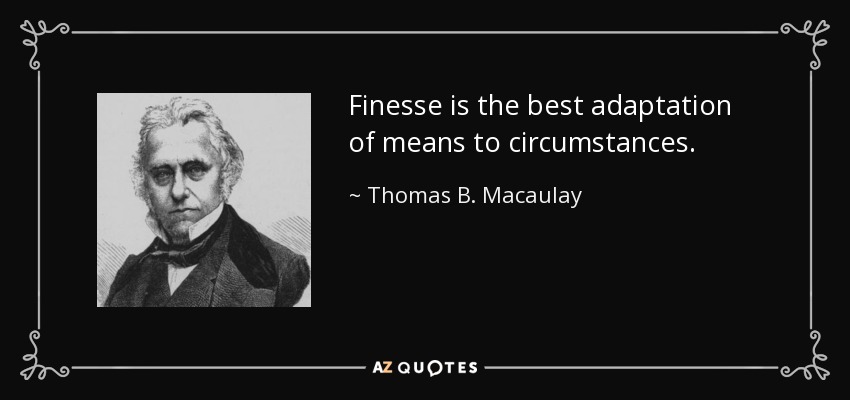
Finesse is the best adaptation of means to circumstances.
Imitation both unconscious and conscious is par excellence the educational method of the family. It is plain that a considerable part of the adaptation of living beings to their environment, i.e., of beings that are born plastic, is passed on from generation to generation through imitation. Were this not so, much if not all of the road traversed by one generation would have to be travelled by the next generation from the very beginning and without short-cuts. Consequently there would be little chance for the novel adaptation, the propitious individual variation, that constitutes progress.
When Western civilization invaded the Near and Far East and what is now called the Third World it imposed its own ideas of a proper environment and a rewarding life. Doing this, it disrupted the delicate patterns of adaptation and created problems that had not existed before.
Amid ancient lore the Word of God stands unique and pre-eminent. Wonderful in its construction, admirable in its adaptation, it contains truths that a child may comprehend, and mysteries into which angels desire to look.
There is change by necessity or adaptation, and there is contrived change or novelty.
What we have seen in the way of adaptation and adjustment seems to indicate that families are adjusting parenting to the world ofwork, rather than the labor markets and industries responding to the parenting and family needs of their employees.
The Pavlovian view of women voters - plug the words in, and they will respond - sends a chill down my spine because it sounds like an adaptation of something I have written about communication between the sexes: When a woman tells a man about a problem, she doesn't want him to fix it; she just wants him to listen and let her know he understands. But there's a difference between a private conversation and a presidential election, between what we want from our leaders.
Architecture ... the adaptation of form to resist force.
Upon the publication of Goethe's epic drama, the Faustian legend had reached an almost unapproachable zenith. Although many failed to appreciate, or indeed, to understand this magnum opus in its entirety, from this point onward his drama was the rule by which all other Faust adaptations were measured. Goethe had eclipsed the earlier legends and became the undisputed authority on the subject of Faust in the eyes of the new Romantic generation. To deviate from his path would be nothing short of blasphemy.
Based on technological research and the transformation of nature, industrialization constantly goes forward, giving proof of incessant creativity. While certain enterprises develop and are concentrated, others die or change their location. Thus new social problems are created: professional or regional unemployment, redeployment and mobility of persons, permanent adaptation of workers and disparity of conditions in the different branches of industry.
A good adaptation of your book is worth it because it is such a wonderful experience to see your world translated onto the screen.
I actually enjoy working with green screen, because I can imagine all that stuff happening, and I really cut my teeth on a movie I made called "Adaptation" where I had to imagine four-page dialogue scenes with my twin brother, who was nothing more than a tennis ball and a gas stand.
So getting that balance between what is honoring scripture and the Word and also acknowledging the fact that by the virtue of putting it on film there's going to be a variation and adaptation, I mean, it's a fine dance and a balance. Our producers and directors have worked so hard to get that right and I'm really proud. I think it's a pretty good job.
I felt I should also contrast Visconti's treatment of the novella - usually damned by Mann fans (who typically respect Britten's more "faithful" adaptation). The Visconti film does many quite wonderful things, although there are good reasons for the condemnation.
My ethical naturalism sees us as facing the predicament of being social animals without evolved adaptations that make social life easy. The fundamental problem that sparks the ethical project lies in our limited responsiveness to one another. The only way we have to address that problem is through a representative, informed, and engaged conversation.
We are equal human beings, and we were born with evil and anger and misunderstanding of what a man is, and so we are as needy and wanting to be part of him, as he, obviously, was needing and wanting to be part of us. And that's why I've really taken the freedom, because it's an adaptation, to give her a voice.
There is a whole field of inquiry that has come up in the last 30 or 40 years - some call it sociobiology or evolutionary psychology - relating to where we get our moral sense and why we value the idea of altruism, and locating both answers in behavioral adaptations for the preservation of our genes.
As an example, there is a Japanese composer / singer whose name is Tanimura [Shinji]: he has composed a song entitled entitled "Kazeno Komoriuta" and I have recorded my piano adaptation of this song and honestly I couldn't expect that it would be so difficult and challenging for me to perform my piano version of this beautiful song.
I'm very pessimistic about adaptations from one medium to another. I've got a very kind of primitive, Puritan view of it. I tend to think that if something was derived for one medium, then there's no real immediate reason to think that it's necessarily going to be as good or better if adapted into another one. There have been very good stage plays that have made some very good films. But there are not so many differences between the theater and the cinema as there are between the cinema and, say, reading a book or reading a comic.
I know I'm a grumpy old man, but I'm always more delighted by readers talking about the actual comics than people talking about how eager they are to have their favorite comics be "elevated" into another medium. Adaptations are great, but for me, comics have always been the destination, not a stepping-stone to get somewhere else.
Dirk Gently has been a long passion (my career started with Douglas Adams and my stage adaptation of Dirk Gently) .
When I decided to make my version of Poe's stories, I wanted to respect the original material or to at least get closer to what his stories are really about. Most other adaptations I've seen sort of follow the story but they never satisfy me as an audience member or as a reader.
To me, the ultimate crime in an adaptation is the crime of reverence. A novel is one form of media, a screenplay is another, and a movie is yet another. There's even reverence to a screenplay.
Slow adaptation is driven by forces such as evolution. Fast adaptation is driven by forces such as insight.
I'm from Toronto. It's a lot more laid back. When you are thrust into different environments, there is an odd adaptation period. And then there are times when unfair, unkind, untrue things are written about you. That bothers me less now.
Follow AzQuotes on Facebook, Twitter and Google+. Every day we present the best quotes! Improve yourself, find your inspiration, share with friends
or simply: