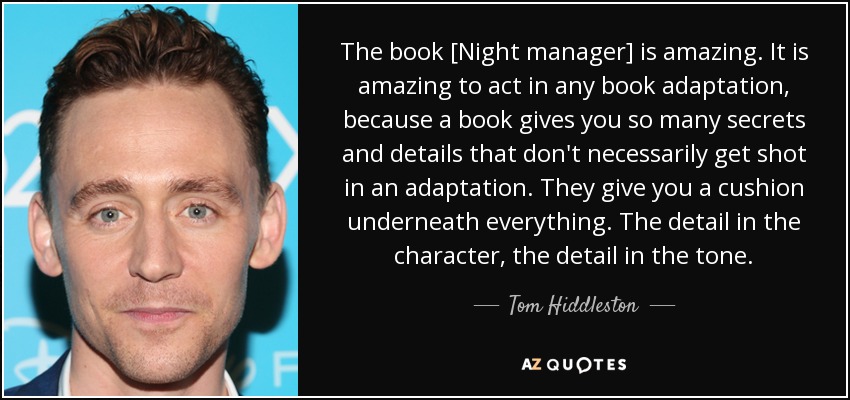
The book [Night manager] is amazing. It is amazing to act in any book adaptation, because a book gives you so many secrets and details that don't necessarily get shot in an adaptation. They give you a cushion underneath everything. The detail in the character, the detail in the tone.
'How do you balance the creative with the biblical?' One could pick up the scripture and read it to oneself and you would be communing directly with that information. As soon as you go into film, as soon as there's a camera, and there's an angle, and there's lighting, and there's editing, you're into the adaptation.
I think now that I've tried directing, I'm not interested in doing adaptations anymore. I could do an adaptation of someone else's work that I would write, but the idea of taking someone else's material entirely doesn't interest me. One of the things that I found really helpful, at least in my mind - and I've never discussed this with the actors or with the people I work with - is that being a neophyte in directing, I feel like I have a kind of authority simply because I'm the writer as well.
I adore doing classic adaptations, but I also feel their frustrations and their limitations.
An adaptation I was working on of Trollope's 'The Pallisers' has been axed by the BBC... I was also going to do Dickens' 'Dombey and Son' but they've asked me to do 'David Copperfield' instead.
One of the things I've always thought is a drag in so many period adaptations is that they are always buttoned up to the neck in so many clothes all the time. I'm always looking for excuses to get them out of their clothes.
I had to learn to think, feel, and see in a totally new fashion, in an uneducated way, in my own way, which is the hardest thing in the world. I had to throw myself into the current, knowing that I would probably sink. The great majority of artists are throwing themselves in with life preservers around their necks, and more often than not it is the life preserver, which sinks them. Nobody can drown in the ocean of reality who voluntarily gives herself up to the experience. Whatever there be of progress in life comes not through adaptation but through daring, through obeying the blind urge.
Wherever the Net arises, there arises also a rebel to resist human control...A network nurtures small failures in order that large failures don't happen as often. It is...fertile ground for learning, adaptation, and evolution...The only organization capable of unprejudiced growth, or unguided learning, is a network. All other topologies limit what can happen.
I've made movies that were adaptations and I've been kind of frustrated by the process because, you know that old axiom, 'It's never as good as the book'? It's often true because nothing competes with your own imagination. When you're reading a book and you imagine something in your head, nothing's going to compete with that.
I'm from Toronto. It's a lot more laid back. When you are thrust into different environments, there is an odd adaptation period. And then there are times when unfair, unkind, untrue things are written about you. That bothers me less now.
I'm very keen. Adaptations of other people's work, too. I got fascinated by the adaptation process, so I think that'd be a really interesting task. I would happily write original screenplays as well. I think it's become one of my favorite genres.
At the time, The Hotel New Hampshire was John Irving's favorite adaptation of his work, which meant a lot to all of us who worked on that movie.It's amazing to me that that was a studio movie. That was a summer studio release! If that doesn't tell you how much the business has changed, nothing will.
There is much appeal for me in Eastern religion, the little I know of it. And something thorny in me finds American adaptations of Buddhism terribly self-indulgent, silly, gooey in the way the English call "wet."
Skateboarding has always been and continues to be creative and rebellious. Art and design are an extremely important part of skateboard culture, even if it's not recognized by the more elitist or pretentious members of the art world. Skateboarding itself requires creative adaptation to the streets and obstacles. My background as a skateboarder helped me to be a better street artist because I was already conditioned to look at the terrain opportunistically.
I think any musical has so many moving parts and the challenge is unifying all the moving parts in particular because you have the camera and now it's all about adaptation and what works in one medium doesn't necessarily work in another so the challenge is to stay as true as you can to the material and yet not be afraid to step out of it and add elements to make it satisfying cinematically.
Darwinian evolution is slow and gradual, step by step. Such an evolution can explain micro-evolution but not macro-evolution. For example, how did the eye evolve? The idea behind Darwinism is that organisms adapt, and that nature selects only those genetic changes which are the mutations that serve a good purpose for adaptation. So taken this way, the eye cannot develop gradually because one-thousandth or one-millionth of an eye would be of no value for survival. So generally this question rules out Darwinism as an adequate theory for macro-evolution.
Shane Salerno and I adapted my book Savages together, and I learned a lot about adaptation. I think it's an extremely difficult thing to do; adaptation might even be more difficult than writing an original screenplay. It's so much a matter of choices, making choices of what to leave in. It was an education.
If you're playing someone who has lived, there's the risk of imitation, or whether you focus on the essence of who that character was as opposed to physical mannerisms. So, you have to figure out what it is ultimately that this particular adaptation of the story, whether it's fiction or not, is trying to say.
Everybody says video-game adaptations are all the same, but I disagree. Normally, video-game adaptations are like Alone In The Dark, Resident Evil, Alien Vs. Predator - sci-fi creature stuff. But I think I've covered] a wide range of genres and time periods, like Transylvania in 1700 and now a Western with BlodRayne II, or adventure with Dungeon Siege, or comedy and satire with Postal.
I've had stuff of mine adapted by other people, so I've come to the conclusion that a movie is a different form from a novel and there is no such thing as a true adaptation. You have to adapt to this other thing and do it right. But that voice of the original should somehow still be there, and the original intent should still be there. So if the original writer saw the movie, the writer would say, "Well, that's not what I wrote, but that's what I meant." And if you can do that, I think you've done your job as a screenwriter.
I think where the criticism of videogames come from is where videogames are just Xeroxes of films, and when you get a film adaptation of that game, you've just Xeroxed something twice. I think that's where a lot of the criticism comes from - there are ultra-violent games that are already based on a million films. But there's definitely beauty and art and design in games. I don't think anybody could deny that.
You usually get a script and you tell people what the story's about, and they have no idea what's going on. Whereas with an adaptation, you come into it, and it seems like everyone you talk to has a million opinions on the cast and the way the story should be told.
Scientists had said, "If you keep burning coal and gas and oil, you will melt the Arctic." And then the Arctic melted just as they had predicted. Did Shell Oil look at the melt and say, "Huh, maybe we should go into the solar-panel business instead?" No, Shell Oil looked at that and said, "Oh, well, now that it's melted it will be easier to drill for more oil up there." That's enough to make you doubt about the big brain being a good adaptation.
Darwin's principle of natural selection leads to the prediction that the proper way to analyze any evolutionary development is to see the new features as adaptive to environments. And that's a perfectly good principle. The problem is that there are many evolutionary biologists who view everything that happens in evolution as directly evolved for adaptive benefit. And that just doesn't work. Whenever you build a structure for adaptive reasons, the structure is going to exhibit properties that have nothing to do with adaptation. They're just side consequences.
Our adaptation to the natural forces is a question of existence or non-existence. We cannot transform the universe or nature so that they adapt themselves to us; on the contrary, we must adapt ourselves to nature and her laws.
Follow AzQuotes on Facebook, Twitter and Google+. Every day we present the best quotes! Improve yourself, find your inspiration, share with friends
or simply: