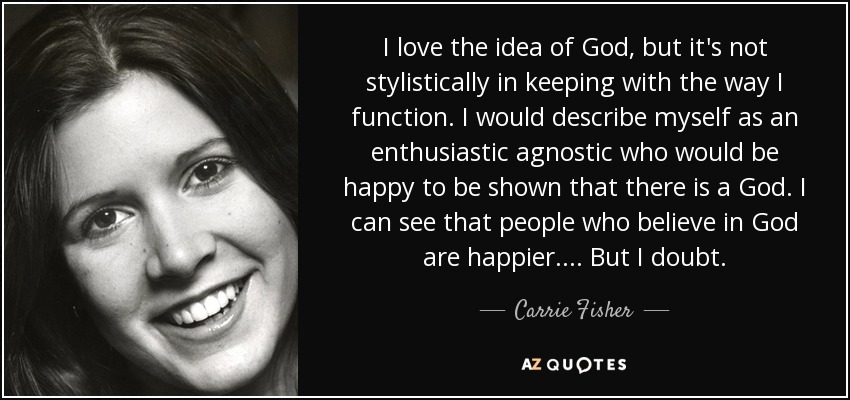
I love the idea of God, but it's not stylistically in keeping with the way I function. I would describe myself as an enthusiastic agnostic who would be happy to be shown that there is a God. I can see that people who believe in God are happier. ... But I doubt.
I grew up in an agnostic broad-minded family.
My challenge is to make sure the things I say and the things I do remain consistent for as often and as long as possible. My why is to inspire people to do the things that inspire them so that together we can change our world. That's why I wake up every single day. I'm agnostic to the form it takes: I teach, I write, I speak, I advise.
If I had to label myself now, I'd call myself a Taoist-Christian-agnostic quantum mechanic.
I was raised Jewish by atheistic-agnostic parents. During this journey, I had people from all walks and all faiths try to help. A Jewish priest who I was friends with wanted to lay hands on me - I didn't ask questions about how - I just said when and where and how often do you want to do it? I didn't argue.
Being a pastor for 20 years I realized that the labels, agnostic, atheist, believer, everybody's human and everybody wants to know what kind of universe we're living in, and everybody's living according to a story.
I don't see any sign of God in this world, in the place where we live and things we know. It can all be explained to my mind perfectly satisfactorily without God. But in the great darkness beyond this little spark of light where I live, of course there may be all kinds of things. There may be a god. So I'm really an agnostic.
The fundamentalist believer is mostly a weird intellectual who often lacks real faith altogether. As a self-appointed attorney for God, who is in no need of attorneys, he very easily turns out to be more godless than the agnostic and the unbeliever. At all events, he seems deaf to poetry.
I definitely have a spiritual outlook. I don't usually read self-help books, but I read a great book by a guy called Wayne Dyer, 'The Power of Intention,' which I loved. I'm not a religious guy, in fact I'm probably agnostic but I thought what this writer had to say was really powerful.
The real heretic is not the atheist or agnostic (who are often decent people) but those who murmur "it doesn't matter what you believe, as long as it makes you feel good." This turns religion into a subjective matter, like taste in furnishings, and robs theology of its claim to ultimate truth.
The list of things about which we strictly have to be agnostic doesn't stop at tooth fairies and celestial teapots. It is infinite. If you want to believe in a particular one of them - teapots, unicorns, or tooth fairies, Thor or Yahweh - the onus is on you to say why you believe in it. The onus is not on the rest of us to say why we do not. We who are atheists are also a-fairyists, a-teapotists, and a-unicornists, but we don't have to bother saying so.
I would not say I am looking for God. Or, I am not looking for God precisely. I am not seeking the God I learned about as a Catholic child, as an 18-year-old novice in a religious community, as an agnostic graduate student, as - but who cares about my disguises? Or God's.
I have resigned from the professional undertaking of coin flipping. I am not here to tell you where gold's going to be. I have no idea. That's my existentialism. I am a student of uncertainty, I have no idea where the stock market is going to be. So when I am creating trades in my portfolio for my clients, I am agnostic. I just want to enhance the probability that I make money come what may.
Prison is a severe and terrible punishment; but for me, thanks to Arthur Balfour, this was not so. I was much cheered on my arrival by the warder at the gate, who had to take particulars about me. He asked my religion, and I replied 'agnostic.' He asked how to spell it, and remarked with a sigh: 'Well, there are many religions, but I suppose they all worship the same God.' This remark kept me cheerful for about a week.
In my most extreme fluctuations I have never been an atheist in the sense of denying the existence of a God ... I think that generally (& more and more so as I grow older) but not always, that an agnostic would be the most correct description of my state of mind.
Any one who thinks is an agnostic about something, otherwise he must believe that he is possessed of all knowledge. And the proper place for such a person is in the madhouse or the home for the feeble-minded.
I am 95% a theist and 5% an atheist; thus ultimately I am an agnostic.
As my colleague, the physical chemist Peter Atkins, puts it, we must be equally agnostic about the theory that there is a teapot in orbrit around the planet Pluto. We can't disprove it. But that doesn't mean the theory that there is a teapot is on level terms with the theory that there isn't.
I am an agnostic on most matters of faith, but on the subjects of maps I have always been a true believer. It is on the map, therefore it is, and I am.
In matters of the intellect, do not pretend that conclusions are certain which are not demonstrated or demonstrable. That I take to be the agnostic faith, which if a man keep whole and undefiled, he shall not be ashamed to look the universe in the face, whatever the future may have in store for him.
At times one remains faithful to a cause only because its opponents do not cease to be insipid.
I think of myself as a positive agnostic. I don't know, therefore I'm open. I don't know, therefore I'm interested.
I did not marry the first girl that I fell in love with, because there was a tremendous religious conflict, at the time. She was an atheist, and I was an agnostic.
Following the herd is fine, until they all run off the side of a cliff together.
Creeds made in Dark Ages are like drawings made in dark rooms
Follow AzQuotes on Facebook, Twitter and Google+. Every day we present the best quotes! Improve yourself, find your inspiration, share with friends
or simply: