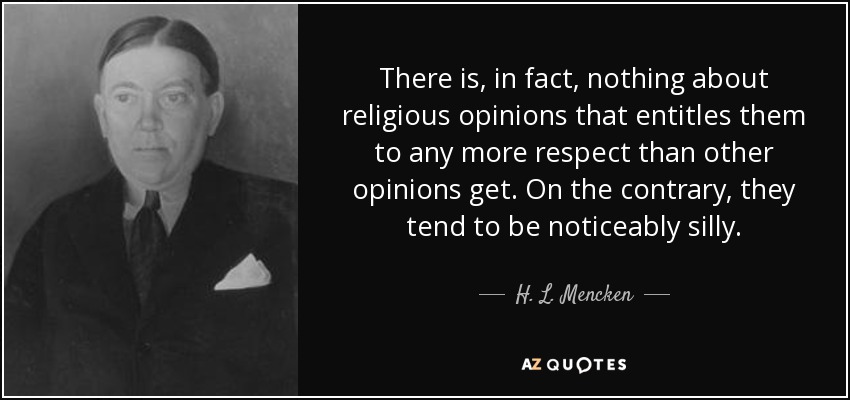
There is, in fact, nothing about religious opinions that entitles them to any more respect than other opinions get. On the contrary, they tend to be noticeably silly.
In one of his last appearances, Mitterrand, the agnostic president, was asked what the real God might say to him if he went to heaven. God would say: "At last, you know." And I would hope that He would add, "Welcome."
An atheist, like a Christian, holds that we can know whether or not there is a God. The Christian holds that we can know there is a God; the atheist, that we can know there is not. The Agnostic suspends judgment, saying that there are not sufficient grounds either for affirmation or for denial. At the same time, an Agnostic may hold that the existence of God, though not impossible, is very improbable; he may even hold it so improbable that it is not worth considering in practice. In that case, he is not far removed from atheism.
We satisfy our endless needs and justify our bloody deeds in the name of destiny and in the name of God.
Following the herd is fine, until they all run off the side of a cliff together.
Creeds made in Dark Ages are like drawings made in dark rooms
All Gaza's temples are torn down and burned and the city is cleansed of every belief but the Christian faith. The most stubborn opponents, faute de mieux, are tied up, marched away to the provincial capital, severely tortured, and all killed mala morte, 'a great number.'
I always like a dog so long as he isn't spelled backward.
Mario, what do you get when you cross an insomniac, an unwilling agnostic and a dyslexic?" "I give." "You get someone who stays up all night torturing himself mentally over the question of whether or not there's a dog.
The agnostic, the skeptic, is neurotic, but this does not imply a false philosophy; it implies the discovery of facts to which he does not know how to adapt himself. The intellectual who tries to escape from neurosis by escaping from the facts is merely acting on the principle that “where ignorance is bliss, ‘tis folly to be wise.
People are invariably surprised to hear me say I am both an atheist and an agnostic, as if this somehow weakens my certainty. I usually reply with a question like, “Well, are you a Republican or an American?” The two words serve different concepts and are not mutually exclusive. Agnosticism addresses knowledge; atheism addresses belief. The agnostic says, “I don't have a knowledge that God exists.” The atheist says, “I don't have a belief that God exists.” You can say both things at the same time. Some agnostics are atheistic and some are theistic.
If a person is intelligent, then of course he is either an agnostic or an atheist. Just as he is a physical coward. They are automatic definitions of high intelligence.
The Church says the Earth is flat. But I know that it is round. For I have seen the shadow on the Moon. And I have more faith in a shadow than in the Church.
I have found Christian dogma unintelligible. Early in life, I absenteed myself from Christian assemblies.
The Puritan hated bear-baiting, not because it gave pain to the bear, but because it gave pleasure to the spectators.
The scientist believes in proof without certainty.
You believe in a book that has sticks turning into snakes, and you say we are the ones that need help?
I suspect the reason is that most people [...] have a residue of feeling that Darwinian evolution isn't quite big enough to explain everything about life. All I can say as a biologist is that the feeling disappears progressively the more you read about and study what is known about life and evolution. I want to add one thing more. The more you understand the significance of evolution, the more you are pushed away from the agnostic position and towards atheism. Complex, statistically improbable things are by their nature more difficult to explain than simple, statistically probable things.
Science is agnostic when it comes to god; not atheistic, as some people prefer to read that laden word wrongly; just agnostic.
I am agnostic only to the extent that I am agnostic about fairies at the bottom of the garden
If belief in the existence of God is predicted to lead to a feeling of contentment, and the prediction is fulfilled, does it follow that God exists? Surely not. All that would follow would be the desireability of the belief.
I had read some books on the Baha'i Faith. I had read - I was looking into Buddhism and trying to understand sort of the agnostic approach, so there was just a bunch of stuff I was just looking at.
You know, on the spectrum of religious belief, there is atheism - these are people that don't believe. There's theism - these are the believers and agnostics say it's beyond comprehension that the whole issue of God us unknowable. You might be interested to know that perhaps the greatest mind of the 20th century Einstein, the one time that he actually used one of these appellations was in a letter about five years before he died and he referred to himself as an agnostic.
Even if you're an agnostic or an atheist, you can create an altar, because an altar is simply paying homage to someone's life and celebrating what they did.
Participation in the collective life of the polis both restrains the extraordinary individual and enlarges the ordinary individual, allowing him to participate in the extraordinary. An individual can achieve participatory excellence via the accomplishments of the polis and need not always be caught up in the agnostic struggle to outdo his peers.
Follow AzQuotes on Facebook, Twitter and Google+. Every day we present the best quotes! Improve yourself, find your inspiration, share with friends
or simply: