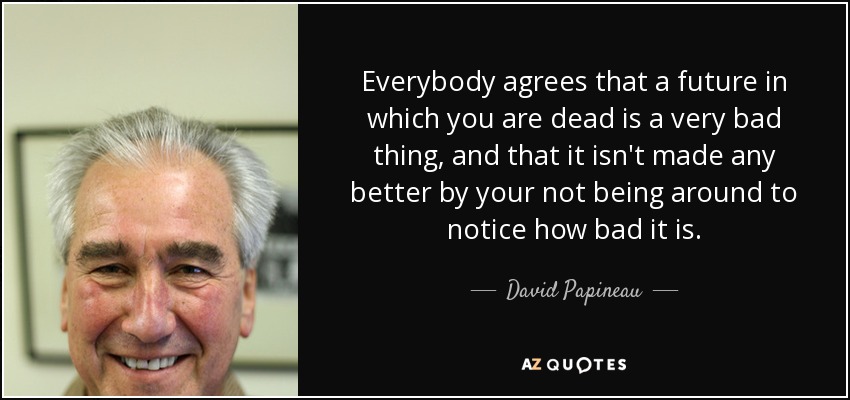
Everybody agrees that a future in which you are dead is a very bad thing, and that it isn't made any better by your not being around to notice how bad it is.
I mean, you can agree or disagree with Iraq or Afghanistan, but by the way, now the great campaigning cause out there is the absence of intervention in Syria. And then in Libya, it's partial intervention. And that doesn't really explain why some countries that have literally nothing to do with the interventions in the Middle East end up getting targeted.
The strange thing, though, is that most people who write novels these days seem to be aware of only a fraction of its possibilities. Kundera goes on and on about this, and I never tire of reading him on the subject, because I agree very deeply with it.
I do agree with Stich that a quick move from our evolutionary origins to the reliability of our cognitive mechanisms is not legitimate. As I see it, the case for the reliability or unreliability of various cognitive mechanisms lies elsewhere.
When you're coming up with your philosophy and approach to performing comedy, you take special note of the things you disagree with as much as the things you agree with.
While I do not agree with all of the claims made by experimental philosophers, especially those who seem to think xphi will somehow replace the rest of philosophy, I think xphi projects are interesting and important, I love Josh Knobe's work, and that these projects contribute something new and worthwhile to the philosophical conversation.
Of course there are collaborations. But in official meetings with Western diplomats from the US and the European Union, the major issues of our relationships are simply not discussed. The topics are on climate change or any other issues they want us to agree with them on. But they never discuss how we could develop an equal relationship. They should stop using pompous orchestrated summits and begin a serious dialogue with small meetings.
I'm always looking for an opportunity to bring progressive Democrats together with some conservative libertarian types, because there are places where we can agree.
Over time, it also became important for me to share my management principles with the people I worked with because we had to agree on how we should be with each other - and that way is unique. Because the logic behind being radically honest and radically transparent with each other wasn't clear, it had to be spelled out in these principles.
Ed Koch had the best line: if you agree with me nine out of twelve times, you should vote for me. If you agree with me twelve out of twelve times, you should find a psychiatrist.
I think in some cases, a penny is nothing compared to the kind of numbers. Then you get to fraud, waste and abuse, Sean. I mean, the fraud and the waste and the abuse, which everybody agrees if you can solve that problem, but it's, you know, mind-boggling the kind of numbers.
I don't throw people under the bus. When I stick by a guy - I may not agree with him all the time, but I sure don't throw him under the bus.
We refuse to dismiss the experts, we listen to them ... they all agree that Britain is better off in, you are better off in.
You do not need to be in the single market we do not need that we are the word's fifth biggest economy. Most economies can agree free trade deals within two years the EU is taking 10 years or never at all, why?
I think - I really think my voice has gotten better in the last two or three years. I don't know why. I've been doing a lot of - a lot more lead singing, and everybody tells me that my voice was better than ever and I agree with them. Maybe I've learned to do more with it. I don't know what.
This has been the left's technique. The technique is to portray a political enemy of the left as this outrageous caveman or whatever decrepit form of humanity that you can describe, and then assume that everybody else agrees, and then cover the story as though everybody agrees.
I don't like the tendency on the part of so many people today to think that those who don't agree with them are bad. In fact, I find that very dangerous.
There is a lot of sixties-bashing going on these days that I don't agree with at all. I feel that extremely important ideals were brought to the forefront of the collective consciousness at that time. Granted, drug use was so pervasive that our generation did not as a group have the capacity to manifest our ideals to any great extent. But many of the people who were young in the sixties and who were most touched by that collective ethos are still touched.
My job was always to pull a vote over from somebody who was likely to be at least at the outset disinclined to agree with me on some things or at least disinclined to agree with the policy that I was defending.
One thing I've experienced and I feel really grateful for now that I'm on my way out is that I felt that the justices gave that back to me. I really did. You know, of course, you can have some sharp exchanges. That's the nature of the thing, and that's fine. But really in the main I felt like the tone from them was, "Yeah. We may not agree with you, but we're going to have a discussion about this." And it did.
I have cultivated a little crew of people whose opinions I understand. It's like the way you'd follow certain film critics because you know what their criteria are, and you may not agree with them, but you can glean from their opinion how you will feel about a film.
I completely agree with Helmut Kohl. I am not an advocate of the "United States of Europe," nor am I an integration fanatic.
We agree: Brussels can't regulate everything. I'm driven by something else: There are forces in Europe that want to generally give national policy priority over a common European approach. We have to prevent this.
I agree with... actually it was [Joseph] Stalin who said that [Winston Churchill] he was a man who changed the history of the world and I think, if he had not been there in 1940, it might very well have been the case that we would have collapsed like France, and I shall honor him always for that.
I'm a recovering drug addict, so it's not a subject that I take lightly, but I do agree that the criminalization of narcotics is the deliberate inhibition of human consciousness.
Follow AzQuotes on Facebook, Twitter and Google+. Every day we present the best quotes! Improve yourself, find your inspiration, share with friends
or simply: