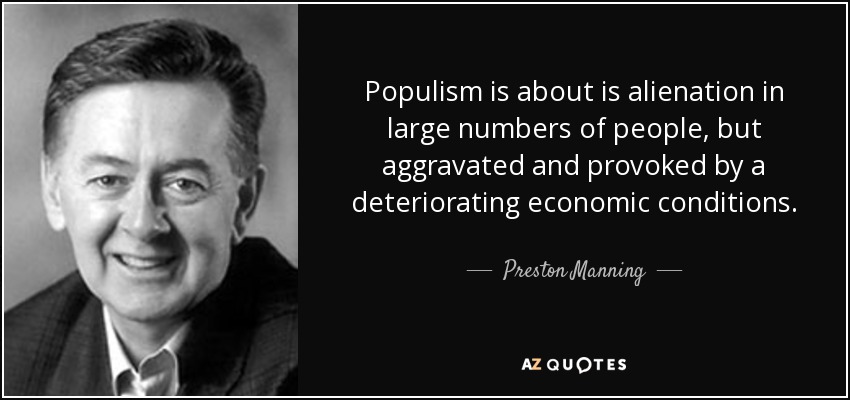
Populism is about is alienation in large numbers of people, but aggravated and provoked by a deteriorating economic conditions.
'Lost in Translation' movie says something interesting about the alienation of being a stranger in a strange land, but also of being a celebrity. That kind of feeling of not being in the same strata as everyone else.
We live in a time where there's an alienation factor. There's a certain disconnection. We don't have any real sense of community anymore.
The music certainly plays a major role. You can be free enough to comfort each other, to touch each other, to embrace each other, to engage each other, to not be afraid of each other. The music certainly has that very strong element. Go back to folk songs, gospel, jazz, and spirituals. See, all of that came out of tremendous pain and hurt, rejection, loss, alienation, and abandonment. What I'm doing is I'm expressing my pain and hope at the same time.
I think if anything, the fact that it's popular right now makes me go: "Well, I guess I'm going to start doing something else then in the next few years." I dunno, it almost feels hackneyed at this point. To start a premise by saying, "I did this awkward thing." But then again, awkwardness and feeling alienated are always going to be a part of comedy. Alienation, I suppose, can't be hackneyed because it will always exist.
If God had perceived that our greatest need was economic, he would have sent an economist. If he had perceived that our greatest need was entertainment, he would have sent us a comedian or an artist. If God had perceived that our greatest need was political stability, he would have sent us a politician. If he had perceived that our greatest need was health, he would have sent us a doctor. But he perceived that our greatest need involved our sin, our alienation from him, our profound rebellion, our death; and he sent us a Savior.
Some days,' I say, 'I feel like I don't belong anywhere in that world. That world out there. 'I point to Grant. 'People walk down our street and people drive down it and people ride their bicycles down it and all of them, even the ones I know, could be from another planet. And I'm a visiting alien.' And aliens don't belong anywhere,' Adam finishes for me, 'except in their own little corners of the universe.' Right,' I say. ~pgs 57-58 Hattie and Adam on alienation
but as he plodded along a vague and almost hallucinatory pall hazed over his mind; he found himself at one point, with no notion of how it could be, a step from an almost certain fatal cliffside fall—falling humiliatingly and helplessly, he thought; on and on, with no one even to witness it. Here there existed no one to record his or anyone else's degradation, and any courage or pride which might manifest itself here at the end would go unmarked: the dead stones, the dust-stricken weeds dry and dying, perceived nothing, recollected nothing, about him or themselves.
Not for a minute did I believe that this wasn’t goodbye. Still, I had loved and been loved in return, and there was nothing greater than that. It far outweighed the alienation of all the previous years. Bones thought five months was too short; I was amazed I’d been granted joy for so long. “I love you,” he moaned, or maybe I said it. I couldn’t tell the difference anymore. The lines had dissolved between us.
In our desire to impose form on the world and our lives we have lost the capacity to see the form that is already there; and in that lies not liberation but alienation, the cutting off from things as they really are.
The principal value of a garden is not understood. It is not to give the possessors vegetables and fruit (that can be better and cheaper done by the market-gardeners), but to teach him patience and philosophy, and the higher virtues - hope deferred, and expectations blighted, leading directly to resignation, and sometimes to alienation.
The natural world is the larger sacred community to which we belong. To be alienated from this community is to become destitute in all that makes us human. To damage this community is to diminish our own existence.
We are at home here. Alienation is unnecessary. Contact with reality at a deep level is part of the Christian's life. He enters into reality, rather than escaping from it. The flight from reality is a mark of Eastern and classical mysticism, not of Christianity.
The universe must be experienced as the Great Self. Each is fulfilled in the other: the Great Self is fulfilled in the individual self, the individual self is fulfilled in the Great Self. Alienation is overcome as soon as we experience this surge of energy from the source that has brought the universe through the centuries. New fields of energy become available to support the human venture. These new energies find expression and support in celebration. For in the end the universe can only be explained in terms of celebration. It is all an exuberant expression of existence itself.
Men love death. In everything they make, they hollow out a central place for death, let its rancid smell contaminate every dimension of whatever still survives. Men especially love murder. In art they celebrate it, and in life they commit it. They embrace murder as if life without it would be devoid of passion, meaning, and action, as if murder were solace, stilling their sobs as they mourn the emptiness and alienation of their lives.
Both education and religion need to ground themselves within the story of the universe as we now understand this story through empirical knowledge. Within this functional cosmology, we can overcome our alienation and begin the renewal of life on a sustainable basis. This story is a numinous revelatory story that could evoke the vision and the energy required to bring not only ourselves but the entire planet into a new order of magnificence.
To be a musician, especially a singer-songwriter - well, you don't do that if you have a thriving social life. You do it because there's an element of alienation in your life.
I really love that dynamic between beauty and sadness...theres always these moments of quiet alienation, the sense of disconnect, but also, these moments of possibility.
I feel Aleister Crowley is a misunderstood genius of the 20th century. Because his whole thing was liberation of the person, of the entity, and that restrictions would foul you up, lead to frustration which leads to violence, crime, mental breakdown, depending on what sort of makeup you have underneath. The further this age we're in now gets into technology and alienation, a lot of the points he's made seem to manifest themselves all down the line.
Nature-deficit disorder describes the human costs of alienation from nature, among them: diminished use of the senses, attention difficulties, and higher rates of physical and emotional illnesses. The disorder can be detected in individuals, families, and communities.
Modern man has been in search of a new language of form to satisfy new longings and aspirations - longings for mental appeasement, aspirations to unity, harmony, serenity - an end to his alienation from nature. All these arts of remote times or strange cultures either give or suggest to the modern artist forms which he can adapt to his needs, the elements of a new iconography.
The Faith does not mean an alienation from any culture for any people because all cultures await Christ and are not destroyed by the Lord. In fact, they reach their maturity.
We need to move: from a spirituality of alienation from the natural world to a spirituality of intimacy with the natural world from a spirituality of the divine as revealed in words to a spirituality of the divine as revealed in the visible world about us.
The fact that there are so many weak, poor and boring stories and novels written and published in America has been ascribed by our rebels to the horrible squareness of our institutions, the idiocy of power, the debasement of sexual instincts, and the failure of writers to be alienated enough. The poems and novels of these same rebellious spirits, and their theoretical statements, are grimy and gritty and very boring too, besides being nonsensical, and it is evident by now that polymorphous sexuality and vehement declarations of alienation are not going to produce great works of art either.
One of the great drivers of the alienation that has made Donald Trump possible is that the growth in the American economy has been weak. In the decade from 2005 to 2015, there was not one year when the US hit three per cent growth. And to the extent there's been growth, virtually all of it has been collected by the top 10 per cent of the population. Obviously, if we knew how to make growth faster, we would. We don't. And it's very difficult to make growth more broadly shared. Because it's not just the US that has this problem.
Follow AzQuotes on Facebook, Twitter and Google+. Every day we present the best quotes! Improve yourself, find your inspiration, share with friends
or simply: