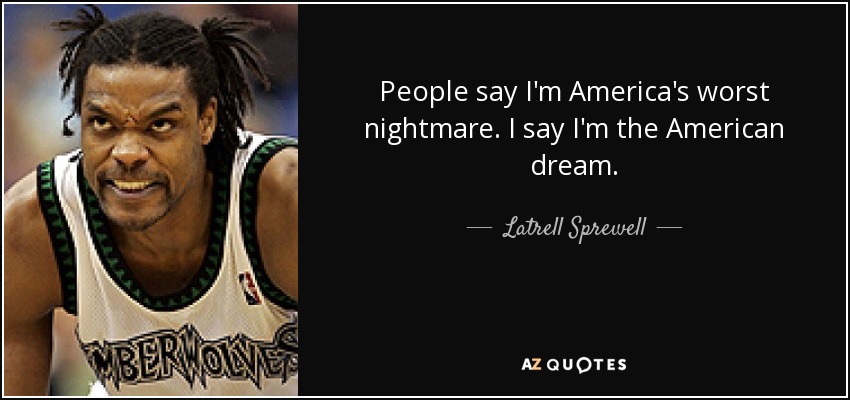
People say I'm America's worst nightmare. I say I'm the American dream.
With the end of communism and the opening of Third World markets, the potential for Playboy is huge. It has been said that the two most famous trademarks in the world are Coca-Cola and the Playboy bunny rabbit. There is certainly no one else in our area that represents the American dream in this particular kind of way. That rabbit means economic freedom, personal freedom and political freedom. That potential is unlimited.
I think that's still what the American Dream means: that with perseverance, with hard work, you can become something, that the classes won't prevent you from becoming, that there's a movement up that ladder with hard work.
The American dream is a multi-metaphor made up of distinct regions. Many regions of this country are almost like different countries. Even in one state, northern and southern California are like two separate countries.
When you've got a economy in which 40 percent of economic growth is happening in the financial sector, that turns out that was all an illusion, that it wasn't growth based on real products and services, but just a bunch of paper shuffling and a house of cards, then what's gonna emerge, at some point, is a sense of resentment, a sense that the system's rigged, and it's not working for ordinary people. And it's not fulfilling the basic American dream.
The erosion of equal opportunity is among the greatest threats to our exceptionalism as a nation. But it also provides us with an exciting and historic opportunity: to help more people than ever achieve the American Dream.
My own American Dream was to serve my country as best I could and make a difference in America - and in the world.
I think, in a lot of ways, celebrities represent the American dream. They have financial fluidity and options at their disposal.
The latest research on social mobility showed that there's a large aggregate decline in the U.S. in your chances of earning more than your parents. But I think where the story becomes more optimistic one is that there are pockets of America, where children from low-income families have significant chances of rising up in the income distribution. This finding of big geographic variation is an encouraging one because it shows that there are places where we see the American Dream thriving and we simply need to understand how can we replicate those successes elsewhere throughout the country.
During the Reagan eighties, the idea that money was a good thing - it was good to be rich; that wealth was a reflection of your character. We see this today in perceptions of Donald Trump: the idea that money is an expression of success and even goodness. I compare that with my dad's generation, where the American Dream was about giving your kids a better life, but not just in material terms. The American Dream was also about doing something good in the world. The home was at the center of the dream, but home also represented community, shelter, and stability for your family.
What, after all, is the narrative of the American Dream? It was a discourse formulated between the 1880s and the 1920s in the United States during the great waves of migration and expansion and reforms of the Progressive Era.
I would say basically the commonplace observation that kids aren't going to earn as much as their parents is now is a coin flip at this point. Are you going to do better than your parents? It's a 50-50 chance, whereas if you were born in the 1940s or 1950s, you had more than a 90 percent chance you were going to do better than your parents. So basically almost a guarantee for most kids that you were going to achieve the American Dream of doing better than your parents did. Today, that's certainly no longer the case.
Success is the American Dream. And that success is not something to be ashamed of, or to demonize.
I think the American Dream should be about a greater progressive legislation that allows for what I call a necessary future world of cooperational humanism.
Trump and I have a lot in common, and that is a belief in the American dream because we both have lived it. I think it's what animates our president-elect more than anything else, is a belief in the boundless potential of every American to live the American dream. And, I think it comes from the fact that we both grew up in it, and both saw it. And in our own ways, we both lived it.
Every refugee finds his American dream on the backs of the nightmare of Black suffering in America.
Our country, our economy - don't doubt me on this - our economy is based on capitalism. Barack Obama's stated reason for being inspired by Reverend Wright was his speech, 'White man's greed runs a world in need.' That inspired Obama, 'White man's greed runs a world in need.' That's the real American dream. Working hard you will get ahead. But you can't have that if you want to create a permanent underclass. You simply cannot have people getting ahead. It destroys the whole notion of a permanent underclass.
When I speak about the "tyranny of choice," I mean an ideology that originates in the era of post-industrial capitalism. It began with the American Dream - the idea of the self-made man, who works his way up from rags to riches. By and by, this career concept developed into a universal life philosophy. Today we believe we should be able to choose everything: the way we live, the way we look, even when it comes to the coffee we buy, we constantly need to weigh our decision. That is extremely unhealthy.
What drives me nuts is that we have these serial sexual predators, who hired back women whose careers were ruined by men who harassed or assaulted them and they're high profile people, and the next day the media is talking about who's going to rehire them. I'm like, Who cares? Why would they be hirable again? I mean, I'm all for comebacks, but what about the women? Shouldn't we be going back to them first? They had the American dream taken away from them.
I think the Playboy philosophy is very, very connected to the American dream.
Liberals insist they believe as strongly in the American dream as the rest of us, but routinely demonize those who succeed in attaining it. They loudly profess their allegiance to capitalism, but resent the inequitable money results it produces.
I am proof that the American dream still exists.
We've heard so much about the American dream: well, Trump is the American nightmare made flesh. All the things about 'the ugly American' that we worry about and which the Americans see in themselves, it's all of that. This is a politics of egotistical display.
Maybe the American Dream is too rich for us now in the U.S. Maybe we're losing it because we are not like our Swedish grandmother who came across the plains, hacked down the trees, and took the Spanish words she encountered and made them hers. Now her great-great-grandchildren sit terrified, wondering what to do with all these Mexicans. The American Dream is an impossible affirmation of possibility. And maybe native-born Americans don't have it anymore. Maybe it has run through their fingers.
And it's a lie that has consequences, because the great American dream is to have a good job, and in recent years, America has failed to deliver that dream more than it has at any time in recent memory. A good job is an individual's primary identity, their very self-worth, their dignity - it establishes the relationship they have with their friends, community and country. When we fail to deliver a good job that fits a citizen's talents, training and experience, we are failing the great American dream.
Follow AzQuotes on Facebook, Twitter and Google+. Every day we present the best quotes! Improve yourself, find your inspiration, share with friends
or simply: