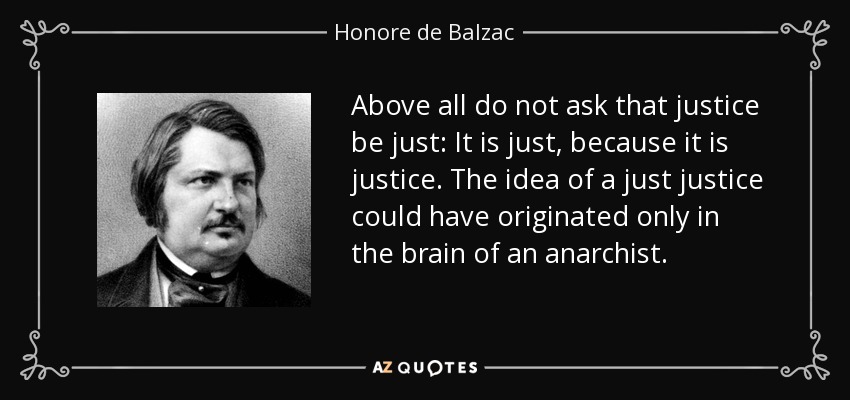
Above all do not ask that justice be just: It is just, because it is justice. The idea of a just justice could have originated only in the brain of an anarchist.
The problem of values arises only when men try to fit together their need to be social animals with their need to be free men. There is no problem, and there are no values, until men want to do both. If an anarchist wants only freedom, whatever the cost, he will prefer the jungle of man at war with man. And if a tyrant wants only social order, he will create the totalitarian state.
In the Spanish people there is a mixture of Gothic, Frankish and Moorish blood. One can speak of the Spaniard as one would speak of a brave anarchist. The Arabian epoch-the Arabs look down on the Turks as they do on dogs-was the most cultured, the most intellectual and in every way best and happiest epoch in Spanish history. It was followed by the period of the persecutions with its unceasing atrocities.
A Christian anarchist has no business belonging to such a reactionary organization [the Catholic Church]. I do not believe in original sin, indulgences, the infallibility of the pope, or obedience to any church official if it is against my conscience. I am not interested in earning "merit" or in being saved by priestly incantation.
An anarchist is an uncomprimising liberal.
My early work is politically anarchist fiction, in that I was an anarchist for a long period of time. I'm not an anarchist any longer, because I've concluded that anarchism is an impractical ideal. Nowadays, I regard myself as a libertarian.
Transcendentalism is, we might say, an early form of anarchism. The Transcendentalists also did not call themselves anarchists, but there are anarchist ideas in their thinking and in their literature. They were all suspicious of authority. We might say that the Transcendentalism played a role in creating an atmosphere of skepticism towards authority, towards government.
Charlie Hebdo mocked everyone. They mocked the left. They mocked the right. They mocked, above all, the extreme right, the extreme right of Le Pen's. If anything could identify their politics, they were kinds of anarchists.
When anarchists are having a debate, they're having a debate about tactics, 'Should you do this?', 'Should you do that?' The question isn't 'Should you do this?', 'Should you do that?', the primary question is how do you build confidence among the masses of people who experience hierarchies, who experience exploitation, who experience oppression.
In debates between anarchists and statists, the burden of proof clearly should rest on those who place their trust in the state. Anarchy's mayhem is wholly conjectural; the state's mayhem is undeniably, factually horrendous.
In a world where inequality of ability is inevitable, anarchists do not sanction any attempt to produce equality by artificial or authoritarian means. The only equality they posit and will strive their utmost to defend is the equality of opportunity. This necessitates the maximum amount of freedom for each individual. This will not necessarily result in equality of incomes or wealth but will result in returns proportionate to service rendered.
My aim is to be understood by everyone. I reject the 'depth' that people demand nowadays, into which you can never descend without a diving bell crammed with cabbalistic bullshit and intellectual metaphysics. This expressionistic anarchy has got to stop... A day will come when the artist will no longer be this bohemian, puffed-up anarchist but a healthy man working in clarity within a collectivist society.
Not until he acquires European manners does the American anarchist become the gentleman who assures you that people cannot be mademoral by Act of Parliament (the truth being that it is only by Acts of Parliament that men in large communities can be made moral, even when they want to).
No more painters, no more scribblers, no more musicians, no more sculptors, no more religions, no more royalists, no more radicals, no more imperialists, no more anarchists, no more socialists, no more communists, no more proletariat, no more democrats, no more republicans, no more bourgeois, no more aristocrats, no more arms, no more police, no more nations, an end at last to all this stupidity, nothing left, nothing at all, nothing, nothing.
The least Anararchic person in that conversation is the person saying 'you can't be an anarchist if you believe in god.' Because that's not an argument, it's just a statement. Why would somebody accept that? Because they either bow to your authority or they are afraid of your aggression. That's threatening to be another kind of ruler. Does that make any sense?
It is the cruelest of all ironies that moderns imagine themselves to be (abstractly understood) "individuals," because in actuality moderns are "types," abstracted and self-abstractive victims of a process of stereotyping that afflicts even would-be rebels and anarchists.
Anarchists have taken over (the GOP).
Those who refuse to support and defend the state have no claim to protection by that state. Killing an anarchist or a pacifist should not be considered "murder" in a legalistic sense. The offense against the state, if any, should be "Using deadly weapons within city limits," or "Creating a traffic hazard," or other misdemeanor.
On the one hand, I'm a kind of crazy anarchist-sympathizer with a hippie background, so this sounds pretty good to me. Make something for the love of it! But the reality is so much more complicated.
Anarchists have always gone against the grain, and that's been a place of hope.
I had relatives in New York City who I stayed with. And in those days, the area from Union Square down Fourth Avenue had small bookstores, many of which were run by Spanish immigrants who'd fled after [Francisco] Franco's victory. I spent time in them, and also in the offices of Freie Arbeiter Stimme (Free Worker's Voice) with anarchists. I picked up a lot of material and talked to people, and it became a major influence.
The communists were mainly responsible for the destruction of the Spanish anarchists. Not just in Catalonia - the communist armies mainly destroyed the collectives elsewhere.
The communists basically acted as the police force of the security system of the [Spain] Republic and were very much opposed to the anarchists, partially because [Joseph] Stalin still hoped at that time to have some kind of pact with Western countries against [Adolf] Hitler. That, of course, failed and Stalin withdrew the support to the Republic. They even withdrew the Spanish gold reserves.
[Camillo] Berneri proposed that the anarchists should link up with the effort of Northern Africa to overthrow the Spanish government, carry out land reform, attract the base of the Moorish army, and see if they could undermine [Francisco] Franco's army through political warfare in Northern Africa combined with guerrilla warfare in Spain. Historians laughed at that, but I don't think they should have. This was the kind of war that might have succeeded in stopping Spanish fascism.
Iceland is capitalist social democratic, rather like the Nordic countries generally. The capital had a mayor who is an anarchist, but the city has been nothing like that. In fact a few years ago it was super-neoliberal, which led to the crash.
Follow AzQuotes on Facebook, Twitter and Google+. Every day we present the best quotes! Improve yourself, find your inspiration, share with friends
or simply: