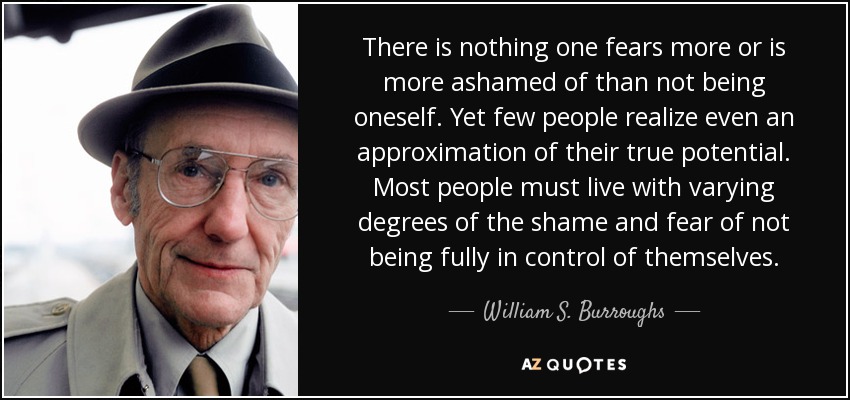
There is nothing one fears more or is more ashamed of than not being oneself. Yet few people realize even an approximation of their true potential. Most people must live with varying degrees of the shame and fear of not being fully in control of themselves.
The scientist is a practical man and his are practical (i.e., practically attainable) aims. He does not seek the ultimate but the proximate. He does not speak of the last analysis but rather of the next approximation. His are not those beautiful structures so delicately designed that a single flaw may cause the collapse of the whole. The scientist builds slowly and with a gross but solid kind of masonry. If dissatisfied with any of his work, even if it be near the very foundations, he can replace that part without damage to the remainder.
Spirituality is much wider than any particular religion, and in the larger ideas of it that are now coming on us even the greatest religion becomes no more than a broad sect or branch of the one universal religion, by which we shall understand in the future man's seeking for the eternal, the divine, the greater self, the source of unity and his attempt to arrive at some equation, some increasing approximation of the values of human life with the eternal and the divine values.
Your superhuman power was to be able not to feel. Is it there inside everybody, this self that comes out while you are in captivity? You become the closest approximation of yourself that can tolerate living there.
Free men are aware of the imperfection inherent in human affairs, and they are willing to fight and die for that which is not perfect. They know that basic human problems can have no final solutions, that our freedom, justice, equality, etc. are far from absolute, and that the good life is compounded of half measures, compromises, lesser evils, and gropings toward the perfect. The rejection of approximations and the insistence on absolutes are the manifestation of a nihilism that loathes freedom, tolerance, and equity.
An entirely honest man, in the severe sense of the word, exists no more than an entirely dishonest knave: the best and the worst are only approximations of those qualities. Who are those that never contradict themselves? yet honesty never contradicts itself: Who are those that always contradict themselves? yet knavery is mere self-contradiction. Thus the knowledge of man determines not the things themselves, but their proportions, the quan∣tum of congruities and incongruities.
It really is appallingly difficult to do something which is complete in every respect, and I think most people are content with mere approximations. Well, my dear friend, I intend to battle on, scrape off and start again.
Every one of us sees 'green' differently. So everything is an approximation of understanding.
Take the so-called standard of living. What do most people mean by "living"? They don’t mean living. They mean the latest and closest plural approximation to singular prenatal passivity which science, in its finite but unbounded wisdom, has succeeded in selling their wives.
Science does not aim at establishing immutable truths and eternal dogmas; its aim is to approach the truth by successive approximations, without claiming that at any stage final and complete accuracy has been achieved.
Justice based purely on laws is about as accurate as a portrait created out of large low-resolution color pixels. If you stand back far enough it looks good. Come any closer and the glaring approximations overtake all semblance of the original. Justice should be viewable under the microscope, not from a telescope. And for that it needs to be based not on law but on truth.
Sorrow, terror, anguish, despair itself are often the chosen expressions of an approximation to the highest good. Our sympathy in tragic fiction depends on this principle; tragedy delights by affording a shadow of the pleasure which exists in pain. This is the source also of the melancholy which is inseparable from the sweetest melody. The pleasure that is in sorrow is sweeter than the pleasure of pleasure itself.
Miss Wynter, I think you should be the evil queen,” Harriet said. “There’s an evil queen?” Daniel echoed. With obvious delight. “Of course,” Harriet replied. “Every good play has an evil queen.” Frances actually raised her hand. “And a un—” “Don’t say it,” Elizabeth growled. Frances crossed her eyes, put her knife to her forehead in an approximation of a horn, and neighed.
To do Mohammed justice, his main attack was against the idolatries of Asia. Only he thought, just as the Arians did and just as the Unitarians do, that he could attack them better with a greater approximation to plain theism. What distinguishes his heresy from anything like an Arian or Albigensian heresy is that, as it sprang up on the borders of Christendom, it could spread outwards to a barbaric world.
One of my major preoccupations is the approximation between what I say and what I do, between what I seem to be and what I am actually becoming.
A poor relation is the most irrelevant thing in nature, a piece of non pertinent correspondence, an odious approximation, a haunting conscience, a preposterous shadow, lengthening in the noontide of our prosperity.
We believe that poverty does not belong in a civilized human society. It belongs in museums [...] A poverty-free world might not be perfect, but it would be the best approximation of the ideal.
Whatever one wishes to say, there is one noun only by which to express it, one verb only to give it life, one adjective only which will describe it. One must search until one has discovered them, this noun, this verb, this adjective, and never rest content with approximations, never resort to trickery, however happy, or to vulgarism, in order to dodge the difficulty.
I consider the differences between man and animals in propensities, feelings, and intellectual faculties, to be the result of the same cause as that which we assign for the variations in other functions, viz. difference of organization; and that the superiority of man in rational endowments is not greater than the more exquisite, complicated, and perfectly developed structure of his brain, and particularly of his ample cerebral hemispheres, to which the rest of the animal kingdom offers no parallel, nor even any near approximation, is sufficient to account for.
It has been said that men carry on a kind of coasting trade with religion. In the voyage of life, they profess to be in search of heaven, but take care not to venture so far in their approximations to it, as entirely to lose sight of the earth; and should their frail vessel be in danger of shipwreck, they will gladly throw their darling vices overboard, as other mariners their treasures, only to fish them up again when the storm is over.
Experimental science hardly ever affords us more than approximations to the truth; and whenever many agents are concerned we are in great danger of being mistaken.
As a first approximation, I define belief not as the object of believing (a dogma, a program, etc.) but as the subject's investment in a proposition, the act of saying it and considering it as true.
I hope that I am generous and tolerant, but certainly on the intellectual side I think that there are discoverable truths, and some things that are closer approximations to the truth than others.
The ideal project does not exist, each time there is the opportunity to realize an approximation.
In this game he had acquired a great deal of muddled knowledge, more than one approximation and less than one certitude. And absence of energy, a curiosity that was too sharp to be crushed immediately, a lack of order in his ideas, a weakening of his spiritual boundaries, which were promptly twisted, an excessive passion for running along forked roads and wearying of the path as soon as he had started on it, mental indigestion demanding varied dishes, quickly tiring of the foods he desired, digesting almost all, but badly, was his state.
Follow AzQuotes on Facebook, Twitter and Google+. Every day we present the best quotes! Improve yourself, find your inspiration, share with friends
or simply: