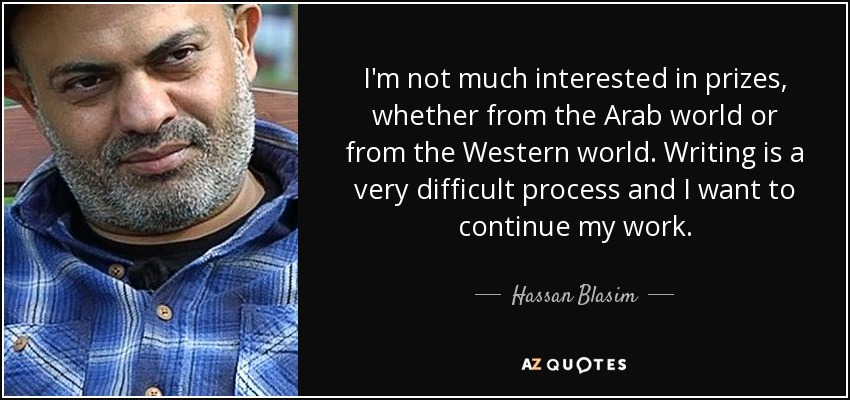
I'm not much interested in prizes, whether from the Arab world or from the Western world. Writing is a very difficult process and I want to continue my work.
Some Iraqi writers are more daring today and have excellent imaginations and their material is rich in human experience. But the Arab prizes, once again, are part of the context of life in the Arab world - anarchy, confusion, and corruption.
In many parts of the world, including the Arab world, the Latin American world, and even parts of the Western world, there is a tradition of writers being quite engaged. Particularly in the Arab world you have had very, very strong traditions of literature and poetry and most of the writers have been deeply committed to the cause of the Arab nation.
Al Jazeera is one entity that everyone across the Arab world watches. Arabs are proud of that.
I think the Arab world has no personality cult situation going on that they have in much of the Western world, South America included. They are a culture of words and religion, and you won't see manycsa charismatic people on Al Jazeera, except for the ones who are now learned presenters. You see Arab leaders getting on TV - which was very hard for me working out how to do the part, since Arab leaders are looking somnambulant, staring into their microphone, almost as if someone's got a hand up their back.
The Arab world had a big problem of frankly venal elites. That is why these revolutions happen, because people didn't think the opportunities were being shared fairly.
The Arab world is also the world that produced some of the greatest improvements in mathematics and in science. Even today, when a Princeton mathematician does an algorithm, he may not remember that "algorithm" derived from the name al-Khwarizmi, who is a ninth-century Arab mathematician.
The Islamic world doesn't stop in the Arab world or Persia. There is the whole Turkic world, the Central Asian world, South Asian world, Southeast Asian world, and African world.
Syria is Iran's only ally in the Arab world. It's their route to the sea. It's the route for them to arm Hezbollah in Lebanon, which threatens, of course, our ally, Israel.
The perception in the Arab world now is that we are having secularists against Islamists, and that's it. So the secularists are progressive; the Islamists are reactionary, conservative. This perception is wrong.
One of the Christian fundamentalists' goals seems to be to rebuild the Temple, which means destroying the Al-Aqsa Mosque, which presumably means war with the Arab world - one of the goals, perhaps, in fulfilling the prophecy of Armageddon. So they strongly support Israeli power and expansionism, and help fund it and lobby for it; but they also support actions that are very harmful and objectionable to most of its population - as do Jewish fundamentalist groups, mostly rooted in the US, which, after all, is one of the most extreme religious fundamentalist societies in the world.
[Roots of terrorism] come out of a long dialectic of U.S. involvement in the affairs of the Islamic world, the oil-producing world, the Arab world, the Middle East - those areas that are considered to be essential to U.S. interests and security.
I think in theory, the United States finds it much easier to deal with situations where there is a leading country. You can go to the leaders of that country and say, for example, to India, "There are all these problems in Bangladesh, we really have to do something about it, what do you suggest we can do to work out a common policy?" But when you don't have the equivalent of India, you have to go capital to capital trying to put together a coalition, which is extraordinarily difficult, especially in the Arab world, because of the historic rivalries and branches of Islam.
Turkey has its own interests and historically, Turkey conquered most of the Arab world, and the Arabs had to fight wars of liberation to free themselves from the Turks. That's in the past and that doesn't necessarily shape what is going on but it's there and it's there in people's memories.
There is something which is going to be one of the main challenges in the Muslim world today, in the Muslim-majority countries in the Arab world, is the religious credibility. How are you going to react to what is said about Islam? So, by touching the prophet of Islam, the reaction should be, who is going to be the guardian?
Our moral authority is as important, if not more important, than our troop strength or our high-tech weapons. We are rapidly losing that moral authority, not only in the Arab world but all over the world.
The Koran was revealed at a time of great change in the Arab world, the seventh-century shift from a matriarchal nomadic culture to an urban patriarchal system.
In America access is always about architecture and never about human beings. Among Israelis and Palestinians, access was rarely about anything but people. While in the U.S. a wheelchair stands out as an explicitly separate experience from the mainstream, in the Israel and Arab worlds it is just another thing that can go wrong in a place where things go wrong all the time.
I'm amazed by the misconceptions about Muslim women and the Arab world that I hear, and that really does hurt me.
We've got to recognize that when we march into Iraq, we're setting up the card tables in front of every university in the Arab world, the Islamic world, to recruit for al-Qaida.
We have to be vigilant on two fronts: (1) to not let our anti-imperialism lead to the defense of authoritarian regimes in the region and (2) to not let our enthusiasm for rebellion lead to cheering on the cruise missiles from US warships. These two sirens should worry us as we make our hesitant way alongside the rebirth of a New Left in the Arab world.
We can remove Saddam because that could start a chain reaction in the Arab world that would be very healthy.
If we free the people of Iraq, we will be respected in the Arab world... and I think we will be respected around the world.
The danger of leaving overwhelming wealth and power in the grasp of a small minority is a lesson that leaders such as ousted Tunisian president Zine el-Abidine Ben Ali and deposed Egyptian president Hosni Mubarak have learned a little too late, as the demonstrations across the Arab world indicate.
The sooner we put Egypt on the right track, the sooner we would be able to have an Egypt that is modern, that is moderate, and that is acting as a beacon for freedom and liberty across the Arab world.
Follow AzQuotes on Facebook, Twitter and Google+. Every day we present the best quotes! Improve yourself, find your inspiration, share with friends
or simply: