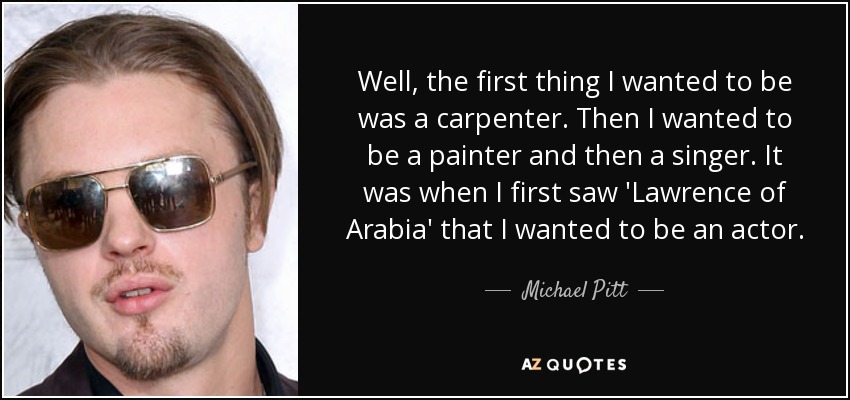
Well, the first thing I wanted to be was a carpenter. Then I wanted to be a painter and then a singer. It was when I first saw 'Lawrence of Arabia' that I wanted to be an actor.
Look, I don't think President Obama would have bowed to the ruler of Saudi Arabia if he didn't have oil to the degree that the Saudis do. I think they and other producing states, almost all of whom, except Norway and Canada, are dictatorships or autocratic systems, have thrown their weight around because of oil.
I've always loved the old epics that tell a simple emotional story, whether it's the tumultuous relationship between Rhett and Scarlett or Lawrence of Arabia's passion to get lost in a faraway place.
Like so many Boomers, I saw Lawrence of Arabia in 1962 when it was first released and when we were young teenagers. Im not quite sure why - I really wish some psychologist would explain this - but that movie had a tremendous effect on many of us.
If you ask a Saudi Imam why women in Saudi Arabia can't drive, he'll say, 'Because Islam demands it.' But that's absurd, because - first of all - Islam demands no such thing; and secondly, the only country in the world in which women can't drive is Saudi Arabia. The inability to understand the difference between a cultural practice and religious belief is shocking among self-described intellectuals.
At Jaffa in Syria and among the Nomads in Arabia, are lakes of enormous size that yield very large masses of asphalt, which are carried off by the inhabitants thereabouts.
Who on earth do the Americans suppose their allies are amongst the Arab world? Even Saudi Arabia they seem to regard as nothing more than a resevoir of oil and money.
Genius in the poet, like the nomad of Arabia, ever a wanderer, still ever makes a home where the well or the palm-tree invites it to pitch the tent. Perpetually passing out of himself and his own positive circumstantial condition of being into other hearts and into other conditions, the poet obtains his knowledge of human life by transporting his own life into the lives of others.
Well it's a gloomy, rainy old day to be here in London, but it could be worse; I could be in Saudi Arabia where men are men, and women are cattle.
Today President Obama is in the Middle East. He met the new king of Saudi Arabia. Obama also met Saudi Arabia's first lady, the second lady, third lady, and fourth lady.
In the last 48 hours King Abdullah from Saudi Arabia passed away. I have a moral dilemma. The king passed away three or four days ago. Is it too soon to hit on Queen Latifah?
... continual hard labor deadens the energies of the soul, and benumbs the faculties of the mind; the ideas become confined, the mind barren, and, like the scorching sands of Arabia, produces nothing; or, like the uncultivated soil, brings forth thorns and thistles. Again, continual hard labor irritates our tempers and sours our dispositions; the whole system become worn out with toil and fatigue; nature herself becomes almost exhausted, and we care but little whether we live or die.
The United States and Saudi Arabia have an extraordinary relationship and friendship that dates back to Franklin Roosevelt and King Faisal.
I lived in Saudi Arabia in the late 1970s. It was, for a Westerner, pretty idyllic. There were the religious police; there were the rules; there were the prayer times. But it was as if we were existing in two separate universes. The Westerners were just allowed to get on with their way of life.
Saud bin Abd al-Aziz was the moon-faced, shortsighted, bespectacled son of the old founder of Saudi Arabia, who'd always been his father's protege but had never quite lived up to everything that his father had.
If I look at the really important questions in [Middle East] region, I see Iran, where there is a strong desire for a freer society and where people are repressed by a small group of ayatollahs. I see Syria, where we can see a similar desire of the people to be free. These two countries fund Hezbollah and other terrorist organizations and are hurting our efforts in Afghanistan and have been extremely harmful in Iraq. Then I also see large, important countries such as Egypt and Saudi Arabia.
Breaking a glass in the northwest is rather like belching in Arabia, for it appears to be done as a mark of appreciation or elation.
Frankly, getting Mexico economically headed in the right direction with good energy policy - Canada, the United States, and Mexico have more known energy reserves than Saudi Arabia and Russia. So developing those and I think you'll see a major movement of people back into Mexico when that occurs when these prices get back. You're going to see a substantial development of the energy business in Mexico and Canada, domestic as well.
I think Saudi Arabia often finances radical Islam and the teaching of hatred to the West and hatred of Americans. I think it is important that we know that. It's important that we know that there is a threat within and a threat without. I think we can stop it with more aggressive use of actual constitutional tools.
Muslims, who have a completely different value system, come to the West, then they should accept that there are certain basic values in the West intrinsic to our culture. Just as I wouldn't suggest that any Westerner walk down the streets of Saudi Arabia in a bikini.
I don't know why it's so hard to believe women. You to go Saudi Arabia and you need two women to testify against a man. Here you need 25.
It took many years to cleanse Arabia of its “false idols.” It will take many more to cleanse Islam of its new false idols-bigotry and fanaticism-worshipped by those who have replaced Muhammad's original vision of tolerance and unity with their own ideals of hatred and discord. But the cleansing is inevitable, and the tide of reform cannot be stopped. The Islamic Reformation is already here. We are all living in it.
The efficient use of energy is as much an issue for Saudi Arabia, with its huge natural resources, as it is for all countries. Increased efficiency makes sense environmentally, but also economically.
Saudi Arabia is one of India's most valued strategic partners.
The anchors of the Arab consensus have long been Egypt and Saudi Arabia, and both are now weakened forces in Arab politics and diplomacy.
Follow AzQuotes on Facebook, Twitter and Google+. Every day we present the best quotes! Improve yourself, find your inspiration, share with friends
or simply: