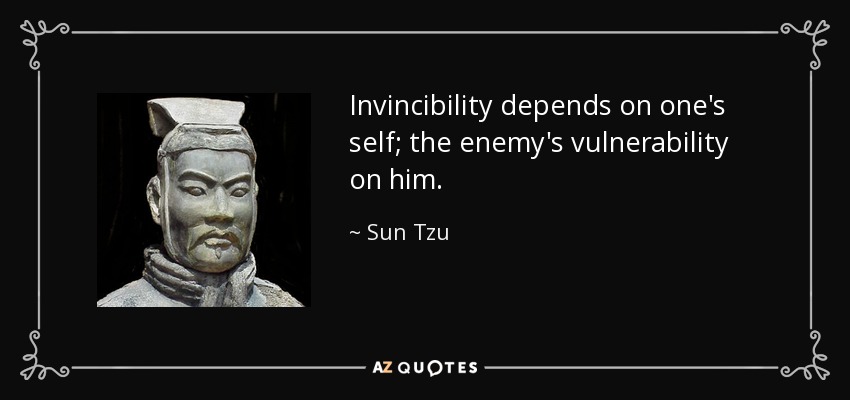
Invincibility depends on one's self; the enemy's vulnerability on him.
War is a matter of vital importance to the state; the province of life or death; the road to survival or ruin. It is mandatory that it be thoroughly studied.
The supreme excellence is not to win a hundred victories in a hundred battles. The supreme excellence is to subdue the armies of your enemies without having to fight them.
The military has no constant form, just as water has no constant shape - adapt as you face the enemy, without letting them know beforehand what you are going to do.
Now the reason the enlightened prince and the wise general conquer the enemy whenever they move and their achievements surpass those of ordinary men is foreknowledge.
The art of war is like the art of the courtesan; indeed they might be called sisters, since both are slaves of desperation.
The art of using troops is this: ......When ten to the enemy's one, surround him; ......When five times his strength, attack him; ......If double his strength, divide him; ......If equally matched you may engage him; ......If weaker numerically, be capable of withdrawing; ......And if in all respects unequal, be capable of eluding him, ..........for a small force is but booty for one more powerful.
A battle that you win cancels any other bad action of yours. In the same way, by losing one, all the good things worked by you before become vain.
Since the handling of arms is a beautiful spectacle, it is delightful to young men.
Knowing how to fight made men more bold, because no one fears doing what it seems to him he has learned to do. Therefore, the ancients wanted their citizens to be trained in every warlike action.
When they remain in garrison, soldiers are maintained with fear and punishment; when they are then led to war, with hope and reward.
Without doubt, ferocious and disordered men are much weaker than timid and ordered ones. For order chases fear from men and disorder lessens ferocity.
Never lead your soldiers to battle if you have not first confirmed their spirit and known them to be without fear and ordered; and never test them except when you see that they hope to win.
To know in war how to recognize an opportunity and seize it is better than anything else.
I don't read a lot of inspirational books for life. But for writing, I think the two best books are The War of Art and William Zinsser's On Writing Well. I read a lot of classics.
The art of war in its highest point of view is policy.
It was part of war; men died, more would die, that was past, and what mattered now was the business in hand; those who lived would get on with it. Whatever sorrow was felt, there was no point in talking or brooding about it, much less in making, for form's sake, a parade of it. Better and healthier to forget it, and look to tomorrow.The celebrated British stiff upper lip, the resolve to conceal emotion which is not only embarrassing and useless, but harmful, is just plain commons sense
When everyone's focused on the conventional parts of war - doing infantry imbeds or chasing IEDs - you look at the thing that seems not that interesting to people, like the circumstances of logistics workers cooking the troops' food or cleaning their latrines.
It is bias to think that the art of war is just for killing people. It is not to kill people, it is to kill evil. It is a strategem to give life to many people by killing the evil of one person.
It is not the willingness to kill on the part of our soldiers which most concerns me. That is an inherent part of war. It is our lack of respect for even the admirable characteristics of our enemy; for courage, for suffering, for death, for his willingness to die for his beliefs, for his companies and squadrons which go forth, one after another, to annihilation against our superior training and equipment.
A prince... must learn from the fox and the lion... One must be a fox in order to recognize traps, and a lion to frighten off wolves. Those who act simply as lions are stupid. So it follows that a prudent ruler cannot, and must not, honour his word when it places him at a disadvantage and when the reasons for which he made his promise no longer exist.
When settling disputes between his subjects, he should ensure that his judgement is irrevocable; and he should be so regarded that no one ever dreams of trying to deceive or trick him.
If not in the interests of the state, do not act. If you cannot succeed, do not use troops. If you are not in danger, do not fight.
It is the business of a general to be serene and inscrutable, impartial and self-controlled.
The General who in advancing does not seek personal fame, and in withdrawing is not concerned with avoiding punishment, but whose only purpose is to protect the people and promote the best interests of his sovereign, is the precious jewel of the state.
Follow AzQuotes on Facebook, Twitter and Google+. Every day we present the best quotes! Improve yourself, find your inspiration, share with friends
or simply: