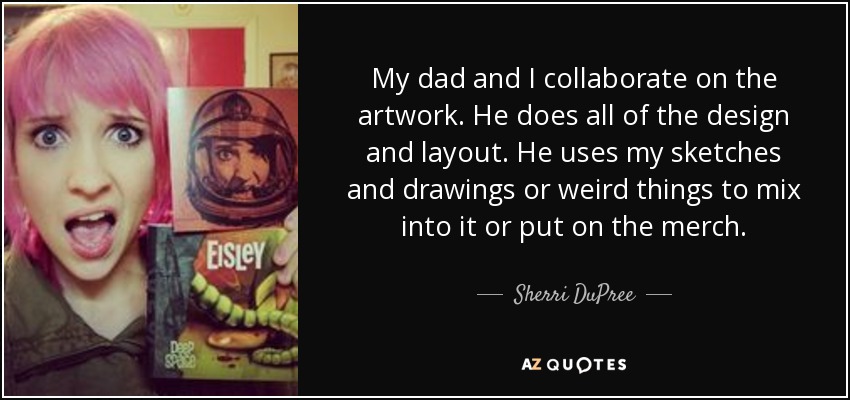
My dad and I collaborate on the artwork. He does all of the design and layout. He uses my sketches and drawings or weird things to mix into it or put on the merch.
Even when I was with Arista records, which was the freest part of my career, you still have to run a lot of stuff by committee whether it's a budget, or the album artwork, or how may songs you get to record. This was total freedom. We had nobody to answer to. We didn't have to get anything approved.
Pearl Jam bassist Jeff Ament and I get excited talking about making record artwork or working with T-shirt designs. The least exciting part for us is talking about the finances; it's like going to the dentist for us. But we at least try to do it in a creative way and put our stamp on it. I can only think that we create something that's worth the value of that dollar.
To all viewers but yourself, what matters is the product: the finished artwork. To you, and you alone, what matters is the process: the experiences of shaping that artwork. The viewers' concerns are not your concerns (although it'd dangerously easy to adopt their attitudes.) Their job is wahtever it is: to be moved by art, to be entertained by it, to make a killing off it, whatever. Your job is to learn to work on your work.
I wish my artwork could persuade millions of people to join a global conversation about sustainability.
It's really thrilling to work with an illustrator - your vision expands with the addition of someone else's artwork/artistic vision.
The collectability of music is something lost in the age of MP3s and album downloads. Holding an album in your hands and having the full-sized artwork reconnects the artist and the listener.
By the time I was in my early-twenties and was living there on the Lower East Side, I was so surrounded by tragedy that I think that inspired me to try to reflect it in the artwork.
There are some bands for whom that works very well and it's no disrespect to them because I'm sure there's something honest and natural about it, but for us I feel like it would be dishonest and kinda disrespectful to that artwork to do that. To be like: "Okay, we're going to go back and only play these songs, even though we have an hour to an hour and a half set and we gotta play more songs, but we'll skimp you on your extra half hour." That's just silly to me.
I was very conceptual about what I was doing; I had the first five albums planned out, and all the songs on every album, and the artwork. I always had these ambitious musical projects in mind.
I was on Instagram or something and I checked my tagged photos, and I realized that suddenly they were all LGBT artwork. I was like, "Oh, my god!" I had no idea. It was the first time I realized I was a figure for that community.
I haven't made art about Israel. There's a covert subtext of Jewish identity in my artwork.
I couldn't know about my culture, my history, without learning the language, so I started learning Arabic - reading, writing. I used to speak Arabic before that, but Tunisian Arabic dialect. Step by step, I discovered calligraphy. I painted before and I just brought the calligraphy into my artwork. That's how everything started. The funny thing is the fact that going back to my roots made me feel French.
I'm trying to create artwork that makes people, and myself, think about judgment as a reflex. This is something that must be changed.
I always hope that the artwork will complement and enrich a story.
CD's are amazing because you get the artwork, you get to look at the lyrics, you get to look at the behind-the-scenes photos or something.
Khairani Barokka is a writer, spoken-word poet, visual artist and performer whose work has a strong vein of activism, particularly around disability, but also how this intersects with, for example, issues of gender - she's campaigned for reproductive rights in her native Indonesian, and is currently studying for a PhD in disability and visual cultures at Goldsmiths. She's written a feminist, environmentalist, anti-colonialist narrative poem, with tactile artwork and a Braille translation. How could I not publish that?
You never really get to touch anything that you're doing unless you print it out. I don't really enjoy making artwork on a computer because it doesn't seem like I've done anything.
When I first heard bands like Tortoise, it seemed to come off the back of that world, like let's make a record with three vibraphones and release it on a seven-inch with black-and-white artwork.
I'm looking for anything interesting in the guitar playing, songwriting, artwork, and production. If you look at the stack of CDs on my desk and in my car, you'll find a very wide range of music under the umbrella of metal.
If I'm talking to a photographer, I'm talking to a stylist, I'm talking to a makeup artist, we're kind of creating and collaborating and making something that is artwork and is special and is different.
Sometimes an artist's vision may get blurred when subjected to a committee because an artwork is usually an expression of something unconscious that is better left in the realm of one person's unconscious if it is to speak to another person's unconscious.
I got a lion on my back because I'm a Leo, and I also just love lions. But I wish I'd researched the artwork a little more. My little sister saw it and said, "Why do you have the Lion King on your back?"
I told myself I'd do well by using the experience I gained during my seven years as Big Bang. In my mind, the executive producer is the person that is in charge of everything up to the point that the album comes out. So not just the music but also the music video, album artwork, photographs, and even the material the album itself would be made out of.
Any artwork is part of something larger, grander and, you know, the situation that it's in is very important.
Follow AzQuotes on Facebook, Twitter and Google+. Every day we present the best quotes! Improve yourself, find your inspiration, share with friends
or simply: