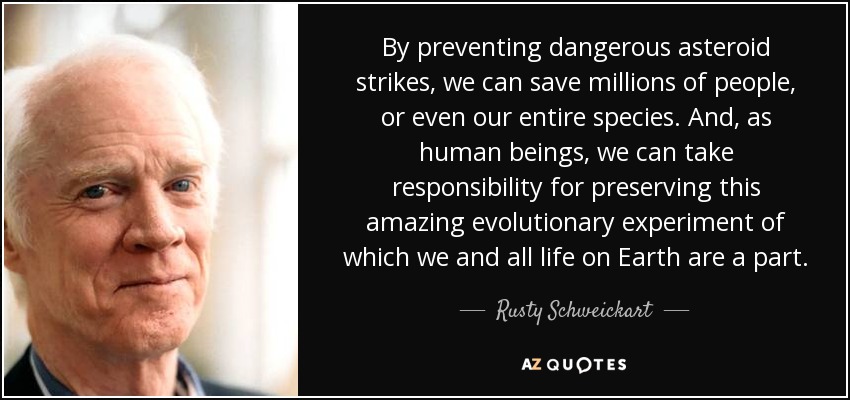
By preventing dangerous asteroid strikes, we can save millions of people, or even our entire species. And, as human beings, we can take responsibility for preserving this amazing evolutionary experiment of which we and all life on Earth are a part.
Now, once again, we find ourselves facing rising gas prices, and the question is: This time, are we going to learn from the past? Are we finally going to get serious about energy conservation? Of course not! We have the brains of mealworms! So we need to get more oil somehow. As far as I can figure, there's only one practical way to do this. That's right: We need to clone more dinosaurs. We have the technology, as was shown in two blockbuster scientific movies, Jurassic Park and Jurassic Park Returns with Exactly the Same Plot. Once we have the dinosaurs, all we need is an asteroid.
When you look at Earth from that one picture, the one from space, it's really a rather attractive thing. I have nothing against the planet per se. I root for the big comet or asteroid as a way of cleansing the planet. The comet or asteroid 65 million years ago is probably what gave us our opening to replace the reptiles. The greatest entertainment I have in my life is chronicling internally, not necessarily for the public, the slow dissolution of order.
I think I need to continue to think and plan and marry all of the different things that we could do that make transportation in space from the earth to the space station, from the earth to the moon to space stations around the moon to visiting an asteroid.
We can't say that when x happens we get a mass extinction. To the extent we understand mass extinction, one has been caused by glaciation event, one has been caused by a massive climate change, and one has been caused by an asteroid. These events turn out to have no precedent.
Newsreader: A huge asteroid could destroy Earth! And by coincidence, that's the subject of tonight's miniseries. Dogbert: In science, researchers proved that this simple device can keep idiots off your television screen. [TV remote control] Click.
People have to take seriously the threat coming from asteroids and what it represents. As Chelyabinsk reminded us, we have to take asteroids as a serious scientific concern, as well as a concern for protection of mankind and survival of the planet. This is not some kook policy. It's the protection of the interests of every single individual life on this planet.
Amorphous forms [of ice], for example, are found naturally on comets, on asteroids, and the crystalline forms are found on Earth or at least could be made on Earth with enough pressure. Nothing else does this.
Why are hemorrhoids called hemorrhoids and asteroids called asteroids? Wouldn't it make more sense if it was the other way around? But if that was true, then a proctologist would be an astronaut.
Certainly whatever climate change and global warming means, we've got a big issue here. Right now, this civilization or this period that we're in is probably going to need the resources off our planet, perhaps the resources from the asteroids, perhaps there will be some on the moon, perhaps some on Mars that we can utilize for our own uses here.
My record producer [David Kahne] said the major record labels these days are like dinosaurs sitting around discussing the asteroid. They know it's going to hit. They don't know when, they don't know where it's coming from. But it's sort of hit already. With iTunes, and all of that.
Like prospecting in the 19th century, reconnaissance of the asteroids would of necessity take place in an arena where trouble is likely and help is distant. Heroic stories of individual triumph and failure, set on landscapes never seen by humankind, are in the cards.
With enough money and international coordination, we can push incoming asteroids out of Earth's path. We might even be able to bring back extinct animals in the lab. The problem really isn't scientific - it's cultural. We aren't yet able to coordinate ourselves as a global civilization to do something simple like bring food to a famine-stricken region. We can actually use current satellite technologies to predict where famine will strike next, but we can't get food there - usually for political reasons.
If we do our homework right, never again should an asteroid that can do damage on the ground impact the Earth. We're living in a time-with our technology-we have the capability to eliminate that major shaper of evolution . . . the evolution of life on this planet.
Once you've got the makings of a star, gravity draws leftover gas and dust into a giant swirling disk. The dust continues to stick together, clumping into rocky asteroids, which eventually become orbiting rocky planets. And voila: a solar system!
There is good reason to believe that we have already entered the Sixth Extinction, a period of destruction of species on a massive scale, comparable to the Fifth Extinction 65 million years ago, when three-quarters of the species on earth were destroyed, apparently by a huge asteroid.
Africa's a wreck and it's not because it was hit by an asteroid. It's a wreck largely because it was hit by Europe.
We can both prevent asteroid impacts and address climate change. It's not either-or.
Asteroids have hit the Earth millions of times. We can see them as shooting stars every night. When they get bigger, things get complicated. It is only a matter of time until a big one hits us. And since we can do something about it, we should.
We could not wipe ourselves out with a nuclear war. I do not want so sound too positive. It would be a catastrophe, but it would not be a final one. We are not powerful enough for that. An asteroid could be that powerful. That is why we need to do our homework.
If you can make a good picture that actually has some substance, that's doubly good nowadays 'cause most everybody else is trying to address how many CGI plates we're gonna do, what little being is gonna come in from another asteroid.
We should go boldly where man has not gone before. Fly by the comets, visit asteroids, visit the moon of Mars. There's a monolith there. A very unusual structure on this potato shaped object that goes around Mars once in seven hours. When people find out about that they're going to say 'Who put that there? Who put that there?' The universe put it there. If you choose, God put it there.
In time, [a Martian] colony would grow to the point of being self- sustaining. When this stage was reached, humanity would have a precious insurance policy against catastrophe at home. During the next millennium there is a significant chance that civilization on Earth will be destroyed by an asteroid, a killer plague or a global war. A Martian colony could keep the flame of civilization and culture alive until Earth could be reverse-colonized from Mars.
Fire, ice, asteroids and pole shifts are bogeymen with which we distract ourselves from the real threat of our time. In an age when everyone invents his own truth, there is no community, only factions. Without community, there can be no consensus to resist the greedy, the envious, the power-mad narcissists who seize control and turn the institutions of civilization into a series of doom machines.
...they discovered only a small asteroid inhabited by a solitary old man who claimed repeatedly that nothing was true, though he was later discovered to be lying.
Follow AzQuotes on Facebook, Twitter and Google+. Every day we present the best quotes! Improve yourself, find your inspiration, share with friends
or simply: