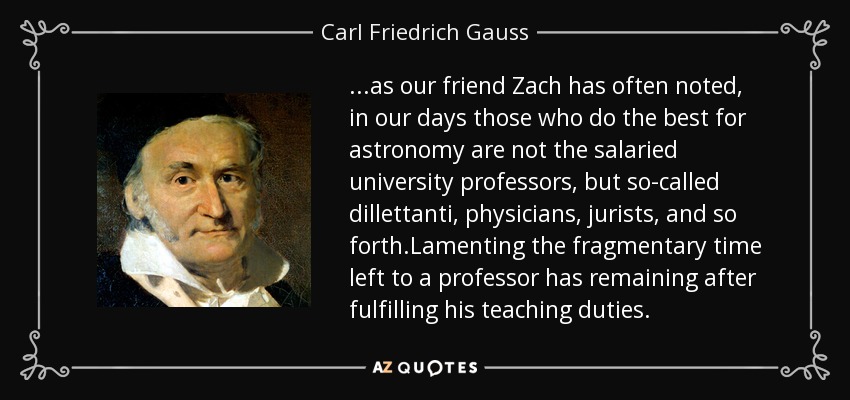
...as our friend Zach has often noted, in our days those who do the best for astronomy are not the salaried university professors, but so-called dillettanti, physicians, jurists, and so forth.Lamenting the fragmentary time left to a professor has remaining after fulfilling his teaching duties.
Combining in our survey then, the whole range of deposits from the most recent to the most ancient group, how striking a succession do they present:- so various yet so uniform-so vast yet so connected. In thus tracing back to the most remote periods in the physical history of our continents, one system of operations, as the means by which many complex formations have been successively produced, the mind becomes impressed with the singleness of nature's laws; and in this respect, at least, geology is hardly inferior in simplicity to astronomy.
An observer situated in a nebula and moving with the nebula will observe the same properties of the universe as any other similarly situated observer at any time.
Mathematics is the queen of sciences and number theory is the queen of mathematics. She often condescends to render service to astronomy and other natural sciences, but in all relations she is entitled to the first rank.
Khalif (Caliph) Al-Ma'mun's period of rule (813 - 833 C.E.) may be considered the 'golden age' of science and learning. He had always been devoted to books and to learned pursuits. His brilliant mind was interested in every form of intellectual activity. Not only poetry but also philosophy, theology, astronomy, medicine and law all occupied his time.
In the progressive growth of astronomy, physics or mechanical science was developed, and when this had been, to a certain degree, successfully cultivated, it gave birth to the science of chemistry.
At the age of three I began to look around my grandfather's library. My first knowledge of astronomy came from reading and looking at pictures at that time. By the time I was six I remember him buying books for me. ... I think I was eight, he bought me a three-inch telescope on a brass mounting. ... So, as far back as I can remember, I had an early interest in science in general, astronomy in particular.
Realizing how often ingenious speculation in the complex biological world has led nowhere and how often the real advances in biology as well as in chemistry, physics and astronomy have kept within the bounds of mechanistic interpretation, we geneticists should rejoice, even with our noses on the grindstone (which means both eyes on the objectives), that we have at command an additional means of testing whatever original ideas pop into our heads.
My interest in science was excited at age nine by an article on astronomy in National Geographic; the author was Donald Menzel of the Harvard Observatory. For the next few years, I regularly made star maps and snuck out at night to make observations from a locust tree in our back yard.
The phenomena of nature, especially those that fall under the inspection of the astronomer, are to be viewed, not only with the usual attention to facts as they occur, but with the eye of reason and experience.
Mr. Dalton's permanent reputation will rest upon his having discovered a simple principle, universally applicable to the facts of chemistry - in fixing the proportions in which bodies combine, and thus laying the foundation for future labors... his merits in this respect resemble those of Kepler in astronomy.
I may remind you that history is not a branch of literature. The facts of history, like the facts of geology or astronomy, can supply material for literary art; for manifest reasons they lend themselves to artistic representation far more readily than those of the natural sciences; but to clothe the story of human society in a literary dress is no more the part of a historian as a historian, than it is the part of an astronomer as an astronomer to present in an artistic shape the story of the stars.
Looking back, it didn't even occur to me that model was a job. I wanted to go into astronomy or to be a lawyer, which is really funny because I would absolutely not be a lawyer in any way now. But I still like astronomy.
The strongest affection and utmost zeal should, I think, promote the studies concerned with the most beautiful objects, most deserving to be known.
Laplace considers astronomy a science of observation, because we can only observe the movements of the planets; we cannot reach them, indeed, to alter their course and to experiment with them. "On earth," said Laplace, "we make phenomena vary by experiments; in the sky, we carefully define all the phenomena presented to us by celestial motion." Certain physicians call medicine a science of observations, because they wrongly think that experimentation is inapplicable to it.
If it's a new planet, sign me up. I'm tired of driving around the block, boldly going where hundreds have gone before in orbit around earth-give me a place to go and I'll go.
As soon as somebody demonstrates the art of flying, settlers from our species of man will not be lacking on the Moon and Jupiter. Who would have believed that a huge ocean could be crossed more peacefully and safely than the the narrow expanse of the Adriatic, the Baltic Sea or the English Channel? Given ships or sails adapted to the breezes of heaven, there will be those who will not shrink from even that vast expanse.
To set foot on the soil of the asteroids, to lift by hand a rock from the Moon, to observe Mars from a distance of several tens of kilometers, to land on its satellite or even on its surface, what can be more fantastic? From the moment of using rocket devices a new great era will begin in astronomy: the epoch of the more intensive study of the firmament.
Astronomy says: the sun will rise tomorrow, Zoology says: on rainbow-fish and lithe gazelle, Psychology says: but first it has to be night, so Biology says: the body-clocks are stopped all over town and History says: here are the blankets, layer on layer, down and down.
As we look out into the Universe and identify the many accidents of physics and astronomy that have worked together to our benefit, it almost seems as if the Universe must in some sense have known that we were coming.
A high-school girl, seated next to a famous astronomer at a dinner party, struck up a conversation with him by asking: "What do you do for a living?" "I study astronomy," he replied. "Really? said the teenager, wide-eyed. "I finished astronomy last year."
Other job markets may lay claim to the title, but astronomy is actually the world's oldest profession.
If astronomy teaches anything, it teaches that man is but a detail in the evolution of the universe, and the resemblant though diverse details are inevitably to be expected in the hosts of orbs around him. He learns that, though he will probably never find his double anywhere, he is destined to discover any number of cousins scattered through space.
After two years of undergraduate study, it was clear that I was bored by the regime of problem-solving required by the Cambridge mathematical tripos. A very sensitive mathematics don recommended that I talk to the historian of astronomy, Michael Hoskin, and the conversation led me to enroll in the History and Philosophy of Science for my final undergraduate year.
In my estimation it was obvious that Jansky had made a fundamental and very important discovery. Furthermore, he had exploited it to the limit of his equipment facilities. If greater progress were to be made it would be necessary to construct new and different equipment especially designed to measure the cosmic static.
Follow AzQuotes on Facebook, Twitter and Google+. Every day we present the best quotes! Improve yourself, find your inspiration, share with friends
or simply: