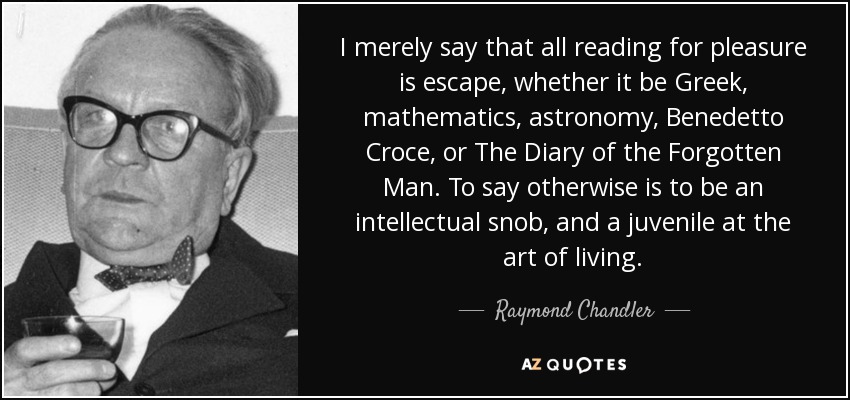
I merely say that all reading for pleasure is escape, whether it be Greek, mathematics, astronomy, Benedetto Croce, or The Diary of the Forgotten Man. To say otherwise is to be an intellectual snob, and a juvenile at the art of living.
For, to my mind, this is a certain principle, that nothing is here treated of but the visible form of the world. He who would learn astronomy, and other recondite arts, let him go elsewhere. (on commenting the text of Genesis 1:6)
My days I devote to reading and experiments in chemistry, and I spend many of the clear nights in the study of astronomy. There is, though I do not know how there is or why there is, a sense of infinite peace and protection in the glittering hosts of heaven. There it must be, I think, in the vast and eternal laws of matter, and not in the daily cares and sins and troubles of men, that whatever is more than animal within us must find its solace and its hope.
(...) The new nine muses, Commerce, Operatic Music, Amor, Publicity, Manufacture, Liberty of Specch, Plural Voting, Gastronomy, Private Hygiene, Seaside Concert Entertainments, Painless Obstetrics and Astronomy for the People.
...for a long time I wanted to become a theologian... now, however, behold how through my efforts God is being debated in astronomy.
By the way, were we to find life-forms on Venus, we would probably call them Venutians, just as people from Mars would be Martians. But according to rules of Latin genitives, to be “of Venus” ought to make you a Venereal. Unfortunately, medical doctors reached that word before astronomers did. Can’t blame them, I suppose. Venereal disease long predates astronomy, which itself stands as only the second oldest profession.
Any patch of sunlight in a wood will show you something about the sun which you could never get from reading books on astronomy. These pure and spontaneous pleasures are ‘patches of Godlight’ in the woods of our experience.
There are a multitude of allied branches of knowledge connected with mans condition; the relation of these to political economy is analogous to the connexion of mechanics, astronomy, optics, sound, heat, and every other branch more or less of physical science, with pure mathematics.
The fact that astronomies change while the stars abide is a true analogy of every realm of human life and thought, religion not least of all. No existent theology can be a final formulation of spiritual truth.
The poet alone knows astronomy, chemistry, vegetation, and animation, for he does not stop at these facts, but employs them as signs. He knows why the plain, or meadow of space, was strown with these flowers we call suns, and moons, and stars; why the deep is adorned with animals, with men, and gods; for, in every word he speaks he rides on them as the horses of thought.
The end of the eighteenth and the commencement of the nineteenth century are remarkable for the small amount of scientific movement going on in this country, especially in its more exact departments. Mathematics were at the last gasp, and astronomy nearly so; I mean in those members of its frame which depend upon precise measurement and systematic calculation. The chilling torpor of routine had begun to spread itself over all those branches of Science which wanted the excitement of experimental research.
The first steps in Agriculture, Astronomy, Zoology, (those first steps which the farmer, the hunter, and the sailor take,) teach that nature's dice are always loaded; that in her heaps and rubbish are concealed sure and useful results.
The sciences, even the best,-mathematics and astronomy,-are like sportsmen, who seize whatever prey offers, even without being able to make any use of it.
The study of geometry is a petty and idle exercise of the mind, if it is applied to no larger system than the starry one. Mathematics should be mixed not only with physics but with ethics; that is mixed mathematics.
To most people, I fancy, the stars are beautiful; but if you asked why, they would be at a loss to reply, until they remembered what they had heard about astronomy, and the great size and distance and possible habitation of those orbs. ... [We] persuade ourselves that the power of the starry heavens lies in the suggestion of astronomical facts.
The Gospel that represents Jesus Christ, not as a system of truth to be received into the mind like I should receive a system of philosophy, or astronomy, but it represents Him as a beal, living, mighty Saviour, able to save me now.
When authoritative reports of radical-design craft having spectacular performance are viewed in the light of a stream of astrobiological discoveries, the possibility that some UFOs are alien does not seem quite so farfetched. Serious-minded scientists in astronomy and other disciplines estimate there could be billions of planets in the universe, and millions that could harbor life. If even a few of those planets were occupied by technological civilizations, their ability (if not desire) to explore other worlds, such as ours, must be a possibility.
The natural pattern of current astronomy is provided by the cryptic unity of nature itself (belief in which is the chief act of faith of the scientist).
The calendar is intolerable to all wisdom, the horror of all astronomy, and a laughing stock from a mathematician's point of view.
The first question concerning the Celestial Bodies is whether there be a system, that is whether the world or universe compose together one globe, with a center, or whether the particular globes of earth and stars be scattered dispersedly, each on its own roots, without any system or common center.
A great man, who was convinced that the truths of political and moral science are capable of the same certainty as those that form the system of physical science, even in those branches like astronomy that seem to approximate mathematical certainty. He cherished this belief, for it led to the consoling hope that humanity would inevitably make progress toward a state of happiness and improved character even as it has already done in its knowledge of the truth.
A human life, I think, should be well rooted in some spot of a native land, where it may get the love of tender kinship for the face of earth, for the labors men go forth to, for the sounds and accents that haunt it, for whatever will give that early home a familiar, unmistakable difference amidst the future widening of knowledge.
Philosophy, astronomy, and politics were marked at zero, I remember. Botany variable, geology profound as regards the mud stains from any region within fifty miles of town, chemistry eccentric, anatomy unsystematic, sensational literature and crime records unique, violin player, boxer, swordsman, lawyer, and self-poisoner by cocaine and tobacco.
Astronomy was born of superstition; eloquence of ambition, hatred, falsehood, and flattery; geometry of avarice; physics of an idle curiosity; and even moral philosophy of human pride. Thus the arts and sciences owe their birth to our vices.
It calls Devotion! genuine growth of night! Devotion! Daughter of Astronomy! An undevout astronomer is mad!
Follow AzQuotes on Facebook, Twitter and Google+. Every day we present the best quotes! Improve yourself, find your inspiration, share with friends
or simply: