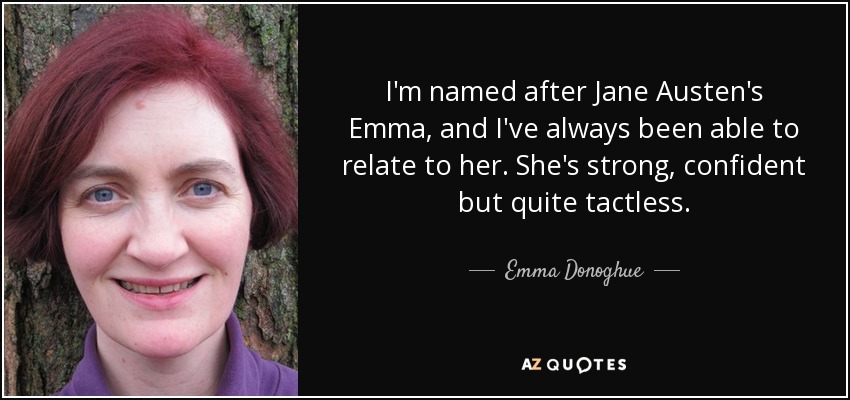
I'm named after Jane Austen's Emma, and I've always been able to relate to her. She's strong, confident but quite tactless.
I'm a Jane Austen/Jane Eyre kind of girl.
Pride and Prejudice' - perhaps more than any other Jane Austen book - is engrained in our literary consciousness.
I always say that the characters in Jane Austen's original books are rather like zombies because they live in this bubble of immense wealth and privilege and no matter what's going on around them they have a singular purpose to maintain their rank and to impress others.
I've always loved books by the Bronte sisters. I love Jane Austen, too. I'm more influenced by people like her than by pop culture.
I actually didn't like Jane Austen. I was more into the Brontes. They were so wild and passionate. I thought there was something a bit tame about Austen.
I'm kind of a mash-up of taste - Graham Greene and Jane Austen; W.G. Sebald and Alice Munro.
It has been suggested that Tiptree is female, a theory that I find absurd, for there is to me something ineluctably masculine about Tiptree’s writing. I don’t think the novels of Jane Austen could have been written by a man nor the stories of Ernest Hemingway by a woman, and in the same way I believe the author of the James Tiptree stories is male.
I love books; my suitcases are always full of them. Books and shoes. I read when I am sad, when I am happy, when I am nervous. My favourite British author is Jane Austen, and my favourite American one is John O'Hara.
I was in Los Angeles making 'Dead Again' and the producer, Lindsay Doran , asked me if I'd be interested in adapting this book, .. Austen is my favorite author and I thought, 'Well, of course, I'd be very interested, but I don't know how. I don't know where to start, A, writing a screenplay and B, sort of adapting it from a great novel.
Jane Austen writes about these humdrum lives with such empathy that they seem endlessly fascinating
The latest gorgeous entry in the Belknap Press' growing library of annotated Jane Austen novels arrives, this time the mighty Emma under the exactingly careful guidance of Bharat Tandon of the University of East Anglia. Belknap has once again done its end of the job superbly: the book is a physical treat-luxuriantly over-sized, heavy with quality paper and solid binding, decked out in a beautiful cover and dozens of well-chosen illustrations throughout. This is one of the prettiest Jane Austen volumes available in bookstoresthis season.
If there was a Jane Austen camp, I would go, no question.
All of women's stories in the 19th century had either one of two endings: you either had the good Jane Austen marriage at the end and you were happy; or you had the terrible Henry James savage downfall because of your own hubris as a woman, or you've made some great error leading you down a path to ruin. One is the story of love that's successful and the other is the story usually of reckless love that goes terribly wrong that destroys the woman.
It was strange to think that all the great women of fiction were, until Jane Austen's day, not only seen by the other sex, but seen only in relation to the other sex. And how small a part of woman's life is that.
I read "Pride and Prejudice" [by Jane Austen]. I was gobsmacked by it - it's so funny and so modern. Unbelievable. You don't expect funny to come through after 200 years - humor doesn't transcend decades, let alone centuries.
Jane Austen is the feminine Peter Pan of letters. She never grew up.
To Jane Austen, every fool is a treasure trove.
Every time I read a Jane Austen novel, I feel like a bartender at the gates of heaven.
There's a history of English literature where the best boils to the top, and Jane Austen stands right at the top of that.
Without those forerunners, Jane Austen and the Brontes and George Eliot could no more have written than Shakespeare could have written without Marlowe, or Marlowe without Chaucer, or Chaucer without those forgotten poets who paved the ways and tamed the natural savagery of the tongue. For masterpieces are not single and solitary births; they are the outcome of many years of thinking in common, of thinking by the body of the people, so that the experience of the mass is behind the single voice.
I do like the idea of the novel of repressed college students being a contemporary novel of courtship! I guess what I would say to that is, we tend to think of historical periods and historical mores as ending a lot more concretely than they do. Like, in an Austen novel, there are lots of reasons - cultural, moral, religious - why the characters don't have sex during courtship. Maybe, even though those reasons have kind of expired, historically, they're still around in some sense.
Follow AzQuotes on Facebook, Twitter and Google+. Every day we present the best quotes! Improve yourself, find your inspiration, share with friends
or simply: