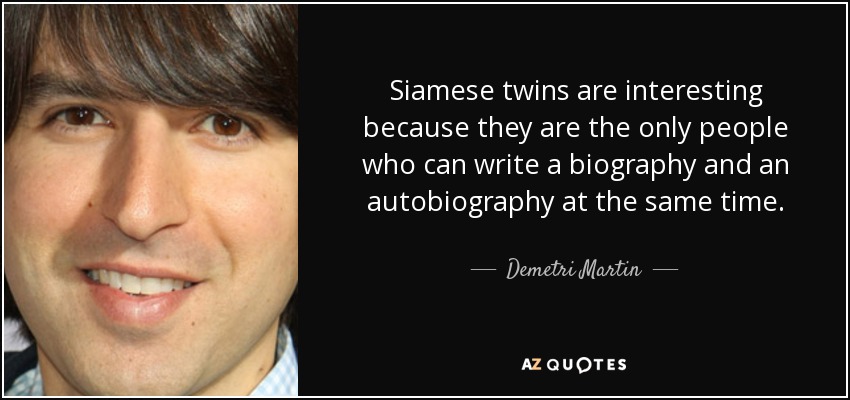
Siamese twins are interesting because they are the only people who can write a biography and an autobiography at the same time.
The second volume of Reiner Stach's epic biography of Franz Kafka . . . [is] a tangle of counter-grained and often under-sourced life stories, but reading Stach's magnificent narrative (wonderfully translated by Shelley Frisch) straight through brings death, not life, to the forefront. Stach is a compulsively readable writer. . . . [A]s in the previous volume, the prose in The Years of Insight is supple and very appealingly complex--all of which, once again, is perfectly rendered by Frisch.
How much he was shaped by being in the hospital so much as a kid. Because he was sick, he was a reader, and because he was a reader, Kennedy had heroes. Because he had heroes, he went into politics. [Kennedy liked Sir Walter Scott, King Arthur's knights, and biographies of political leaders.] If he hadn't been sick, he might have been like everybody else in the family, a jock.
I read every biography [of Jackie Kennedy] I could get my hands on.
I had to imagine myself into certain aspects of [Julian Assange] character for our version of events. That involved extrapolating based on clues in his biography, his public persona, photographs, and other accounts of him by people who encountered him during that extraordinary period from 2007 to 2010 that we charted in the film [The Fifth Estate]. So, it involved a lot of research but, sadly, no contact with the man himself.
We're artists. We cry out to be exploited on some level. Write a dissertation on my work. Write a biography about me.
I was giving a lecture and I said, that's enough about The Photographic Life, meaning my biography, now let's talk about the life of a photograph. And in that one instant I got the title for a potential next book.
I don't make films about celebrities, are not interested in celebrities. I don't make biographies at all.
I did a lot before [being cast] because I knew how important it would be for playing somebody real, or attempting to - to show the team [the role] was something I would be fascinated to do. I read a couple of biographies and I watched everything I could find [about princess Margaret].
Some of the biographies [of princess Margaret] were really sensationalist, News of the World sorts, but they were great because they also gave first and secondhand accounts of her at home. The butlers come forward and give little moments, some of which you discard and some which ring somehow true and you use.
I read Warren Zevon's bizarre biography, "I'll Sleep When I'm Dead." His wife, Crystal Zevon, posthumously published a journal he wrote and some interviews with ex-band members. Like [Keith] Richards's book "Life," it's brutally honest.
For a while I got into the South Pacific theater of World War II. I read "American Caesar" by William Manchester, the biography of General MacArthur. Because of that I ended up reading "Tales of the South Pacific" by James Michener and then because of that reading his "Hawaii." That is what happens.
I was kind of relieved with the way the book [The Proud Highway] came out. It's beyond an autobiography or a biography. I never knew what was going to come up next.
The reality is, if you go to the library and read biographies, thousands of people have changed, radically changed. St. Augustine was one of them. He lived a terrible a life for the first 33 years, and then he radically changed.
Unfortunately, I'm not a history buff. I don't read biographies, except of some of those writers whom I've collected over the years - particularly Samuel Beckett and Henry Miller, people like Charles Bukowski and John Fante and David Foster Wallace.
I think psychologically [Margaret Thatcher] is really worth studying. I am reading Charles Moore's biography of her, and he has gotten us right there with a woman who lived the unexamined life, and lived it deliberately, and who has contempt for history, even her own.
I am not a historian. I don't see what I do as being a rival to biography.
I will read biographies or autobiographies while I'm writing, but mostly I put books in a to-read queue, like Rachel Cusk's new novel, "Outline."
My biography of Jesus is probably the first popular biography that does not use the New Testament as its primary source material.
Becoming Richard Pryor is a compulsively readable book that sets a new gold standard for American biography. Scott Scaul's research is extraordinary; his writing is taut, elegant, and insightful; and he captures both the hilarity and pain that made Richard Pryor such a towering figure.
I began wondering, can one really write a biography of an illness? But I found myself thinking of cancer as this character that has lived for 4,000 years, and I wanted to know what was its birth, what is its mind, its personality, its psyche?
Just as there is nothing between the admirable omelet and the intolerable, so with autobiography.
No sooner does a great man depart, and leave his character as public property, than a crowd of little men rushes towards it. There they are gathered together, blinking up to it with such vision as they have, scanning it from afar, hovering round it this way and that, each cunningly endeavoring, by all arts, to catch some reflex of it in the little mirror of himself.
To write the lives of the great in separating them from their works necessarily ends by above all stressing their pettiness, because it is in their work that they have put the best of themselves.
When I read biographies, I'm only interested in the first few chapters. I'm not interested in when people become successful. I'm interested in what made them successful.
Follow AzQuotes on Facebook, Twitter and Google+. Every day we present the best quotes! Improve yourself, find your inspiration, share with friends
or simply: