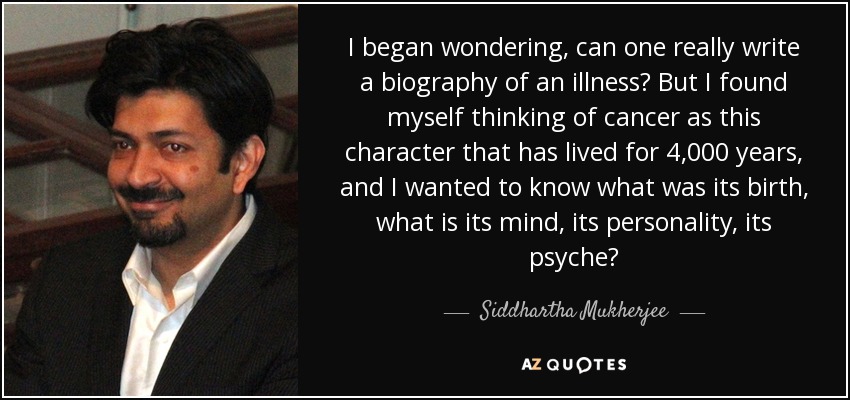
I began wondering, can one really write a biography of an illness? But I found myself thinking of cancer as this character that has lived for 4,000 years, and I wanted to know what was its birth, what is its mind, its personality, its psyche?
Just as there is nothing between the admirable omelet and the intolerable, so with autobiography.
No sooner does a great man depart, and leave his character as public property, than a crowd of little men rushes towards it. There they are gathered together, blinking up to it with such vision as they have, scanning it from afar, hovering round it this way and that, each cunningly endeavoring, by all arts, to catch some reflex of it in the little mirror of himself.
To write the lives of the great in separating them from their works necessarily ends by above all stressing their pettiness, because it is in their work that they have put the best of themselves.
When I read biographies, I'm only interested in the first few chapters. I'm not interested in when people become successful. I'm interested in what made them successful.
All fiction is lies – if it weren’t, it would be biography, history, or reportage.
Two Drink Mike enjoys dancing and knows a magic trick. Whereas, No Drink Mike enjoys biographies, and has serious opinions on wildlife. And Five Drink Mike... dances with wildlife.
A form of art that I like is portraiture. I've been thinking about portraiture, and its relationship to writing and literature, biography and autobiography, and so that will be my next thing.
I hope any poem I've ever written could stand on its own and not need to be a part of biography, critical theory or cultural studies. I don't want to give a poetry reading and have to provide the story behind the poem in order for it to make sense to an audience. I certainly don't want the poem to require a critical intermediary - a "spokescritic." I want my poems to be independently meaningful moments of power for a good reader. And that's the expectation I initially bring to other poets' writing.
I'd prefer people read about Churchill and how he wasn't overwhelmed by Nazi Germany. Amazing; that the morale of a country rested on one person's shoulders. Extraordinary people carried that country through its darkest hours; truly inspirational. I suppose that's my theme. Whether it's a biography or a movie; whether it's fictional or true, I'm inspired by people doing great things.
I am perhaps more proud of having helped to redeem the character of the cave-man than of any other single achievement of mine in the field of anthropology.
As strange as this may sound, I very seldom read fiction. Because my novels require so much research, almost everything I read is non - fiction - histories, biographies, translations of ancient texts.
An autobiography is only 'a sort of life' - it may contain less errors of fact than a biography, but it is of necessity even more selective: it begins later and it ends prematurely.
I read a lot. I especially read memoirs and biographies. It's very helpful when you're thinking about what's possible and what exists in human behavior; if it exists out there then it can exist on the stage. I really try to go to a lot of concerts. A lot of live events. I just try to keep my ears really, really open.
You have to get inside the people you are writing about. You have to go below the surface. And that's to a very large degree what all writers are doing - they're trying to get below the surface. Whether it's in fiction or poetry or writing history and biography. Some people make that possible because they write wonderful letters and diaries. And you have to sort of go where the material is.
Read. Read. Read. Read. Read great books. Read poetry, history, biography. Read the novels that have stood the test of time. And read closely.
Some writers just write about their own lives. Well, I don't want to do that. I want to have a really boring life. A quiet, boring life so no one wants to write a biography. I'm the only writer in history only to have one wife, for instance.
I usually have Kafka biography in my bathroom. It's a book I can open at random and feel interested in immediately. It's really funny. With this book, since I'm opening it at random and immediately interested, I don't feel the need to read more than I want to read, in that there's not, like, a plot that leads me along. So I can stop whenever.
[Photography] allows me to accede to an infra-knowledge; it supplies me with a collection of partial objects and can flatter a certain fetishism of mine: for this 'me' which like knowledge, which nourishes a kind of amorous preference for it. In the same way, I like certain biographical features which, in a writer's life, delight me as much as certain photographs; I have called these features 'biographemes'; Photography has the same relation to History that the biographeme has to biography.
The reason I moved to Nashville was because I was reading biographies of a lot of my country music heroes, and I thought it would be better to actually go where the history was, as opposed to just reading about it.
The biographies of the great men see their excesses as signs of their greatness. But Jean Rhys, in her biography, is read as borderline; Anaïs Nin is borderline; Djuna is borderline; etc. etc. Borderline personality disorder being an overwhelmingly gendered diagnosis. I write in Heroines: “The charges of borderline personality disorder are the same charges against girls writing literature, I realize - too emotional, too impulsive, no boundaries."
in the newspapers I read a biography about an American. He left his whole huge fortune to factories and for the positive sciences, his skeleton to the students at the academy there, and his skin to make a drum so as to have the American national anthem drummed on it day and night.
Your biography becomes your biology. This biography includes the totality of your choices, the things you feed your body - you thoughts, your actions, your food - the thing you feed your life.
Biography is the mesh through which real life escapes.
A biography should be a dissection and demonstration of how a particular human being was made and worked.
Follow AzQuotes on Facebook, Twitter and Google+. Every day we present the best quotes! Improve yourself, find your inspiration, share with friends
or simply: