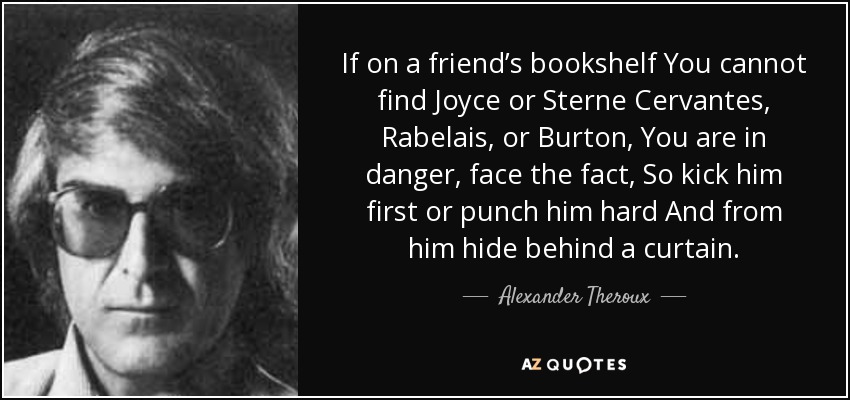
If on a friend’s bookshelf You cannot find Joyce or Sterne Cervantes, Rabelais, or Burton, You are in danger, face the fact, So kick him first or punch him hard And from him hide behind a curtain.
Thousands of volumes have been written about aviation, but we do not automatically have thousands of true and special friends in their authors. That rare writer who comes alive on a page does it by giving of himself, by writing of meanings, and not just of fact or of things that have happened to him. The writers of flight who have done this are usually found together in a special section on private bookshelves.
If the Bible is what it claims to be, how can we allow it to remain on a bookshelf?
The Dick, Jane, and Spot primers have gone to that bookshelf in the sky. I have, in some ways, a tender feeling toward them, so I think it's for the best.
The first book by an African American I read was Carl T. Rowan's memoir, Go South to Sorrow. I found it on the bookshelf at the back of my fifth-grade classroom, an adult book. I can remember the quality of the morning on which I read. It was a sunlit morning in January, a Saturday morning, cold, high, empty. I sat in a rectangle of sunlight, near the grate of the floor heater in the yellow bedroom. And as I read, I became aware of warmth and comfort and optimism. I was made aware of my comfort by the knowledge that others were not, are not, comforted. Carl Rowan at my age was not comforted.
I love gay and lesbian parents. But I think we need a law that says lesbians and gay men have to raise their children together. This way, the kids would not only know how to build bookshelves, but they'd also instinctively know how to decorate them.
People have libraries at home, they have bookshelves, they have CDs. And they sort of try, people try to bring great artists into their lives, into their physical houses and sort of live with portions of them. But they're not really deeply engaging with them.
Our cities need to change, fast. Tactical Urbanism is a guided tour of solutions created when local people decide they can't wait for politics to catch up before they improve their neighborhoods. This weathervane book deserves a place on any urbanist's bookshelf.
Sometimes I long for a convent cell, with the sublime wisdom of centuries set out on bookshelves all along the wall and a view across the cornfields--there must be cornfields and they must wave in the breeze--and there I would immerse myself in the wisdom of the ages and in myself. Then I might perhaps find peace and clarity. But that would be no great feat. It is right here, in this very place, in the here and the now, that I must find them.
I'm a gastronome first and foremost. I have several bookshelves in my home full of cookbooks, foodie magazines and food writer books and I am always on the hunt for a great recipe or local foodie haunt to try.
The crazy thing is that when we go to somebody's house, what's better than looking at their bookshelves? Nobody's ever going to say, "Can I see the index to your Kindle?" It's so depressing and so unsexy. Sure, it's there, but nobody is going to get excited by that.
Literary texts do not exist on bookshelves: they are processes of signification materialized only in the practice of reading. For literature to happen, the reader is quite as vital as the author.
Genre categorization is a capitalist (rather than artistic) thing, a symptom of marketing and major-chain bookshelf placement.
A little more than a hundred years ago, "Tel Aviv" was not a city. It was a title of a novel written by an author. The "Return to Zion" was a name of another novel. There was a bookshelf. There was no country. There was no state. There was no nation. There was no physical Jewish reality in this country.
For proponents of ecosystem-based management,the good news is that another new book, Ecosystem-based Management for the Oceans, conveys the topic at its state-of-the-art level of development...both Marine Ecosystems and Global Change and Ecosystem-based Management for the Oceans are valuable troves that could profitably be mined, and any academic bookshelf would wear them well.
More people should visit Antarctica, metaphorically speaking, on their own. That is one of the conclusions I have reached, one of my recommendations: explore something, even if it's just a bookshelf. Make a stab in the dark. Read off the beaten path. Your attention is precious. Be careful of other people trying to direct how you dispense it. Confront your own values. Decide what it is you are looking for an then look for it. Perform connoisseurship. We all need to create our own vocabulary of appreciation, or we are trapped by the vocabulary of others.
I've always loved books. I'm passionate about them. I think books are sexy. They are smooth and solid and contain delightful surprises. They smell good. They fit into a handbag and can be carried around and opened at will. They don't change. They are what they are and nothing else. One day I want to own a lot of books and have them nbear to me in my house, so that I can stroll to my bookshelves and choose what I fancy. I want a harem. I shall keep my favourites by my bed.
Adrienne Mayor's inquiry into the myth--and surprising reality--of Amazon women begins with the fierce Greek huntress Atalanta, but takes us deep into the past and as far afield as the Great Wall of China. With the restless curiosity and meticulous scholarship that have become her hallmark, the author once again has found a gap in my bookshelf and filled it, admirably.
I hope for so much from every book I read. And time and again, I find myself disappointed. I look across my bookshelves and see hundreds of titles which in my memory seem merely mediocre or second-rate. Only occasionally does a novel appear for which I feel a lasting passion, a book that I think could in time become a classic.
My own feminist revolution evolved slowly, and traveled the world with me. To this day I have no idea what dissident professor or librarian placed feminist tests on the bookshelves at the university library in Jeddah, but I found them there. They filled me with terror. I understood they were pulling at a thread that would unravel everything. Now that I am older, I can see that feeling terrified is how you recognize what you need. Terror encourages you to jump, even when you don't know if you will ever land.
At a tender age, I commandeered half a quire of foolscap from my father's desk and sat down to write a book. ...I had observed onprinted fly leaves the words "By the author of, etc." ...So under the title of my prospective work I wrote: By the author of "Les Miserables," "The Woman in White," "Dombey and Son," "Tom Brown's Schooldays" and "Our Life in the Highlands," the last-named being an opus of good Queen Victoria. I had not read all these works but they existed on our bookshelves, and I hoped to produce something worthy of comparison.
The row of dolls watched her impassively from the bookshelf, their tea party propriety almost certainly offended.
I have Margaery Tyrell's - I didn't take it, I was given it - but yes, David [Benioff] and Dan [Weiss] gave me Margaery Tyrell's wedding crown. So that is sitting on my bookshelf.
I have a nice bookshelf in my office, but not my house. I'm crass, but not that crass.
We have a generation of kids who may never see a bookshelf or never see books in houses. What are they going to think about books? How will books become meaningful in their lives except as yet another form of digitalized content? A book is not just digitalized content.
Follow AzQuotes on Facebook, Twitter and Google+. Every day we present the best quotes! Improve yourself, find your inspiration, share with friends
or simply: