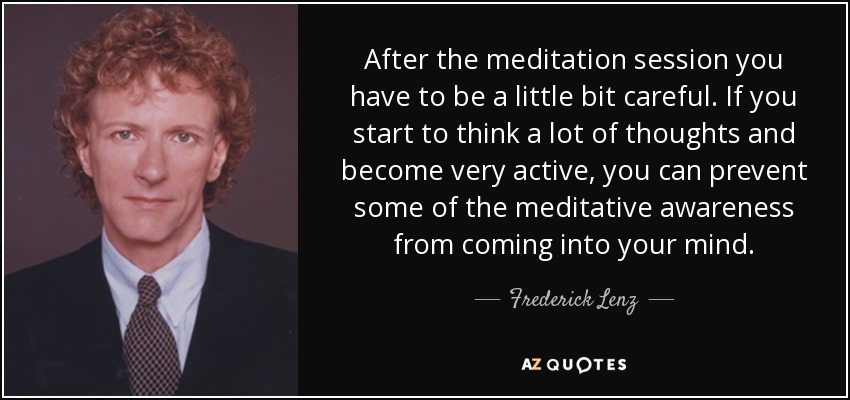
After the meditation session you have to be a little bit careful. If you start to think a lot of thoughts and become very active, you can prevent some of the meditative awareness from coming into your mind.
Learn not to judge your meditation. Just meditate, do your best, set a minimum period of time and meditate.
Don't judge your meditations. Don't rate them. The physical mind cannot tell how well you did. As long as you are sitting there trying, something will happen.
The force that drives the green fuse, as Dylan Thomas said, cannot be understood. So self-discovery is to accept your daily meditation, to observe yourself meditating and not be concerned with the results.
The only bad meditation is when you don't meditate.
To meditate with full effort, produces infinity, freedom.
Meditation is the pathway to enlightenment. Move the ego aside and be still, open, clear, bright and fully conscious.
You should always feel, no matter how many times you've meditated before, that this is your first meditation. You have no idea what will happen or what won't happen.
There are many ways to meditate. When you meditate, you are learning how to feel again.
To meditate, you need to feel, and feeling is a lost art. You need to feel the stillness of existence and also the sound of existence. You need to feel that which lies beyond your awareness field, and that which is within it.
If you can bring earnestness to your meditation, you will find that happiness is something that will run through your life constantly.
There's no risk in doing a lousy meditation or not meditating at all. There's no risk in being convenient and comfortable. There's a lot of risk in the world of enlightenment.
Try to read books about meditation, but not so many different viewpoints that they get confusing. There is no best way. It's just what works for you at the time.
Sometimes you won't feel pleasant during a meditation session; it seems like an uphill run. But when you get to the top, the view is rather breathtaking.
When you meditate, you focus to clear the mind and to bring the willpower together. But then, toward the end of the session let go, just become eternity.
Real winning and losing all takes place at the meditation table. This is where the battles are. Winning is stopping thought. Losing is sitting there and being subjected to all kinds of ridiculous thoughts
In meditation what you are trying to do is simply get rid of your own junk. You are trying to move all the confusion out of your mind, all the heaviness, all the emotional upsets, all the impressions that you have picked up since your last meditation.
The trick to keeping your meditation practice alive, not simply consistent but wonderful, is you need to bring a certain will or force into every meditation.
Buddhism itself is all about empowering yourself, not about getting what you want.
The Dalai Lama once said that 'If science proves some belief of Buddhism wrong, then Buddhism will have to change!' This is a great thought! And great thoughts belong to great men only!
The Buddhist, who thanks no man, who says "Do not flatter your benefactors," but who, in his conviction that every good deed can by no possibility escape its reward, will not deceive the benefactor by pretending that he has done more than he should, is a Transcendentalist.
Americans are interested because they are open-minded. They have an education system that teaches them to find out for themselves why things are the way they are. Open-minded people tend to be interested in Buddhism because Buddha urged people to investigate things - he didn't just command them to believe.
Some people get the impression that Buddhism talks too much about suffering. In order to become prosperous, a person must initially work very hard, so he or she has to sacrifice a lot of leisure time. Similarly, the Buddhist is willing to sacrifice immediate comfort so that he or she can achieve lasting happiness.
There are techniques of Buddhism, such as meditation, that anyone can adopt. And, of course, there are Christian monks and nuns who already use Buddhist methods in order to develop their devotion, compassion, and ability to forgive.
Naturally, the Zen Master Rama philosophy is to have a high state of awareness and material success.
Follow AzQuotes on Facebook, Twitter and Google+. Every day we present the best quotes! Improve yourself, find your inspiration, share with friends
or simply: