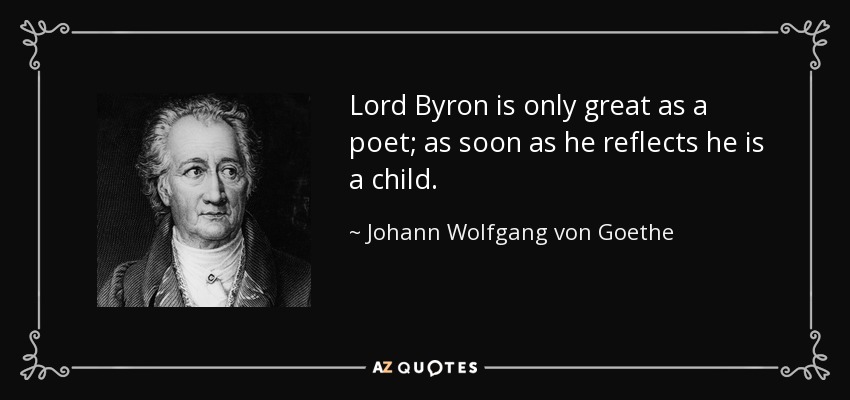
Lord Byron is only great as a poet; as soon as he reflects he is a child.
All human history attests That happiness for man, - the hungry sinner! - Since Eve ate apples, much depends on dinner. ~Lord Byron, Don Juan, Canto XIII, stanza 99
From the poetry of Lord Byron they drew a system of ethics compounded of misanthropy and voluptuousness,-a system in which the two great commandments were to hate your neighbour and to love your neighbour's wife.
Truthfully, in this age those with intellect have no courage and those with some modicum of physical courage have no intellect. If things are to alter during the next fifty years then we must re-embrace Byron’s ideal: the cultured thug.
What a man sees in the human race is merely himself in the deep and honest privacy of his own heart. Byron despised the race because he despised himself. I feel as Byron did, and for the same reason.
Mothers remember a child's first words, and quote them in tones usually reserved for Byron.
Most poetry is the utterance of a man in some state of passion, love, joy, grief, rage, etc., and no doubt this is as it should be. But no man is perpetually in a passion and those states in which he is amused and amusing, detached and irreverent, if less important, are no less amusing. If there were no poets who, like Byron, express these states, Poetry would lack something.
I have to say that it was a very strange experience when, later in life, I represented Byron Scott and was negotiating with West - whose picture I used to have over my bed! That took some getting used to.
forgive me also that I didn't fight like Lord Byron for the happiness of captive peoples that I watched only risings of the moon and museums
Yet Byron never made tea as you do, who fill the pot so that when you put the lid on the tea spills over. There is a brown pool on the table--it is running among your books and papers. Now you mop it up, clumsily, with your pocket-hankerchief. You then stuff your hankerchief back into your pocket--that is not Byron; that is so essentially you that if I think of you in twenty years' time, when we are both famous, gouty and intolerable, it will be by that scene: and if you are dead, I shall weep.
You speak of Lord Byron and me; there is this great difference between us. He describes what he sees I describe what I imagine. Mine is the hardest task.
All that is good in our history is gathered in libraries. At this moment, Plato is down there at the library waiting for us. So is Aristotle. Spinoza is there and so is Kats. Shelly and Byron adn Sam Johnson are there waiting to tell us their magnificent stories. All you have to do is walk in the library door and the great company open their arms to you. They are so happy to see you that they come out with you into the street and to your home. And they do what hardly any friend will-- they are silent when you wish to think.
Bardot, Byron, Hitler, Hemingway, Monroe, Sade: we do not require our heroes to be subtle, just to be big. Then we can depend on someone to make them subtle.
Though [Abraham Lincoln] never would travel to Europe, he went with Shakespeare's kings to Merry England; he went with Lord Byron poetry to Spain and Portugal. Literature allowed him to transcend his surroundings.
In the future, a new generation of artists will be writing genomes as fluently as Blake and Byron wrote verses.
Byron is one tough guy and he can play through just about anything. I know he will be ready to go on Sunday.
I was Byron and Shakespeare formerly.
To make positive change requires lasting commitment, lasting commitment requires measurable targets, measurable targets requires detailed action plans, detailed action plans requires a goal you desire, desire requires a positive attitude to change your life, and the option to change your life requires WORK. Byron Pulsifer, from Nothing Ventured, Nothing Gained If you deny yourself commitment, what can you do with your life?
Golf took young kids like Byron Nelson, Ben Hogan and myself out of the caddie ranks and gave us money and a little bit of fame and let us live in the tall cotton.
Much of the fire with him [Ben Hogan] was lit by Byron Nelson, who came from the same town - the same caddie yard - and achieved fame and fortune several years ahead of Ben and who, as a kid, had always been popular and better liked than Ben. No puzzle at all.
I always considered myself a loner. I mean, not like a poor-me, Byron-esque, I-should-have-brought-a-swimming-buddy loner. I mean the sort of person who doesn’t feel too upset about the prospect of a weekend spent seeing no one, and reading good books on the couch. It wasn’t like I was a people hater or anything. I enjoyed activities and the company of friends. But they were a side dish. I always thought I would be happy without them.
...then he looked at my T-shirt and saw Byron's picture on it and he quoted "She Walks in Beauty," which is like my favorite poem next to the one by Baudelaire about his girlfriend being nothing but worm food, except that Lily called that one first because Baudelaire is her fave poet and so she got the shirt with him on it, even though Byron is way more scrumptious and I would do him on sharp gravel if I had the chance. --from The Chronicles of Abby Normal
Byron says he won't go there. He give Kenny and Joey a story about "Wool Pooh," the supposed evil twin of Winnie-the-Pooh. They believe him, but Kenny still wants to go.
I learned that you should feel when writing, not like Lord Byron on a mountain top, but like child stringing beads in kindergarten, - happy, absorbed and quietly putting one bead on after another.
I hate the whole race. There is no believing a word they say, your professional poets, I mean there never existed a more worthless set than Byron and his friends for example.
Follow AzQuotes on Facebook, Twitter and Google+. Every day we present the best quotes! Improve yourself, find your inspiration, share with friends
or simply: