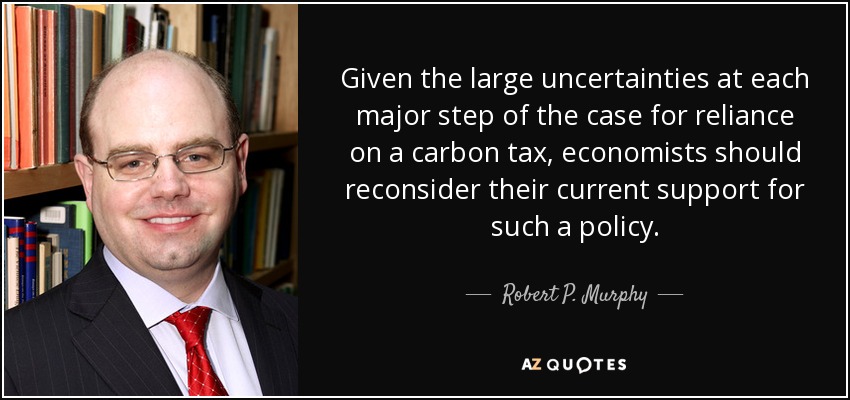
Given the large uncertainties at each major step of the case for reliance on a carbon tax, economists should reconsider their current support for such a policy.
In the head-spinning cosmos of climate change, everyday hundreds of people claim there are 'thousands of papers' in support of a theory, yet no one can actually name one single paper with empirical evidence that shows carbon dioxide emissions are the main cause of global warming.
Plastic metaphors and carbon copy similes that aren't going to do anything for anybody and it doesn't showcase creativity; it showcases the fact that the soul of the music has been compromised to control the industry.
NASA's Aqua satellite is showing that water vapor, the dominant greenhouse gas, works to offset the effect of carbon dioxide - CO2. This information, contrary to the assumption used in all the warming models, is ignored by global warming alarmists.
All this argument is the temperature going up or not, it's absurd. Of course it's going up. It has gone up since the early 1800s, before the Industrial Revolution, because we're coming out of the Little Ice Age, not because we're putting more carbon dioxide into the air.
We have known since the 1800s that carbon dioxide traps heat in the atmosphere. The right amount keeps the climate conducive to human life.
I don't believe in a price on carbon, because the government is going to control it and they're going to fail.
I can't believe that Hillary Clinton wants the world to think that whenever she gets into political trouble, she's going to have her husband come roaring about, breaking furniture, sucking up oxygen, spewing carbon dioxide. My impression is that she's strong enough to defend herself - she certainly showed that in the recent Democratic debate. But apparently she's not strong enough to control Mr. Bill. And if that's the case, any sane voter would have to think twice before enabling this sort of circus act in the White House.
Build high-speed, electrified trains over the most-traveled corridors. It'sreally hard to power carbon-free airplanes, but electrified trains are much easier. We'll be a half century behind the Japanese, but better late than never.
We need a firm cap on carbon emissions from fossil fuels. No coal, oil, or gas could enter the economy until the buyer had a permit. All permits would be auctioned by the federal government, and the number of permits auctioned would be decreased by three percent per year. Permits could be traded, but they could not be created out of whole cloth by companies that plant forests or dump iron filings at sea.
I'm passionate about restoring the efficacy of American democracy, making capitalism sustainable, prioritizing advances in technology, and seizing the opportunities to use that kind of innovation to help usher in a new economy that doesn't rely on carbon-spewing fossil fuels.
Our carbon emissions have to eventually go to zero. We have to. Otherwise we're never going to have a stable climate and that's what our goal is for human civilization to thrive, a stable climate. We don't want one that's hotter, we don't want one that's colder, we want one that's stable.
There's no question that natural gas is a lot better than coal or oil, in the sense that natural gas produces less carbon per unit of energy produced.
Natural gas is a very flexible source of energy that can help us bridge the gap between our current high-carbon economy and our zero-carbon future.
We're not paying a real price for carbon. If we were, we wouldn't be using as much. We need to have the right perspective. It's not just about next quarter's financial return. It's about where we want to be in ten years.
The first thing we can do as individuals and as communities, like a school or a university or a church, is cut our energy use. Do an energy audit or measure our carbon footprint using online carbon calculators that are free, easy, and cheap. Get a list of the ways that we can stop wasting so much energy and save money.
Some time ago we discovered the carbon cycle - a long-term set of chemical reactions that govern climates based on how much carbon is free in the atmosphere. At that point, it became clear that humans were affecting our environments far more profoundly than we realized. By releasing so much carbon and greenhouse gas into the environment, we're making long-term changes to every aspect of the natural world.
It's only been in the past two generations that we truly understood the impact our civilization has had on the natural world. To our credit as a species, we have turned this obscure scientific fact about carbon cycles into one of the most important political issues of the 21st century.
The fact that we have been able to perturb the carbon cycle with our industrial revolution is evidence of how vulnerable we are - because when we destroy our environments, we destroy our food and energy supplies. In short, we destroy ourselves.
Part of what I wanted to do in my book was point out that we have almost reached the point where we can prevent a mass extinction with the science and technology we have today. We can build carbon neutral cities.
My first goal would be to reduce the perturbation in the carbon cycle. That would mean using carbon neutral sources of energy, and changing our agricultural practices to be less disruptive and polluting. I'm not talking about a policy here so much as changing the way our infrastructure works. That's why I'm so fascinated with changing the way we build cities, because they are the most developed forms of physical infrastructure for human habitation.
I just can't fathom tweeting, and I'd rather spend my time writing a book than a blog, but I rather grudgingly agreed to a Facebook page. I had a brief, intense romance with Facebook. It's weirdly addictive, but anything that time-sucking is a danger for a writer who writes as slowly as I do. Now I post only occasionally and nothing very confessional. I think I'm carbon dating myself as I speak.
I'm working with wind, solar, and biofuels companies as well as with organizations like ACORE [American Council On Renewable Energy], Growth Energy, and AREDAY to raise public awareness and seek practical technological solutions to reduce our reliance on fossilized carbon. My book Don't Wait for the Next War will be out in October, where I will offer my prescription for America's growth, responsible development, and security.
If we don't cut carbon's money pipeline, we will pay for their gasoline with floods, droughts, fires, super storms, drowned cities, mass extinctions, wars, and collapsing civilizations.
I don't think any Australian will ever forget, there will never be a Carbon Tax under a government I lead.
Follow AzQuotes on Facebook, Twitter and Google+. Every day we present the best quotes! Improve yourself, find your inspiration, share with friends
or simply: